|
|
|
|
|
Diabetes research in the Weiss laboratory has two parts: structure-function relationships in insulin
and mechanisms of gene regulation of beta-cell transcription factors. Studies of insulin seek to define
the hormone's mechanism of folding and binding to the insulin receptor. Particular emphasis is placed on
the role of protein dynamics: what conformational changes are required for biological activity and what
constraints does induced fit place on the evolution of insulin sequences? We are using D-amino-acid
substitutions to constrain or swivel the folding of the main chain. Structural and dynamic consequences
are being characterized by X-ray crystallography and 2D-NMR spectroscopy. Functional consequences are
being assessed by measurement of receptor affinities and by photo-cross-linking of analogs to the
insulin receptor. Synthetic studies are collaborative with Prof. P. G. Katsoyannis (Mt. Sinai School
of Medicine, NY, NY).
Because insulin is also an amyloid protein and prone to misfolding, we are also exploring the misfolded
structure of insulin in a fibril. The misfolding transition involves conversion of helix to beta sheet.
Such studies, employing laser Raman spectroscopy (in collaboration with Prof. Paul Carey in this department)
and solid-state NMR (in collaboration with Dr. Robert Tycko, NIDDK, National Institutes of Health) seek
to ask whether sites of conformational change required for receptor binding are related to sites of
conformational change involved in misfolding. Studies of insulin fibrils provide a model whose
characterization likely to yield broad insight into protein fibrils in other contexts, such as Alzheimer's
disease.
Investigations of beta-cell transcription factors were stimulated by the discovery by G. I. Bell and colleagues
that mutations in such factors can cause a form of diabetes mellitus (Type II diabetes mellitus of the young;
MODY). Pathophysiologic studies of K. Polonsky and colleagues have demonstrated a selective deficit in
glucose-stimulated insulin secretion.
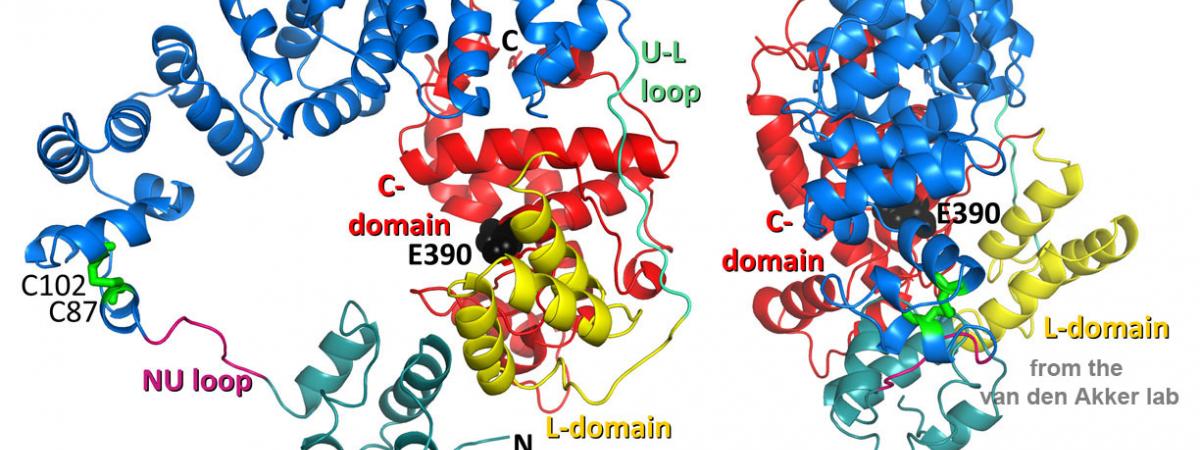
Initial structural studies have focused on the dimerization domain of HNF-1-alpha, a homeodomain-containing
factor and weak activator of insulin gene expression. The dimerization domain contains a novel four-helix
bundle and is a site of MODY mutation. We have proposed that an anti-parallel "mini-zipper" on one face of
the bundle recognizes the top surface of the saddle-shaped transcriptional coactivator DCoH (dimerization
cofactor of homeodomains). An NMR model of the HNF-1 dimerization domain documents this mini-zipper; an
high-resolution crystal structure is in progress. Analysis of mutant domains suggest that the structure
and stability of the domain are regulated by the phi dihedral angle of its central beta-turn. A clinical
mutation in the turn has been isolated causing diabetes mellitus.
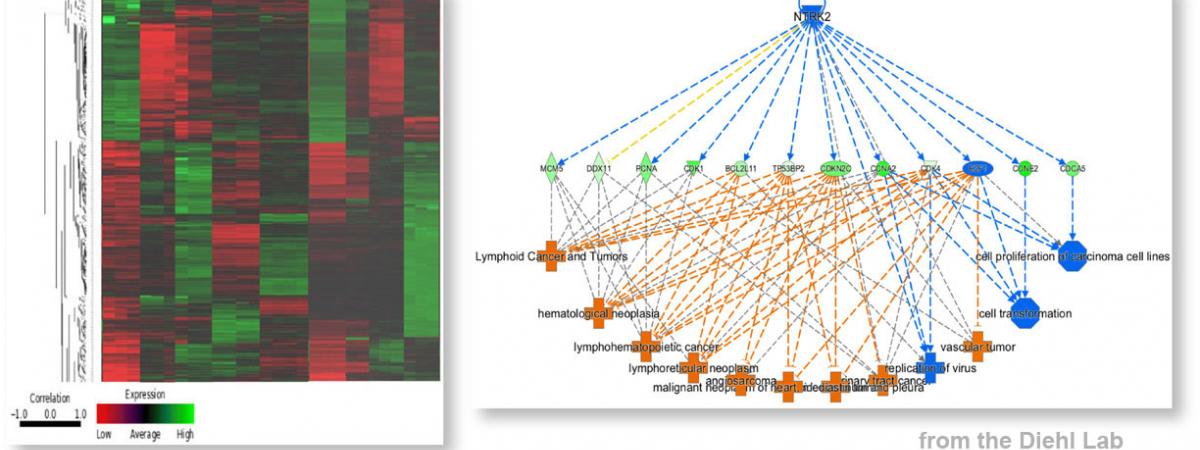
Future work seeks to identify downstream targets of the HNF-1-alpha factor in mammalian beta-cell lines in
culture. Deciphering of the downstream pathway promises to provide insight into the molecular basis of
glucose-stimulated insulin secretion.
Hua, Q.X., Zhao, M., Narayana, N., Nakagawa, S.H., Jia, W., and Weiss, M.A.
"Diabetes-associated Mutations in a b-Cell Transcription
Factor Destabilize an Anti-Parallel "Mini-Zipper.""
Proc. Natl. Acad. Sci. USA (2000) 97:1999-2004.
Nakagawa, S. H., Zhao, M., Hua, Q. X., Weiss, M. A.
"The Importance of Residue B8 in Insulin Activity, Structure and Folding."
Proc. Am. Peptide Symp. (1999) pp. 471-472.
Zhao, M., Nakagawa, S. H., Hua, Q. X., Weiss, M. A.
"Exploring the Foldability and Function of Insulin by Combinatorial Peptide Chemistry"
Proc. Am. Peptide Symp. (1999) pp. 369-371.
Hua, Q. X., Jia, W., Bullock, kB., Habener, J. F., and Weiss, M. A.
"Transitional Activator-Coactivator Recognition: Nascent Folding of a Kinase-Inducible
Transactivation Domain Predicts Its Structure on Coactivator Binding."
Biochemistry (1998) 37:5858-5866
Hua, Q. X., Hu, S-Q, Frank, B. H., Jia, W., Chu, Y-C., Wang, S-H, Burke, G. T., Katsoyannis, P. G., and Weiss, M. A.
"Mapping the Functional Surface of Insulin by Deisgn. Structure and Function of a Novel A-Chain Analogue."
J. Molec. Biol. (1996) 264(2):390-403.
Hua, Q. X., Narhi, L., Jia, W., Arakawa, T., Rosenfeld, R., Hawkins, N., Miller, J. A., and Weiss, M. A.
"Native and Non-native Structure in a Protein-folding Intermediate: Spectroscopic Studies of Partially
Reduced IGF-I and an Engineered Alanine Model."
J. Molec. Biol. (1996) 259:297-313.
Jacoby, E., Hua, Q. X., Stern, A., Frank, B. H., and Weiss, M. A.
"Structure and Dynamics of a Protein Assembly: 1H-NMR Studies of the 36 kD R6 Insulin Hexamer."
J. Molec. Biol. (1996) 258:136-157.
Hua, Q. X., Gozani, S., Chance, R. E., Hoffmann, J. A., Frank, B. H., and Weiss, M. A.
"Structure of a Protein in a Kinetic Trap."
Nature Struct. Biol. (1995) 2:129-138
eml10@po.cwru.edu
-- About this server
-- Copyright 1994-2000 CWRU
-- Unauthorized use prohibited