|
Edelstein wins Industrial Applications in Physics Prize for MRI work
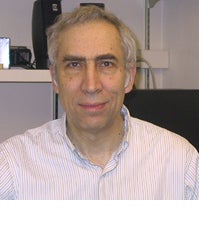
William Edelstein, a senior research associate in physics in The College of Arts and Sciences at Case, was recently recognized by the American Institute of Physics for being a key figure in transforming Magnetic Resonance Imaging (MRI) from a lab experiment to a clinically practical device.
The AIP named Edelstein the winner of its Industrial Applications in Physics Prize for his “pioneering developments leading to commercialization of high-resolution MRI for medical applications."
The prize will be given to Edelstein at the 2005 Industrial Physics Forum, being held from November 6-8 at the National Institute of Standards and Technology in Gaithersburg, Maryland.
The AIP recognized Edelstein's critical contributions to MRI, which began at the University of Aberdeen in Scotland from 1977-80 where he collaborated in constructing one of the first whole-body scanners, and was the primary inventor of the "Spin Warp" imaging method that is still used in all commercial MRI systems.
In the fall of 1980, he joined the GE Corporate Research and Development Center in Schenectady, NY, where he and a small group of GE scientists were encouraged to investigate medical magnetic resonance technology.
At the time, GE management decided to produce an MRI product using 1.5 T magnets with their very strong magnetic fields. This required the solution of a host of technical problems. Scientists and engineers in the GE Corporate R&D group and others at GE Medical Systems in Milwaukee, WI made rapid progress and the first 1.5-T product was available less than two years later.
Throughout this period, Edelstein led or was a key part of physics-related projects producing important science, ideas or inventions that solved critical problems and noticeably moved the field forward. He investigated fundamental issues of signal-to-noise ratio and image quality. He helped design and improve the structures creating linear magnetic field variation ("gradients") that produce the MRI image information. He worked on developing MRI radiofrequency coils both for whole-body imaging as well as for localized regions of the body. He collaborated in devising the MRI Phased Array that produces images combining the superior resolution of localized coils with a large field of view. These and other technical improvements pioneered by Edelstein helped make MRI systems commercially viable and clinically useful.
Edelstein retired in 2001 from the GE Corporate Research and Development Center. His current work at Case includes theoretical research on reducing the considerable noise associated with MRI machines.
Edelstein is a fellow of The American Physical Society, the Institute of Physics (UK), and a GE Coolidge Fellow. He is a Fellow of the International Society of Magnetic Resonance in Medicine and a recipient of their Gold Medal Prize. He earned his undergraduate degree at the University of Illinois at Urbana-Champaign and did his graduate work at Harvard.
|

