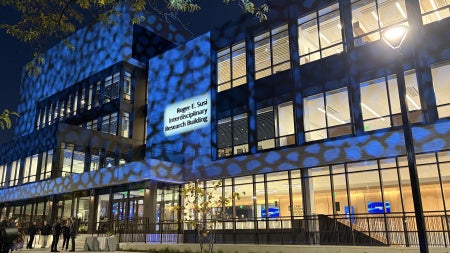
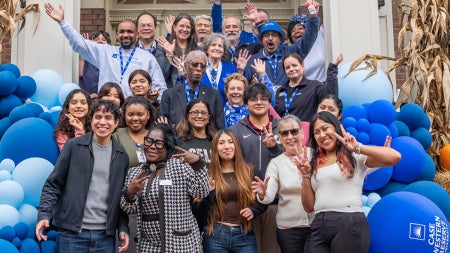
At the Oct. 21 opening of the Interdisciplinary Science and Engineering Building—now named the Roger E. Susi Interdisciplinary Research Building in recognition of a $50 million gift from Roger (CIT ’77) and Kayoko Susi—Case Western Reserve University launched the most ambitious philanthropic campaign in its 200-year history.

With a goal of $2.5 billion, Breakthrough Point comes as CWRU closes out its bicentennial year, and President and Morton L. Mandel Presidential Chair Eric W. Kaler positions the university to begin its next 200 years of turning ideas into impact.
“The timing of this campaign is intentional. It capitalizes on our remarkable momentum and will accelerate our growth and impact as one of the country’s leading research institutions,” said Kaler. “Our $2.5 billion goal is ambitious. And we are primed to achieve it, driven by our 200-year history of a bias for action and fueled by a collaborative university community that is innovative, future-focused and results-driven.”
Breakthrough Point will focus on three pillars: preparing leaders for tomorrow, powering innovation into impact, and advancing health and well-being. These priorities build on CWRU’s look to the future—and the impact of the CWRU community on it.
“This is an extremely important time at Case Western Reserve,” said campaign co-chair Fred DiSanto (WRC ’85, MGT ’86). “And we can move this university forward for generations to come—particularly as it relates to research, infrastructure and talent.”
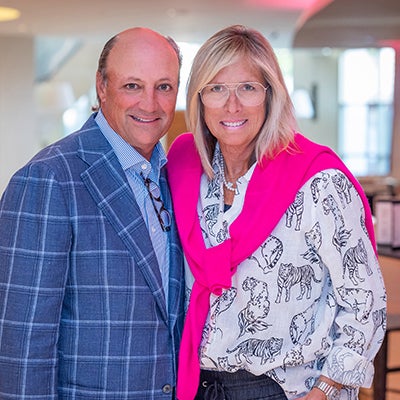
DiSanto, who formerly served as chair of the CWRU Board of Trustees, and his wife, Brittan, are longtime supporters of Case Western Reserve University, and will co-chair the Breakthrough Point campaign.
“Fred and I believe strongly in the mission of Case Western Reserve, and this is an opportunity to give our time to an institution that had a formative impact on our lives,” Brittan DiSanto said.
The campaign is already moving innovation forward through a number of significant gifts this year—including two of the most substantial in CWRU history: the $125 million combined gift from the Jack, Joseph and Morton Mandel Foundation and the Jack, Joseph and Morton Mandel Supporting Foundation announced in April, and the Susis’ $50 million gift for the Susi Building.
The space will support work in the following research clusters:
- James M. Galm, PhD, PE Electrochemical Engineering & Energy Science
- Advanced Materials & Manufacturing
- Molecular Therapeutics
- Precision Diagnostics & Therapeutics
- NeuroTechnology NeuroRobotics
- Climate & Ecosystem Science
“This building has the potential to create groundbreaking, significant advances—some of which may be supported by the Breakthrough Point campaign,” Susi said.
Through shared spaces, laboratories and equipment, the Susi Building is designed around interconnected research that can lead to breakthroughs in challenges that impact everyday life.
Among the shared spaces: the Jack, Joseph and Morton Mandel Studio, which will serve as a gathering place for Mandel Fellows in the university’s Experimental Humanities program to discuss and finalize their research, with subjects ranging from the ethics of artificial intelligence to historical insights into the consequences of climate change. Expanding and sustaining the program was a core part of the Mandel Foundation’s transformational gift, which was the largest in the foundations’ histories and believed to be the biggest gift ever to higher education in Ohio.
“This grant represents a commitment to the present and future of the university, and an investment in the leaders it develops whose meaningful advances will improve our city and our society,” said Jehuda Reinharz, president and CEO of the Mandel Foundation.
In addition to expanding the Experimental Humanities program, the Mandel gift will establish the Jack, Joseph and Morton Mandel Humanities Building; will double the existing scholarship endowment capacity at the Jack, Joseph and Morton Mandel School of Applied Social Sciences; and has created the Morton L. Mandel Presidential Chair, with President Kaler as the inaugural holder.
"The Mandel Foundation's investment in Case Western Reserve reflects our continued belief in the increasing value and importance of higher education, particularly in the humanities," said Stephen Hoffman, the Mandel Foundation's board chair and member of the CWRU Board of Trustees. "It represents our confidence in President Kaler's leadership and vision as well as the remarkable momentum of this university as it celebrates its bicentennial.”
Breakthrough Point goals
The Breakthrough Point
The crux of Breakthrough Point is supporting Case Western Reserve University and its community.
“This campaign is about our community coming together and making a commitment to support the people on this campus doing incredible things,” said Carol Moss, senior vice president of University Relations and Development. “The faculty, researchers and students—backed by support from partners like the Mandel Foundation and Roger and Kayoko—can have an impact on the world around us.”
Case Western Reserve’s last campaign, Forward Thinking, concluded in 2019 after raising $1.82 billion—funding 98 endowed professorships, increasing scholarship support by nearly $254 million and investing in infrastructure around campus, including the Health Education Campus with Cleveland Clinic, the Maltz Performing Arts Center, the Larry Sears and Sally Zlotnick Sears think[box] and the Jack, Joseph and Morton Mandel School of Applied Social Sciences.
Breakthrough Point will continue to build upon the work made possible in the last campaign, centering in on the three pillars, each designed to support the university and community in perpetuity:
Preparing leaders for tomorrow
Investing in the students, scholars and faculty shaping what comes next by:
- Creating more pathways into experiential learning
- Expanding support for faculty and research mentors
- Unlocking potential with broader access to scholarships and fellowships
Powering innovation into impact
Pursuing questions that matter and developing solutions for urgent needs by:
- Providing the space and tools to discover
- Advancing ethical, human-centered technology
- Embracing interdisciplinary thinking and unexpected partnerships
Advancing health and well-being
Accelerating research and medical breakthroughs, and training the next generation of caregivers by:
- Reimagining access to care—in our community and around the world
- Focusing on discovery with real-world application
- Innovating at the intersection of health and technology
Case Western Reserve has long fostered an environment in which innovation and challenging the status quo are not just encouraged but expected—from creating the first modern blood transfusion to developing antivirus software. It’s where leaders—from the first woman admiral in the U.S. Navy, Alene Duerk, to 16 Nobel Laureates—have carved pathways for generations to come.
The Breakthrough Point channels that momentum. Explore the Breakthrough Point: case.edu/campaign