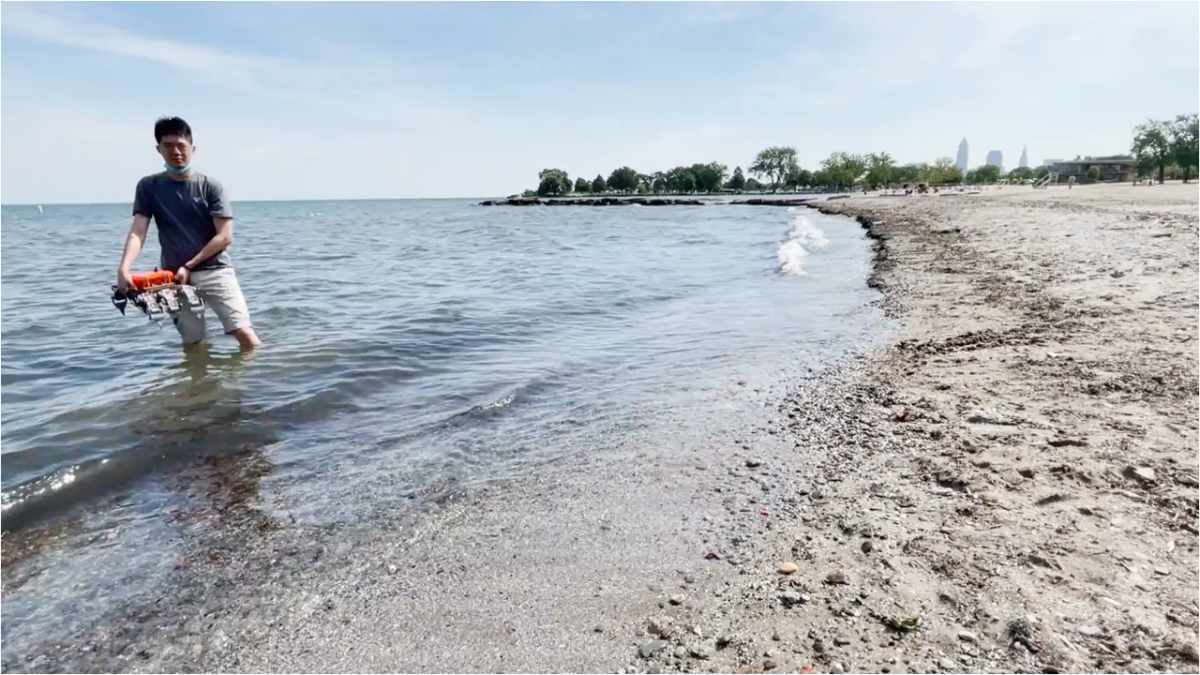
Case Western Reserve University nets $2.5 million Naval Research Grant to develop swimming crab robots
Case Western Reserve University's Biologically Inspired Robotics Lab has been awarded a $2.5 million grant from the Office of Naval Research to develop a new generation of crab-inspired robots capable of swimming—and ultimately deploying from the skies to the deep-sea floor.
Kathryn Daltorio, associate professor in the Case School of Engineering, said the project brings together a cross-disciplinary team to solve one of robotics' hardest problems: building a machine that can move efficiently through radically different environments, from the air to open water to the benthic surface, also known as the bottom of the ocean.
Daltorio's Crab Lab has long studied how crabs use their legs for crawling, climbing and gripping. Now, the team wants to know if those same legs can be adapted for swimming.
“Crabs have figured out how to use one body plan for so many different tasks,” Daltorio said. “We're trying to learn as much as we can from these animals—and then push beyond what they do naturally.”

The project draws on the expertise of four collaborators from the engineering school:
- Materials scientist Sam Root, assistant professor, is investigating whether a single base material—inspired by the chiton, a marine mollusk whose shell integrates hard and soft components—can be used to fabricate an entire robot body, making parts easier to assemble and more durable.
- Zach Patterson, assistant professor, is applying lessons from turtle locomotion to help crack the challenge of swimming control.
- Brian Taylor, assistant professor, is studying air-to-sea deployment.
- And Gourav Datta, assistant professor in the Department of Electrical, Computer and Systems Engineering, is developing a neuromorphic, “biologically inspired” AI to help the robot adapt in real time. In other words, the robot will learn from its mistakes.
Partnering with Glenna Clifton, a biologist from the University of Portland who studies crab movement, the team will study live crabs alongside their robotic models throughout the project.
“The tricky piece for this project,” said Daltorio, who described nature as “the best engineer,” is designing a robot that can be dropped from the air and navigate all the way to the seafloor. “That requires rethinking everything—materials, movement, sensing and intelligence—at once.”
The grant was made possible with Congressional support and includes a partnership with Stony Brook University, which was also awarded a grant from the Office of Naval Research.