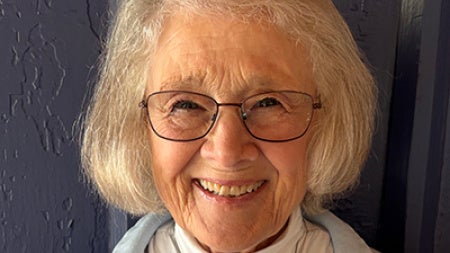
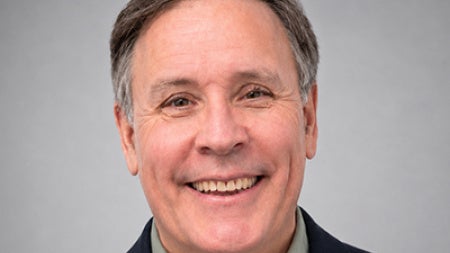
During Case Western Reserve’s Forward Thinking capital campaign, then-President Barbara R. Snyder started the President’s Challenge: an opportunity for alumni and friends to make scholarship commitments through their estates for the university’s future—while seeing the impact on students today. The initiative continues under President Eric W. Kaler, and donors continue to find inspiration in the opportunities it presents. Here, find two of the many examples of such supporters.
Honoring friendships and transforming futures
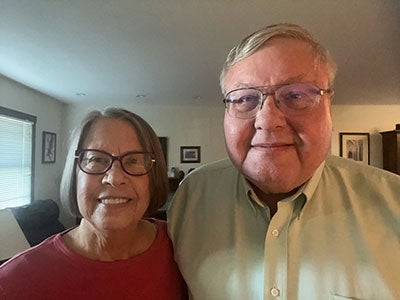
When Robert Gingell (CIT ’77) first stepped onto the Case Western Reserve campus, he had little idea how profoundly the university would shape the rest of his life. Together with his wife, Diane, the Gingells have remained deeply connected to CWRU—through philanthropy, professional work and lifelong friendships. Now, through a $1.5 million estate gift, they are ensuring that future generations of graduate students will benefit from the same kind of opportunities that proved transformational in their own lives.
The Gingells’ planned gift will permanently endow the William A. Shannon Graduate Fellowship in Computer and Data Sciences, created in memory of Rob Gingell’s close friend, classmate and colleague Bill Shannon (CIT ’78; GRS ’81, computer engineering).
For Rob Gingell, the fellowship carries personal significance, honoring both Shannon’s friendship and the doors that opened for him at CWRU.
“It seemed like an opportunity to remember him and the experiences we had at CWRU, which were so helpful to the things we accomplished later on,” he said.
Those experiences began almost immediately when Rob Gingell arrived at the university. As a first-year student, he walked into the computing department hoping to continue projects he had begun in high school. Instead, faculty invited him to join major research initiatives already underway.
“The university let me do as much as I wanted to do,” he recalled. “I found the place remarkably open to some freshman wandering in and wanting to use major research facilities.”
After graduating, Rob Gingell worked at the university for several years, building CWRUnet—the first campuswide network—and leading efforts to modernize the Jennings Computing Center, which provided computer access and instruction for faculty and students across the university. Shannon, who completed his master’s thesis at CWRU on related work while Gingell was working there, later helped recruit Rob Gingell to Sun Microsystems, where Rob rose to become a Sun Fellow, vice president and chief engineer.
“My friendship with Bill spanned being classmates, to mentoring his master’s work, to recruiting me into the most impactful job of my career at Sun,” Rob Gingell reflected. “Which is why I think it’s fitting he be honored in making opportunities available to others.”
Diane Gingell, a Cleveland native, also began her career at CWRU, first working in the Computing Center and later as project manager for automating the university’s libraries—an effort that created one of the first online catalogs and circulation systems.
“I have very strong feelings for the university and everything it meant to me and everybody I worked with,” she said. “It was always a premier place to work.”
The Gingells believe the Shannon Fellowship will enable future graduate students to discover their direction, just as CWRU did for them.
“The issue is really how students get to CWRU,” Rob Gingell explained. “The fellowship will give people the opportunity to enter the environment where all the things that supported my development—and that of my friends—can come to pass.”
Shaping engineers through experience
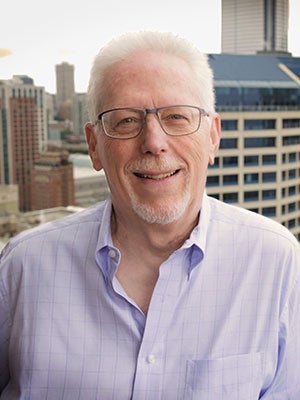
Halfway through his first year at Case Institute of Technology, Grant Saviers (CIT ’66; GRS ’68, engineering) walked into the computing center and discovered the Burroughs 220—a room-sized machine humming with mystery. Encouraged to experiment, he discovered both an interest in computer engineering and a lifelong passion for exploration and innovation.
That early curiosity became the foundation of a pioneering career. Saviers learned computer engineering before it was even a formal degree, and went on to shape the field as an executive at Digital Equipment Corp. and, later, as CEO and chairman of Adaptec.
Decades later, that early experience continues to shape his philanthropy. Together with his wife, Dorrit, Saviers has consistently supported scholarships, experiential learning and makerspaces, such as Sears think[box], since 1976—always with the goal of ensuring students have the same opportunities he did to test ideas, take risks and learn by doing.
Now, the couple is building on that legacy with an estate gift of $2 million to establish The Saviers Fellowship Fund. The endowment will provide teaching fellowships for graduate students in Case School of Engineering, enhancing their professional development while they enrich the education of undergraduates.
Saviers has long emphasized experiential learning as a cornerstone of engineering education. Reflecting on his support of Sears think[box], he noted, “You have to get your fingers dirty and go nose-to-nose with physical reality to be a great engineer.”
He sees the new fellowship fund as a continuation of this commitment.
“It’s a natural extension to ensure the success of our investment in experiential learning,” Saviers explained. “I want to see students have the same opportunities I had.”