


CWRU partners with STEMpower to provide hands-on education in 49 countries
More than 1 million students have benefited, gaining a wide range of skills
Hundreds of people gathered outside a large tent in the heart of Robe City in Ethiopia one April morning, drawn by the excitement of what was unfolding within.
An eight-hour drive from the capital of Addis Ababa, the city is rooted in agriculture, its economy largely driven by barley and wheat production. Opportunities for students to gain hands-on learning in STEM (sciences, technology, engineering and mathematics) disciplines have been limited.
But on that spring day, those very disciplines were on display at the city’s first STEM fair. Inside the tent, local high school students showcased innovations they spent months developing, proudly explaining the possibilities to local dignitaries, visitors, community members and their families.
Fittingly, their projects reflected the needs of the community, from a mobile application to digitally access hard-to-find textbooks to a machine designed to produce butter more efficiently than manual methods.
For many, the fair represented a compelling vision of education that blends hands-on learning, creativity and possibilities for real-world impact in new ways. It’s a vision being shaped by a nonprofit called STEMpower, in a growing partnership with Case Western Reserve.

In the last eight years, STEMpower has built a network of 164 STEM centers in 49 countries—and it’s still growing—benefiting more than 1 million students. The nonprofit was founded by Mark Gelfand (HON ’22)—a Cleveland-area native who has spent more than 30 years bringing STEM education initiatives to students in cities across the United States, and, since 2014, in Ethiopia and other sub-Saharan African countries.
“Many young students learn more effectively from mentors who teach through physical interaction with actual lab equipment,” Gelfand said. “By discovering and overcoming challenges, the students gain a wide set of exciting skills.”
Among those students is Ayitegeb Demisie, a 17-year-old student at Robe High School, who participated at the April fair, displaying an affordable multipurpose grain milling machine he developed to help farmers process maize and other crops and reduce Ethiopia’s dependence on imported machines. “One year ago, this project was just an idea, and [STEMpower] invested in us,” he said. “They are really, I think, proud of us.”
Tackling an urgent need

The motivation behind STEMpower is rooted in a pressing reality: Africa has the world’s youngest population with more than 400 million people between the ages of 15 and 35, according to the African Union. Yet access to hands-on STEM education remains uneven.
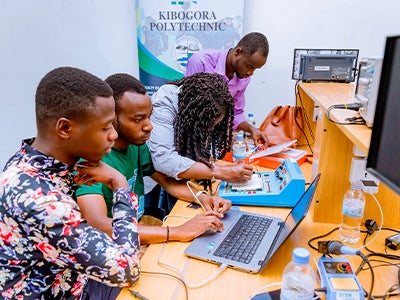
STEMpower aims to address unmet needs by creating centers with well-stocked laboratories. The centers also support entrepreneurship training, STEM fairs and community engagement, linking education with economic development.
At the centers, students transform locally available resources into higher-value products—by turning seed oils into soap, for example—strengthening learning experiences and local economies. “In creating permanent physical infrastructure in nearly every Sub-Saharan country, including the island nations,” STEMpower’s website states, “we may be the only nonprofit of any category to have ever achieved such a wide level of coverage.”
Gelfand’s connection to Case Western Reserve is personal. Although he did not attend CWRU, family members did: his father, Harvey Gelfand (GRS ’69, education); mother, Dolores Gordon Gelfand (CLC ’66; GRS ’67, speech pathology and audiology); and uncle, Leonard Gelfand (CIT ’50).
To honor his uncle’s legacy at the university, Mark Gelfand has supported STEM education, including through the Leonard Gelfand STEM Center at CWRU, which provides hands-on STEM programs for K-12 students in Northeast Ohio and professional development for teachers.
Knowing CWRU’s hands-on approach to engineering education, Mark Gelfand also established an endowment in 2019 to create the Gelfand Global STEMpower Initiative on campus, making CWRU the only U.S. university partner in his nonprofit’s work in Africa.
CWRU faculty provide mentorship, technical expertise and guidance for STEMpower’s activities. And through the Gelfand Global Fellows program, CWRU graduate students lead STEM education projects on the ground, receiving full tuition support and stipends.
“Fellows combine their scientific expertise with an understanding of the local context to develop innovative, locally relevant activities that inspire students to explore engineering,” said Daniel Lacks, PhD, a vice provost and the C. Benson Branch Professor of Chemical Engineering, who leads the initiative.
One fellow’s journey
For Zemene Tegegn, a PhD student in chemical engineering at CWRU, the work as a Gelfand Global Fellow melds his professional growth and personal passions. Originally from Delo Mena, Ethiopia, he attended schools now active in STEMpower.
In 2022, Tegegn developed a pilot STEM program at his former high school. It’s now a multi-city initiative, reaching more than 5,000 students across 24 schools. Students are learning to create chemical microfactories, build robotics and electronics systems, develop digital skills, and apply engineering design and manufacturing to locally driven problem-solving.
Moreover, they are launching small businesses and participating in national STEM competitions, moving from theoretical learning to applied innovation.

Tegegn also helped bring Robe’s STEM fair to life, working closely with STEMpower partner Madda Walabu University and the Robe City Education Office.
To him, the most meaningful part of the work is seeing students in action. “Through CWRU’s Gelfand Global STEMpower Initiative,” he said, “my dream of becoming a scientist is coming true—and I’m helping the next generation believe they can achieve theirs, too.”