Advance aims at detecting cancers earlier, improving treatment and outcomes
Physicists and engineers at Case Western Reserve University have developed an optical sensor, based on nanostructured metamaterials, that’s 1 million times more sensitive than the current best available—one capable of identifying a single lightweight molecule in a highly dilute solution. Their goal: to provide oncologists a way to detect a single molecule of an enzyme produced by circulating cancer cells. Such detection could allow doctors to diagnose patients with certain cancers far earlier than possible today, monitor treatment and resistance and more.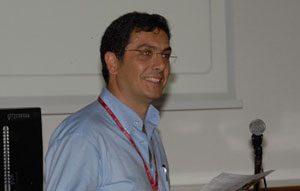 “The prognosis of many cancers depends on the stage of the cancer at diagnosis,” said Giuseppe “Pino” Strangi, professor of physics at Case Western Reserve and leader of the research.
“Very early, most circulating tumor cells express proteins of a very low molecular weight, less than 500 Daltons,” Strangi explained. “These proteins are usually too small and in too low a concentration to detect with current test methods, yielding false negative results.
“With this platform, we’ve detected proteins of 244 Daltons, which should enable doctors to detect cancers earlier—we don’t know how much earlier yet,” he said. “This biosensing platform may help to unlock the next era of initial cancer detection.”
The researchers believe the sensing technology will also be useful in diagnosing and monitoring other diseases as well.
Their research is published online in the journal Nature Materials. Strangi worked with postdoctoral researchers Kandammathee Valiyaveedu Sreekanth and Efe Ilker, PhD students Yunus Alapan and Mohamed ElKabbash, Assistant Professor of Physics Michael Hinczewski, Assistant Professor of Aerospace and Mechanical Engineering Umut Gurkan (co-PI) and Antonio De Luca, who was a visiting research scholar in Strangi’s lab during this study and is now an associate professor of physics at the University of Calabria in Italy.
“The prognosis of many cancers depends on the stage of the cancer at diagnosis,” said Giuseppe “Pino” Strangi, professor of physics at Case Western Reserve and leader of the research.
“Very early, most circulating tumor cells express proteins of a very low molecular weight, less than 500 Daltons,” Strangi explained. “These proteins are usually too small and in too low a concentration to detect with current test methods, yielding false negative results.
“With this platform, we’ve detected proteins of 244 Daltons, which should enable doctors to detect cancers earlier—we don’t know how much earlier yet,” he said. “This biosensing platform may help to unlock the next era of initial cancer detection.”
The researchers believe the sensing technology will also be useful in diagnosing and monitoring other diseases as well.
Their research is published online in the journal Nature Materials. Strangi worked with postdoctoral researchers Kandammathee Valiyaveedu Sreekanth and Efe Ilker, PhD students Yunus Alapan and Mohamed ElKabbash, Assistant Professor of Physics Michael Hinczewski, Assistant Professor of Aerospace and Mechanical Engineering Umut Gurkan (co-PI) and Antonio De Luca, who was a visiting research scholar in Strangi’s lab during this study and is now an associate professor of physics at the University of Calabria in Italy.