The dedicated professionals behind nursing's “best-kept secret” specialty
National CRNA Week is Jan. 18–24, and we’re celebrating the advanced nursing professionals who play a critical part in safe anesthesia care.
In medical settings across the country, certified registered nurse anesthetists (CRNAs) guide patients through some of their most challenging times. While the specialty may not be widely known, these dedicated nurses play a critical role in anesthesia administration.
This week, Jan. 18–24, we’re celebrating the expertise and commitment of these practitioners with National CRNA Week. It’s a fitting time to recognize the anesthesia specialists who quietly make complex care feel safe, human and reassuring.
But what does this specialty really look like? To get a feel for the rigorous field, we talked with three Frances Payne Bolton School of Nursing’s Doctor of Nursing Practice (DNP) in nursing anesthesia students to learn why they think the specialty is critical, what the doctorate program is really like and how they balance demanding academics with traveling, spending time with family and the joy of scoring the best finds from local thrift stores.

Robert Sharkey
Education: Bachelor of Science in Nursing, Gannon University
Nursing experience: Heart Failure and Cardiac ICUs, University Hospitals Cleveland Medical Center
What is something people may not know—but should—about CRNAs?
I once heard nurse anesthesia described as “nursing’s best kept secret.” I think there’s a common misconception of what CRNAs do. Sometimes people assume that CRNAs simply carry out a physician’s orders, but we are taught to independently assess patients, develop an anesthetic plan and safely wake patients up. The reality is that CRNAs work collaboratively as part of the perioperative team.
What inspired you to pursue the CRNA specialty?
I originally pursued nursing because of the negative experiences my grandmother faced when she developed Alzheimer’s. I entered the ICU to build a strong foundation, but over the years, I felt increasingly powerless in an emotionally draining environment. When I shadowed a CRNA, I saw the direct impact they had on patient care and the role they played in making patients safe and comfortable. They had this almost sixth sense to anticipate problems before they happened. Afterwards, I reflected on the core qualities and attributes that I thought made up a CRNA and decided to pursue this field.
What is your favorite part of the nurse anesthesia DNP program at CWRU?
It is hard to choose one favorite part of CWRU’s CRNA program. As the saying goes, “it takes a village.” There is a strong culture among the students to support one another. I also highly value the diversity of our faculty. All my professors have been active clinicians who bring their unique, real-world perspectives into the classroom. I think that this is an invaluable tool for students to have.
Why should someone consider becoming a CRNA?
I have two quotes from my peers that stick out to me: “the days are long, and the weeks are fast” and “it’s a marathon, not a sprint.” People can describe what school is like forever, but you won’t understand this journey until you’re the one walking it. Enjoy the time you have before starting school. Make time to enjoy the growth that happens along the way.
What inspires you outside of school?
My girlfriend and my family inspire me. I have a very supportive network that allows me to pursue this career—and that’s very important to have. One of my favorite interests is thrifting. I love finding niche things that nobody knows anything about!
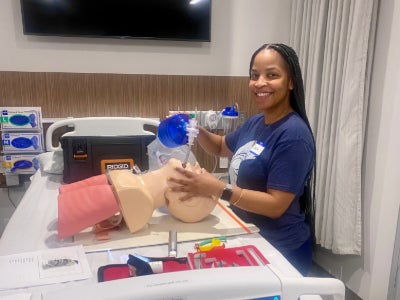
Dawn F. Lynn, RN
Education: Bachelor of Science in Nursing, Prairie View A&M University
Nursing experience: Nurse at the Pediatric Intensive Care Unit at Texas Children’s Hospital
What drew you to nursing and the CRNA specialty?
I have been deeply inspired by my maternal grandmother throughout my journey in the nurse anesthesia program here at CWRU. She aspired to become a registered nurse but lacked access to the resources and opportunities needed to pursue that path. Her story has been a constant source of motivation and fuel to keep me moving forward, emphasizing the importance of education, representation and staying the course.
I was also inspired by the chance to contribute to a profession that serves increasingly diverse patient populations and to help ensure equitable, high-quality care for all patients in perioperative settings. The ability to combine independent clinical decision making with meaningful patient advocacy ultimately confirmed my decision to pursue nurse anesthesia.
Why is the CRNA role critical in healthcare?
It offers a nursing-centered, holistic approach to anesthesia care during some of the most vulnerable moments in a patient’s experience. CRNAs must continuously evaluate and respond to both physiological changes and individual patient needs, which is essential for safe outcomes. CRNAs often serve as the primary anesthesia provider, making their role crucial to both access and continuity of care across diverse healthcare settings.
What experience stands out to you from your time in the nurse anesthesia DNP program?
One unforgettable experience was intubating a patient on my first day of clinical! This was my first time intubating a real patient, marking a major shift from simulation to actual clinical practice. I was so nervous, and it felt like time slowed down, and everything I had learned came together in that moment. This experience boosted my confidence early on and reflects my overall experience in the program—one marked by strong clinical support, hands-on learning and ongoing growth.
What is something that would surprise people about CRNAs?
Many people are surprised to learn that CRNAs are highly trained nurses who practice as licensed, independent anesthesia providers. CRNAs manage anesthesia care throughout the perioperative period and, in many settings, serve as the primary anesthesia provider, making their role vital to patient safety, access and continuity of care.
Outside of work, what’s next for you?
I have dedicated all my focus over the past 31 months to nurse anesthesia education and training, but I am really looking forward to returning to activities that bring me balance and joy, such as spending time with family and friends, working out and traveling!

Erin Tansey, RN
Education: Bachelor of Science in Nursing, University of Arizona
Nursing Experience: RN at a pediatric intensive care unit at a Level I trauma center
Why do you think the CRNA field is important in medicine?
Nurses have safely and effectively administered anesthesia since the late 1800s. While CRNAs have become more widely recognized in recent decades, the profession has a long and rich history rooted in patient safety and excellence in care.
CRNAs provide safe, high-quality anesthesia and pain management for millions of patients each year. With a strong background in critical care nursing, CRNAs bring a unique skill set that makes them indispensable members of the healthcare team. Nurse anesthetists deliver quality patient-centered care. Nursing is consistently ranked as the most trusted profession, and I am proud to carry those values forward as a future nurse anesthetist.
What interested you most about becoming a CRNA?
After several experiences shadowing a CRNA, I was drawn to the diversity of cases they manage, their depth of knowledge and the way they are able to provide comfort and reassurance to patients during vulnerable moments. Like many ICU nurses, my favorite assignments were 1:1 patient ratios, where I could focus all of my attention on a single patient. As a CRNA, that level of focused, individualized care is part of everyday practice.
What has been the most rewarding part of the nurse anesthesia DNP program?
I love that we are integrated into clinical practice from the very beginning of the program. Being able to immediately apply what we learn in didactic courses to real-world clinical situations is invaluable. We have access to a wide variety of excellent clinical sites and work alongside incredibly supportive CRNAs who are passionate about teaching. I feel genuinely supported by both the program and the CRNAs I work with every day.
What’s kept you motivated throughout your CRNA education?
As students, we often tend to be hard on ourselves and focus on what we don’t yet know. As a second-year student, I was asked to help with an ultrasound lab for first-year student registered nurse anesthetists (SRNAs). Teaching other students was incredibly rewarding and allowed me to see how far I’ve come and how much I’ve learned throughout the program.
How do you balance a rigorous academic program and life?
CRNA school is challenging, but it is also incredibly rewarding. The support from faculty, preceptors and fellow students makes the journey worthwhile and reinforces why this profession is so special. Outside of school, I enjoy spending time outdoors and traveling. I have visited 22 countries and counting. I love exploring new coffee shops and am always on the lookout for new restaurants to try. I stay active and de-stress through Pilates, yoga and hiking, and now that winter is here, I’m hoping to get in a few ski days as well.