Experts at CWRU School of Law’s Nuremberg Conference pen a modern commentary to the Nuremberg Principles
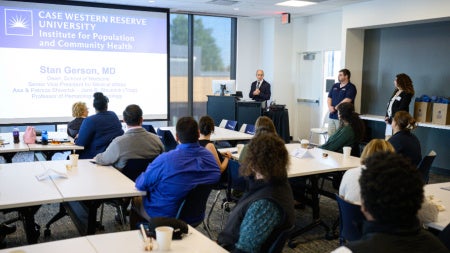
On Oct. 1, 1946, the Nuremberg Tribunal issued its historic judgment, convicting leaders of Nazi Germany of war crimes, crimes against humanity and the crime of aggression. To mark the historic occasion, Case Western Reserve University School of Law hosted “International Law Weekend Midwest: The legacy of Nuremberg: An International Conference Commemorating the 80th Anniversary of the Nuremberg Judgment” earlier this month.
The international conference was co-sponsored by the American Branch of the International Law Association and the Robert H. Jackson Center. Historians, international prosecutors, ambassadors and leading academics from across the globe came together to discuss the legacy of the Nuremberg Judgment, from its application to the modern international tribunals to its relevance to contemporary events. The conference began with a keynote speech by Jack El-Hai, screenwriter and co-producer of the 2025 Hollywood film, Nuremberg.
Participating experts drafted, debated and ultimately adopted a concise commentary to reflect the contemporary meaning of the Nuremberg Principles, which were unanimously affirmed by the United Nations General Assembly on Dec. 11, 1946, and distilled into seven tenets by the UN International Law Commission in 1950.
“Since then, the Nuremberg Principles have become the cornerstone of international criminal law,” said CWRU Law Professor Michael Scharf, the president of the American Branch of the International Law Association. “They have been cited in numerous UN reports, academic commentary, and the decisions of international tribunals and domestic courts as reflecting customary international law.”
“As international criminal law experts, we recognize the continuing vitality of the Nuremberg Principles and urge their application to current conflicts and atrocity situations,” said Washington University Law Professor Leila Nadya Sadat, who serves as chair of the American Branch of the International Law Association Board of Directors.
“But the Nuremberg Principles have not remained static,” Scharf noted. “Over time, states, international organizations, and courts have introduced interpretive gloss to the Nuremberg Principles.” For example, Scharf said "it is now recognized that the international crimes recognized by the Nuremberg Charter are subject to universal jurisdiction, meaning any country can prosecute a perpetrator of these international crimes. Perpetrators can be held responsible under command responsibility, joint criminal enterprise liability, and other forms of perpetration. Obedience to orders is not a defense where the perpetrator knew the order was unlawful or where it was a manifestly unlawful order. The doctrine of head of state immunity is not applicable to prosecution of international crimes in international courts. Individuals are criminally responsible for war crimes committed in either international or internal armed conflicts. And individuals can be prosecuted for crimes against humanity committed during peacetime as well as during armed conflict."
Thus, the participating experts set out to draft a commentary setting forth the modern meaning of the Nuremberg Principles in a concise format to guide soldiers, officials, and national and international courts. “As the first effort by leading experts to bring the Nuremberg Principles up to date, this is a significant achievement,” said Scharf.
View the Commentary and the list of the experts who drafted it.