Five questions with...AANA president and nursing alum Jeffrey Molter
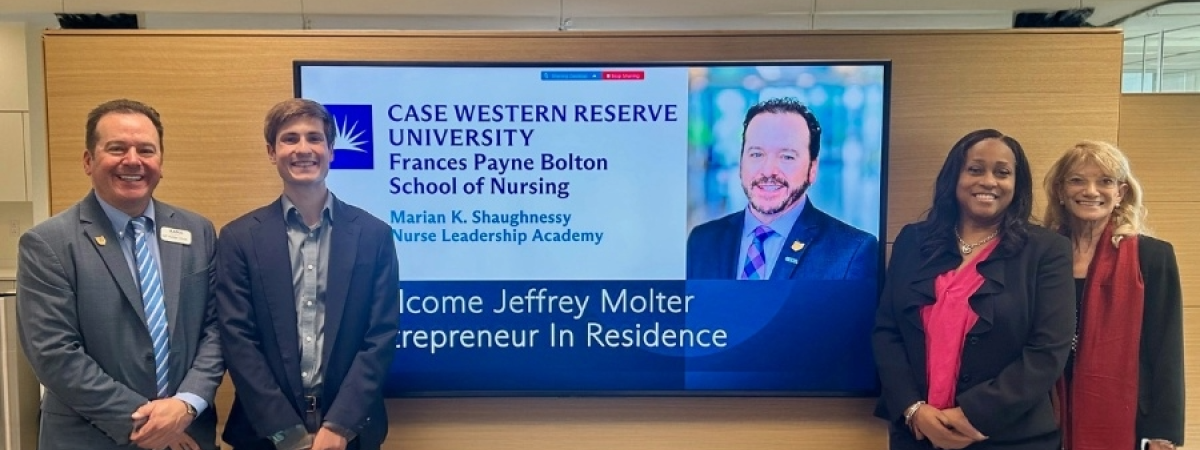
As the current president and chairman of the board of directors of the American Association of Nurse Anesthesiology (AANA), Jeffrey Molter, CRNA (NUR ’00) leads a professional membership organization representing more than 69,000 Certified Registered Nurse Anesthetists (CRNAs). While his influence is now national, his professional journey—and his leadership philosophy—are deeply rooted in his time at Case Western Reserve University Frances Payne Bolton School of Nursing, where he earned a Master of Science in Nursing degree, served as a clinical instructor and met his future business partners.
Molter began his nurse anesthesiology career at large tertiary medical centers, including Mt. Sinai Medical Center and St. Vincent Charity Hospital in Cleveland, before transitioning to practice in rural Ohio at ambulatory surgery centers. Alongside fellow CWRU nurse anesthesiology alumni Scott Urigel, CRNA, MSN (CWR ’97, NUR ’02), Brendan Hernon, CRNA, MSN (NUR ’02) and David Hall, CRNA, MSN (NUR ’95), he founded the Western Reserve Anesthesia Associates. Together, the group built a practice rooted in collaboration, education and service.
Molter and Urigel also launched Western Reserve Anesthesia Education, teaching nurse anesthetists and physicians the art and science of ultrasound‑guided peripheral nerve blocks through hands‑on workshops held multiple times each year. Their work eventually led to the development of Block Buddy Pro, one of the first mobile applications designed to support ultrasound‑guided peripheral nerve blocks on both iPhone and Android platforms.
In addition to his clinical and entrepreneurial work, Molter’s leadership journey includes decades of professional advocacy. He became involved with the Ohio State Association of Nurse Anesthetists, where he progressed from committee service to the board of directors and later served as president. That experience led him to national leadership with AANA, where he served as a board member, held executive‑level positions and was ultimately elected president.
Today, Molter continues to practice clinically at the Institute of Orthopedic Surgery in Lima, Ohio, while serving the profession at the national level—remaining closely connected to the alumni community that helped shape his career.
1. How has your CWRU education impacted your career?
One faculty member who impacted my career and my life is Jack Kless, CRNA, PhD. Kless was the program director when I applied in 1996, and he saw something in me that I did not see in myself. My undergraduate GPA was not something to be proud of, but he suggested I take graduate‑level courses at Case Western Reserve University before applying to the nurse anesthesiology program to demonstrate that I had the ability to do the work. He continued to mentor me during the program and continues to do so today. He has even invited me back to the university multiple times to give lectures on the business of anesthesia and nurse anesthesiology advocacy.
2. Beyond professional titles, what does a meaningful career look like to you?
A meaningful career to me means that I show up every day to help patients get through a procedure as safely and as comfortably as possible. This starts with the preoperative interview—educating the patient on the planned anesthetic, answering any questions and making them feel comfortable with what is about to happen. Patients entrust their lives to me, and it is an honor and a privilege to take care of them. Outside of the operating room, I want to be remembered for developing and empowering other nurse anesthetists to advance research, education, practice and policy that directly impact the health of individuals and our communities.
3. What is the one breakthrough or shift in your specialty that excites you most for the next decade?
The implementation of advanced technology and artificial intelligence in nurse anesthesiology is very exciting to me. In my 27‑year career as a CRNA, I have seen dramatic changes, but the current levels of acceleration are mind‑blowing. When I learned peripheral nerve blocks in the late 1990s, we relied on anatomical landmarks and nerve stimulators. Today, with ultrasound technology, we can visualize specific nerves and directly watch the local anesthetic get deposited next to them. Some ultrasound machines now even have artificial intelligence capabilities that help “highlight” the specific nerve you are looking to target.
4. What inspired you to become a nurse?
My grandmother Helen was a nurse, and I always loved and admired her. When I was in high school, she suggested I investigate the field of nurse anesthesiology. She worked at Mt. Sinai Medical Center and respected what the CRNAs did. I had never heard of a CRNA before, so I did some research at the library and decided that is what I wanted to become. When my work gets tough, I remind myself that helping others is not always going to be easy—and it should not be. After all, we are all unique individuals, and every person deserves care that is suited to their specific needs.
5. Can you share a moment where you faced a significant challenge and how your CWRU foundation helped you?
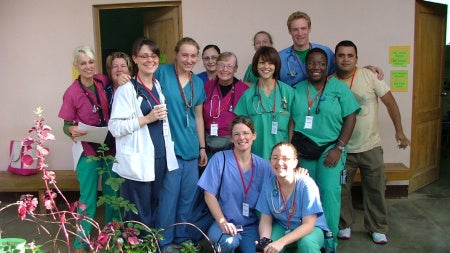
In 2011, I went on a surgical mission trip to Ouanaminthe, Haiti. We had limited resources, but we were able to provide much‑needed surgical care to a community for a week. It was a life‑changing experience that made me realize how much I had taken for granted in this country. I returned three more times, and with each trip, we became more efficient and were able to care for more people in the community.
I also met one of my best friends, Emmanuel, who served as one of our translators. He was attending college in the United States at the time, and today he lives in Ohio with his family. When you look at the mission of the Frances Payne Bolton School of Nursing—to “develop and empower nurse leaders who advance research, education, practice and policy that have a positive impact on the health of individuals and communities”—nothing speaks truer to the impact Case Western Reserve University has had on my life and career.