Fulbright Program to bring CWRU professor to Poland to revolutionize radiation therapy
For most, Poland elicits thoughts of delicious pierogies, famous composers and trailblazing astronomers. For Agata Exner, PhD, it was once known as home but will soon gain a new meaning: a place to continue making strides in cancer research and radiation technology through cross-cultural collaboration.
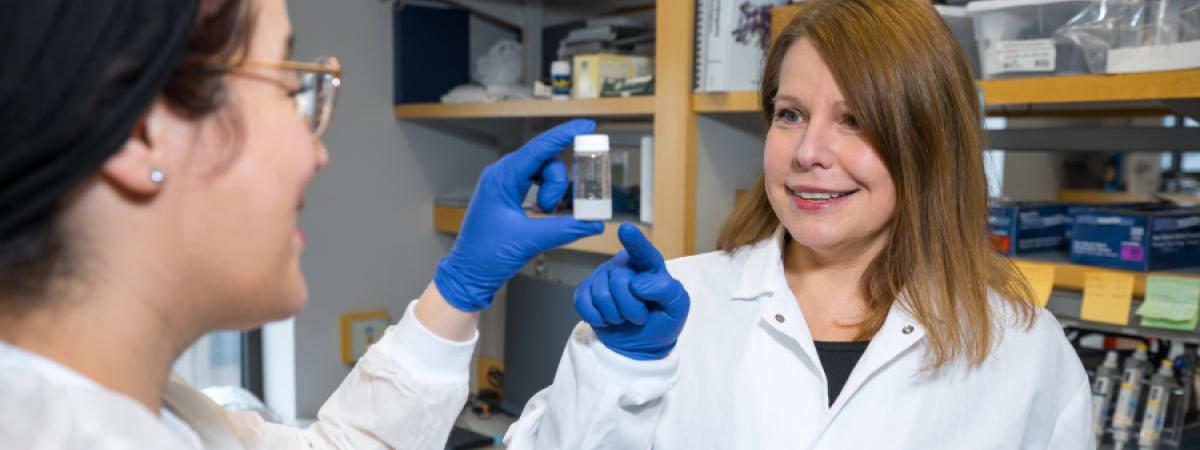
Director of Case Western Reserve University School of Medicine’s Center for Imaging Research and co-leader of Case Comprehensive Cancer Center’s Cancer Imaging Program, Exner was recently awarded a Fulbright Program grant that will take her to Krakow, Poland, from April to June 2026 to conduct research alongside international investigators. While there, Exner will work with partners at Jagiellonian University—where Nicolaus Copernicus studied—in the Department of Biophysics and Cancer Biology to develop new methods for reversing tumor hypoxia, which is a deficiency of oxygen.
Many tumors show resistance to radiation therapy due to a naturally low level of oxygen in the tissue, but a bubble technology developed by Exner and her Case Western Reserve colleagues helps deliver more oxygen to tumors before radiation, making them more susceptible to the treatment.
Exner, who is also a professor of biomedical engineering as well as the Henry Willson Payne Professor and vice chair of basic research in the Department of Radiology, has long been fascinated by how biomedical engineering can build on basic science discoveries to help bring real medical solutions to patients.
“The tools developed by biomedical engineers can have broad impact and potentially help millions of patients worldwide,” she said. “I came to CWRU to study biomedical engineering for this reason, and through various experiences became intrigued by the problem of developing better methods for treating cancer.”
Exner knows the greatest innovators don’t work alone. At the heart of the Fulbright Program is the collaborative aspect that builds bridges between the U.S. and other countries in order to develop groundbreaking medical advancements together.
“Science does not thrive in isolation,” added Exner. “Innovation takes place at the intersections of new fields, which is what makes new collaboration critical to advancing any research. One person, or even one team, cannot be an expert in everything, and thus finding collaborators with complementary yet distinct expertise can make research magic happen.”
Exner is excited to create new connections in Poland—and equally thrilled to apply what she learns to her work at CWRU. She hopes to use Jagiellonian University’s resources to improve the effectiveness of standard cancer therapy and continue that partnership by building student exchange and training programs, further strengthening CWRU’s biomedical engineering and cancer imaging programs.
And maybe she’ll bring back some good recipes too.
“I hope to return home with broadened horizons both scientifically and socially,” she shared. “I am looking forward to new cultural experiences, spending time with my family there, and brushing up on my Polish language and culinary skills.”