Global legal effort takes shape at Ukraine’s border
CWRU School of Law faculty and alumni support Ukrainian prosecutors as they prepare landmark cases over environmental war crimes and ecocide
For more than 70 years, the Kakhovka dam’s reservoir provided water to irrigate southern Ukraine and cool the nearby Zaporizhzhia nuclear power plant. But in June 2023, that dam exploded while under the control of the Russian military, which invaded Ukraine a year prior.
The blast sent deadly floodwaters to surrounding communities via the Dnieper River, and along with it, toxic heavy metals and other pollutants, which settled in the soil before reaching the Black Sea. Two years later, a study provided proof of harmful results, noting it caused a “toxic timebomb” of environmental damage.
Ukraine has documented thousands of similar incidents it considers “environmental crimes of war” for potential international prosecutions—with a particular focus on Russian military commanders. But it’s no small task, and they’ll need help preparing to prosecute these crimes.
Enter: Case Western Reserve University School of Law.
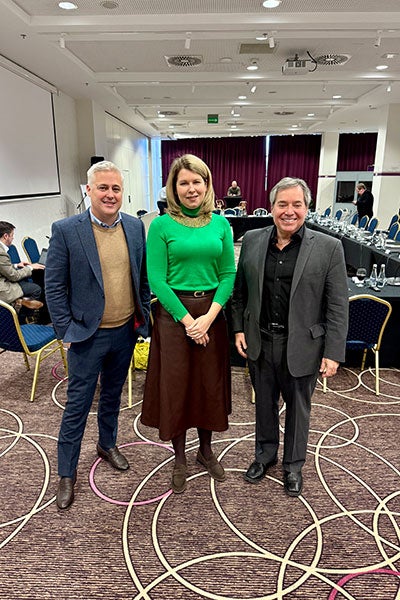
Last month, Associate Dean for Global Legal Studies Michael Scharf traveled to Rzeszow, a Polish town along the Ukrainian border, where he led a group of experts assisting 35 Ukrainian prosecutors and four judges in preparing for upcoming cases charging Russian officials with commission of environmental war crimes and the crime of ecocide.
The five-day training included mock trials and simulations modeled after upcoming cases involving the Karkhova dam explosion as well as the flooding of coal mines, destruction of nature reserves and a drone attack on the Chernobyl reactor containment shield—all considered to be perpetrated by Russian hands.
Scharf, who is also the Joseph C. Hostetler - BakerHostetler Professor of Law at Case Western Reserve and president of the American Branch of the International Law Association, helped design the program in partnership with the London-based International Bar Association (IBA).
Andre Monette (LAW ’06), fellow IBA member, international environmental attorney and partner at Barnes and Thornburg LLP, was among the experts helping Ukrainian prosecutors prepare opening and closing statements, and discussed how to present evidence and respond to likely defense counsel arguments.
Monette, who specializes in legal issues in water supply and quality, credits his education at CWRU School of Law for his ability to help.
"With CWRU's top-ranked international law and environmental law programs, I received an education that provided me the expertise I needed to help the Ukrainians try cases that will set precedents for international law,” he said.
Also sharing the floor with Scharf during the training was Ukraine Supreme Court Justice Ganna Vronska, who, as it turned out, spent time at CWRU School of Law as well as an exchange student in 1994.
“[My time at CWRU] gave me invaluable experience and shaped much of my professional path,” said Vronska, whose research at that time was on the United States Supreme Court. She credits this research for leading her to become who she is today.
“[It was an] unforgettable journey that started with the experience I gained at CWRU,” she said.
The trials in Ukraine are set to begin in the spring, and will be one of the few expected to levy charges against Russia for environmental war crimes. They will be the very first trials ever on ecocide—a newly proposed type of international crime made distinct because it focuses on the environmental harm itself, not just the impact on civilians.
Scharf noted that these trials will be closely watched by jurists and diplomats alike, and emphasized the law school’s contribution to the potentially historic value of these trials.
“CWRU School of Law, which has provided assistance to five international criminal tribunals, is once again playing an important role on the world stage,” he said. “This time we are striving for justice not just for human victims of atrocity, but for nature itself.