How Fred D. Gray’s time at Case Western Reserve helped shape a civil rights legend
“My objective in coming here was to finish law school in three years, return to Alabama, become a lawyer and destroy everything segregated I could find.”
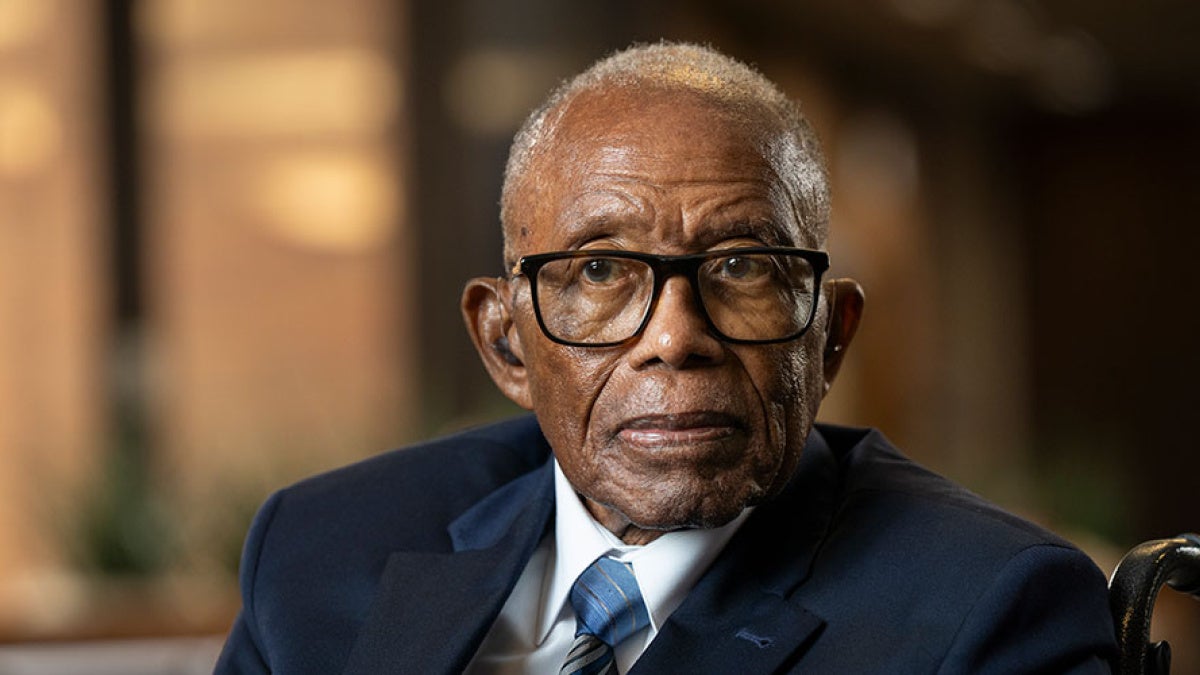
If you think this sounds like the opening line in the next novel by Percival Everett or Colson Whitehead, it would be a good guess, but incorrect nonetheless. Turns out, it was the ironclad mindset of renowned civil rights attorney Fred D. Gray (LAW ’54) when he arrived at Case Western Reserve University School of Law.
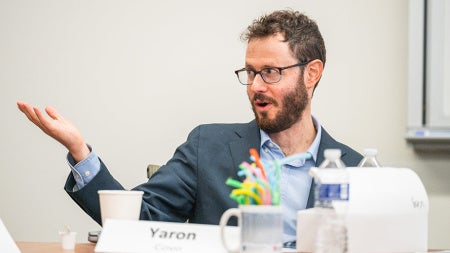
Gray returned to the university last week—exactly 75 years to the day he first set foot on campus—to speak to a packed house in a special conversation with Atiba R. Ellis, the Morris G. Shanker Professor of Law and Associate Dean for Enrichment and Engagement at the School of Law.
It’s a small miracle that Gray even made it to Cleveland in the first place in 1951. As an undergraduate student at Alabama State College, he was encouraged by a faculty member with ties to Cleveland to pursue a legal degree at Case Western Reserve—because it was illegal for him to attend law school in Alabama.
However, there was one more hurdle to clear after arriving on campus—the expenses.
“After I took my first exam, I couldn't even tell what my result was because I hadn't paid all my tuition,” Gray said. “Fortunately, I had already applied for a scholarship from Omega Psi Phi fraternity, and it happened to come in at just the right time.”
With that roadblock in the rearview, it was full steam ahead for Gray.
“Everything about Case [Western Reserve] was special to me,” he said. “It was the first opportunity I had to compete with students attending a major university in the country. And there were 125 students in that class, some of them from many of the major universities throughout the country, here in law school. And here I was—there were seven of us Black students in that class in ’51. But we were able to make it.”
And make it he did. After graduating in 1954, Gray returned to his native Montgomery and began using the law to challenge segregation wherever he found it. He first defended Claudette Colvin after she refused to give up her seat on a bus, and later represented Rosa Parks and Martin Luther King Jr. He also fought for justice in the Tuskegee Syphilis Study class action lawsuit, building a legacy defined by standing up for those denied their rights.
Over a career spanning more than seven decades, Gray won a number of lawsuits—including several before the United States Supreme Court—that helped reshape constitutional and civil rights law. In 2002, he became the first Black president of the Alabama Bar Association, and in 2022, he was presented with the Presidential Medal of Freedom, the highest civilian award in the United States.
Although he turns 96 in December, it was clear to all in attendance at last week’s talk that Gray’s passion has not waned whatsoever.
“Each generation has to consider the problems before it, look at what it can do, and do the best that it can to help solve those problems,” he said. “If we don’t help to solve it, it won’t get solved. The struggle for justice continues.”
This video from the Equal Justice Initiative provides more context on Gray’s role in the Montgomery Bus Boycott.