A legacy of discovery: Supporting transformational research in glial sciences
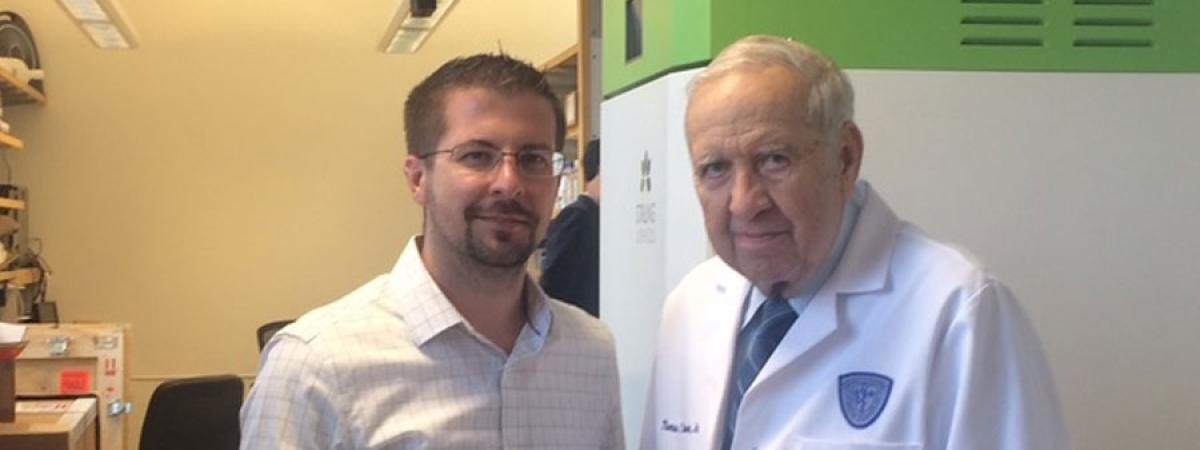
For Tom Peterson—a lifelong inventor whose late wife had multiple sclerosis (MS)—scientific discovery was profoundly personal. This deep passion led him to the lab of Paul Tesar, PhD (CWR ’03), director of the Institute for Glial Sciences, where the inventor and the scientist shared a vision of conquering MS.
Today, that shared vision is powered by a $2.5 million commitment to Case Western Reserve University from the Thomas F. Peterson Jr. Charitable Trust, aimed at accelerating Tesar's pioneering research into neurological diseases.
This gift honors the legacy of Peterson, who died in 2021, and reflects the dedication of his trust manager Bob Lustig (ADL '57, LAW '60). Lustig described Peterson as a "renaissance man" whose passion for discovery extended far beyond conventional pursuits.
"In his basement laboratory—a space that would rival any professional research facility—Tom conducted groundbreaking personal research," Lustig said. "He was one of the very early people to come up with the theory, which he proved through data, that changes in the Earth's magnetic atmosphere affect people with MS."
MS is a debilitating disease in which the immune system attacks the myelin sheath, the protective layer surrounding nerve cells. This damage leads to nerve cell dysfunction and disability, resulting in difficulties with movement, coordination and sensation. Current treatments focus on reducing inflammatory attacks but do not address the loss of myelin or nerve-cell death. Tesar's focus is on repairing the damaged myelin sheath in the central nervous system.
The $2.5 million commitment will bolster Tesar's efforts in identifying new therapeutic strategies to stimulate the brain's own cells to regenerate myelin. The research aims to move beyond treatments that merely slow the disease to those that can actively restore lost function for patients.
"Tom Peterson was a mentor who inspired me to pursue so much uncharted territory in neurological disease research," said Tesar. "I am so grateful for this extraordinary gift that will continue to fuel out-of-the-box discoveries and add to his incredible legacy of scientific innovation."
This most recent commitment continues a history of generosity by Peterson during his lifetime as well as
the Peterson Trust, with more than $15 million donated to projects across the university—including support for numerous research funds at the School of Medicine, a professorship in cancer and energy research, and a biomedical scholars fund to support the school’s PhD and MD/PhD programs.