Making an impact in real time
Meet a 2L earning her online JD while working full-time in voting rights advocacy—where she’s also doing a legal externship.
On April 29, 2026, the U.S. Supreme Court ruled 6–3 in Louisiana v. Callais that Louisiana’s congressional map containing two majority-Black districts was an unconstitutional racial gerrymander. This major ruling made it much harder to use the 1965 Voting Rights Act to challenge unfair voting maps.
In many parts of the U.S.—most notably the southeast—race and political party often align, which politicians frequently use to their advantage. Now, anyone challenging a voting map must prove that the map was drawn based on race, rather than just political strategy.
The decision came as a blow to many voting rights advocates, who argue that this allows politicians to hide behind political excuses to justify maps that end up discriminating against minority voters, thereby weakening federal protections against gerrymandering.
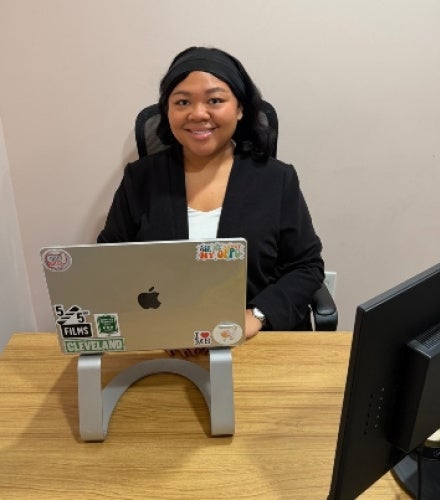
One of those advocates is Case Western Reserve University law student Sydney Jones.
Jones, a 2L in the School of Law’s online JD program, works remotely as the research director for Fair Fight Action, a nonprofit voting rights organization based in Georgia. But starting in June, she took on a new role at her workplace: legal extern.
It was in her capacity as extern that she and her Atlanta-based colleagues immediately got to work analyzing the court’s consequential ruling, researching its short- and long-term implications. The result: a press release and two reports outlining the ruling’s statewide and national impacts.
“We try and figure out what [the ruling] is actually saying, what it means,” said Jones, “and then we provide insights on what we can do as an organization.”
Advocacy work was always in the cards for Jones, who graduated from University of Toledo in 2018 with a Bachelor of Arts in political science. It was there that she began to work as an organizer, building connections in the field and growing her passion for research. Although law school was always the goal for her, upon graduation, she got an offer she couldn’t refuse: a congressional internship on Capitol Hill.
Once she moved to Washington, D.C., she quickly advanced from intern to staff assistant to legislative correspondent—a job she loved—before moving on to work for Kamala Harris’ presidential campaign and the Democratic National Committee. Research was the continuous thread that connected each step of her journey, which finally landed her as research director at Fair Fight Action in 2024, where she oversees a three-person team, monitors media and voting legislation, vets candidates and conducts legislation analysis.
By then, Jones still had hopes of going to law school, but putting her momentum-filled career on pause for three years to go to law school? She wasn’t so sure.
Enter: the online JD program at CWRU School of Law.
“I saw that CWRU had a program that would allow me to work full-time but still get my JD. There was no in-person requirement. That was really appealing to me, and gave me the confidence to know I would be able to do it without it interfering with work,” she recalled. “I think, otherwise, I just wouldn't have gone to law school.”
Putting newfound knowledge to work
The flexibility of the online JD allows Jones to maintain her full-time position—including traveling to Fair Fight’s Atlanta home offices every six weeks and taking exams from hotel rooms—while layering in her externship for course credit. And while she’s always loved her work at Fair Fight Action, Jones feels that the externship has deepened that affinity, showing her exactly how a JD can help expand her work on voting rights.
“I feel like I'm having more of an impact,” Jones explained. “The Supreme Court decision [on Callais] came down, and now all these states are trying to do redistricting,” she explained, “In Georgia, we put on a pressure campaign and they decided not to include redistricting in their special session. So, being able to see those tangible results of my work—I actually feel like I'm making a difference.”
Jones is applying her 1L coursework on the job—particularly “Legislation and Regulation,” which gave her a formal framework to evaluate legislative intent, plain meaning and administrative implications when tracking bills in state legislatures. For the Calais decision, Jones applied what she learned about judicial analysis, recognizing when Supreme Court opinions align with—or diverge from—established jurisprudential methods.
“Having that background legal knowledge from that class—the way they can change how they interpret the laws based on their own political goals,” Jones said, “That was really eye-opening for me, to view it in that way.”
Ultimately, she plans to continue working in voting rights and election law for the long-term. In the near term, Jones wants to explore another experience to grow her practical expertise, perhaps at a D.C.-based election law firm to gain private-firm legal experience. And even though her Fair Fight Action externship officially ended the first week of August, the work continues.
“I think because of all the work that I've been able to do on [the Callais decision], we're just going to kind of integrate this work back into my full-time workflow,” she explained, “which is really exciting for me, because that just gives me more legal experience. And I'm very excited about that.”