Meet a PhD student selected for a national Science, Mathematics, and Research for Transformation Scholarship
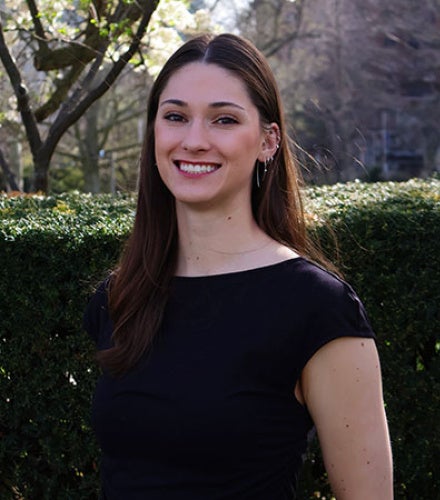
Jenna Jaklich is nearly three years away from completing her PhD program in materials science and engineering at Case Western Reserve University, but she already has a post-grad job lined up. Thanks to a Science, Mathematics, and Research for Transformation (SMART) Scholarship, she will take a role as a staff scientist at the U.S. Naval Research Laboratory upon completion of her degree.
The opportunity is perfectly attuned to Jaklich’s interests and prior research experience.
Jaklich earned her bachelor’s degree from CWRU in 2024. After initially beginning her graduate degree at another institution, Jaklich was drawn back to CWRU to work with Matthew Willard, PhD, professor in the Department of Materials Science and Engineering at Case School of Engineering.
While an undergraduate student at CWRU, Jaklich worked in Willard’s lab, which gave her early access to and experience with nationally funded research and publications.
In Willard’s lab, Jaklich—then a first-year undergraduate—worked alongside a PhD student on Lawrence Livermore National Laboratory-funded research on optimizing magnetostriction in a variety of compositions.
Now, as a PhD student, Jaklich continues to work on magnetostriction with a focus on exploring a super magnetic phase in a FeCoMn series of alloys. Such research could have a wide range of potential applications that touch many aspects of daily life, including in clean energy initiatives, robotics and medical devices, such as hearing aids.
In addition to Jaklich’s research in Willard’s lab, she completed two internships with Lawrence Livermore National Laboratory and spent two summers conducting research at the U.S. Naval Research Laboratory.
“I love that national labs allow you to pursue research that interests you; I like the idea of being able to continue to expand my field based on my interests and do fundamental research rather than just trying to create a material to meet one goal set by a company,” she said.
In addition to post-graduate employment, Jaklich will receive a stipend and full tuition coverage as a SMART Scholarship recipient.
Learn more about Jaklich’s research.
Answers have been lightly edited for clarity and length.
1. What drew you to CWRU?
I was initially drawn to CWRU for undergrad because of its overall excellence; the materials science department was nationally ranked, and if I had decided to switch majors, I was still going to be at one of the best schools in the nation.
2. Why did you decide to study materials science and engineering?
I chose materials science due to its wide areas of application. I could work in any engineering field without having to commit to just one. With a degree in materials science, I could work on aerospace vehicles, bridges, medical devices, implants, etc., but didn’t have to focus on just mechanical/civil/biomedical fields. So far, my research has encompassed sensors, hypersonic vehicles and jet turbine engines.
3. Can you describe your research interests?
My research interests encompass both nanocrystalline soft magnetic materials and ultra-high temperature materials/materials for extreme environments.
4. Can you describe the basis of your research when you were at the Lawrence Livermore National Lab ((LLNL) and the U.S. Naval Research Laboratory?
At LLNL, I was working on nanocrystalline soft magnets for sensor applications. Specifically, I was optimizing magnetostriction while maintaining a low coercivity and high magnetization.
At the Naval Research Lab, I was in the space-craft division and focused on ultra-high temperature ceramics for hypersonic applications.
5. Why did you apply for the SMART Scholarship and what will it allow you to do?
I applied to SMART because it offers a unique path of stability and mentorship that is rare in early-career science. I’m looking to develop a long-term research career within the DoD, and SMART provides the perfect framework to do that—I get to contribute to the mission during my PhD through my internships, build a collaborative relationship with my sponsoring facility, and hit the ground running as a civilian scientist the moment I graduate.
6. What interests you in working with naval research?
I will be in the spacecraft division working on hypersonic/Mach 10 vehicles, and their current projects will allow me to be a part of cutting edge research.
7. Are you involved on campus in any other ways?
Alongside research, I’ve continued my softball career by being a volunteer assistant coach for the CWRU varsity softball team. As a pitching coach, I was a part of their 2026 season, going undefeated to win the Swarthmore Regional in just three games before ultimately falling to the 48-0 Virginia Wesleyan Marlins in their Super Regional. Having the opportunity to coach gives me an outlet to compete, and I find so much fulfillment in being able to support the girls both on and off the field.