Meet six undergraduate students presenting their research at Intersections today
Case Western Reserve University undergraduate students make meaningful contributions in research and creative endeavors across campus. Supported by mentors, the experience they gain is both practical and driven by passion. While they build skills for their future studies and careers, they also take what they observe and ask questions of their own—pushing research in new directions.
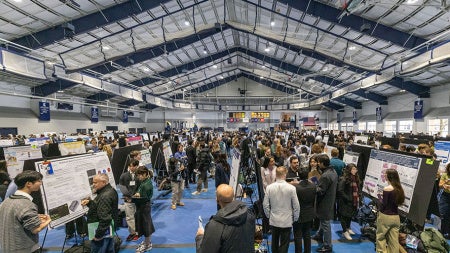
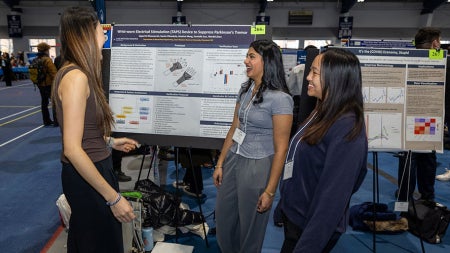
Many undergraduate researchers will present their discoveries today (Dec. 5) at Intersections, a symposium that gives faculty, staff, students and members of the broader community an opportunity to see the breadth of work completed by undergraduates at CWRU. The Undergraduate Research Office hosts Intersections three times a year: at the end of the fall, spring and summer terms.
Today’s poster session will be held from 11:30 a.m. to 2 p.m. in the Veale Convocation, Recreation and Athletic Center. Students will share their work in the arts, humanities, engineering, life sciences, physical sciences and social sciences.
We spoke with six of today’s presenters to give you a preview of the event. View the presenter list and learn more about the event.
Answers have been edited for clarity and length.
Lindsey Ahn
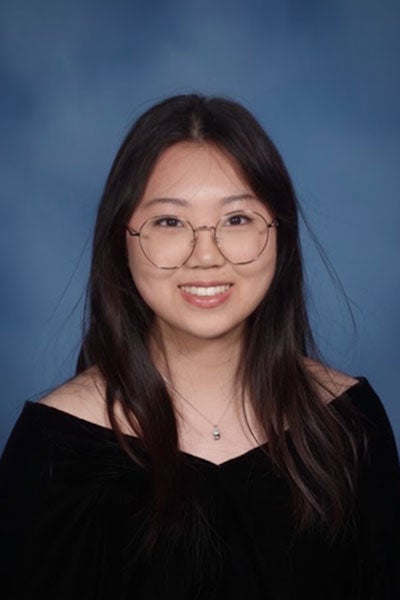
Third-year student majoring in chemical biology working with faculty mentor Matthew Bertin, PhD
1. Tell us about the project you’ll be presenting.
My project focuses on developing a deployable material to mitigate the proliferation of cyanobacterial harmful algal blooms (cyanoHABs) and detoxify their associated toxins. Some cyanobacteria produce Microcystin-LR (MC-LR), a prevalent class of hepatotoxic cyanotoxins that have increasingly become a public health concern as highlighted by the 2014 Toledo Water Crisis.
Inspired by Dr. Douglas T. Genna's work at Youngstown University where he engineered a metal-organic framework (MOF) that successfully remediated oil spills, I am designing a MOF that can be conjugated to a thiol probe to functionalize Microcystin-Leu-LR, a congener of MC-LR through Michael addition, with the goal of significantly reducing its toxicity.
2. What did you enjoy most about working on this project? What kind of work went into it?
I enjoyed the problem solving involved in optimizing my experiments and seeing how small changes in reaction conditions and kinetics could drastically impact my results. For instance, whether I was able to achieve successful and reproducible thiol probe conjugation ultimately came down to something as simple as my solvent choice.
I also valued working closely with my PI, Dr. Matthew Bertin, as he guided me through the thought processes behind identifying specific signals confirming thiol attachment via LC-MS, and taught me how to use and troubleshoot mass spectrometry and HPLC instruments.
3. Why do you believe students should get involved with Intersections?
I think presenting at Intersections is a nice way to strengthen communication skills and become more comfortable with sharing your work in front of an audience. The interdisciplinary nature gives you the chance to practice explaining your research to people who aren't experts in your field, which is an important skill in any research career. Intersections also takes place in a familiar environment, where students are able to receive feedback and build their confidence for future conferences.
Madeline Ang
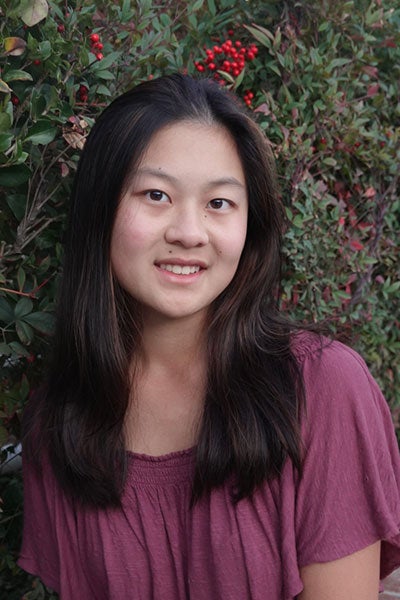
Second-year student majoring in neuroscience working with faculty mentor Jessica Fox, PhD
1. Tell us about the project you’ll be presenting.
Proprioception, the ability to balance and navigate the environment, is important for all living animals. In true flies, mechanosensory structures called halteres provide this sense of spatial orientation both in and out of flight. This project investigates the haltere’s role in stability during non-flight behaviors.
Our findings demonstrate direct communication between the halteres and legs: haltere activity is driven by sensory input from the legs, and subsequently provides information necessary to stabilize the legs and body. While multisensory integration is usually thought to happen in the brain, this pathway is an example of sensors directly influencing each other’s activity.
2. What did you enjoy most about working on this project? What kind of work went into it?
This project allowed me to constantly ask questions and test new hypotheses. I enjoyed exploring various analysis methods and using the skills learned in courses such as programming to design, execute and analyze experiments. This intellectual freedom led to a large and analytically challenging dataset, but it taught me how to ask the right questions to analyze and present a coherent story.
3. Have you presented before?
This will be my first time presenting at a symposium. I am looking forward to discussing my work with professors and peers, as well as learning about the cross-disciplinary research being carried out.
4. Why do you believe students should get involved with Intersections?
Intersections makes it easy for students to explore a wide range of research fields, to practice articulating their work to a broad audience, and to receive feedback from the academic community. There is an impressive array of research happening at and around CWRU, across a multitude of disciplines, and seeing it all brought together is incredible.
Christopher Batarseh
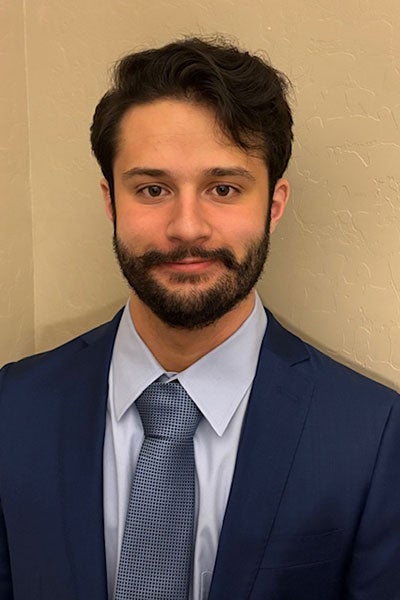
Fourth-year student majoring in political science and sociology working with faculty mentor Kathryn Lavelle, PhD
1. Tell us about the project you’ll be presenting.
I am looking at how trade interdependence affects state behavior. In other words: How does trade between two nation states, commonly referred to as "countries" affect relations between them and its ability to promote peaceful relations between countries?
This topic was chosen because it challenges long-held assumptions in international relations, especially the idea that globalization and trade naturally deter war at a time when inter-state conflicts are once again increasing worldwide. For reference, in recent years inter-state conflict (conflict between two countries) has risen to levels not seen since the height of the Cold War.
After the project, three main findings were uncovered. Mainly that trade-interdependence in inter-state relations results either in conflict, peace or a middle-ground of a mix of hostile and peaceful relations. Additionally, pre-existing conflicts, power balances, and public opinion usually outweigh trade interdependence in nation state relations. Secondly, when trade interdependence majorly affects relations between nation states it results in peaceful and cooperative relations. Moreover, trade interdependence is a moderately powerful force in inter-state relations. Lastly, the conditions to cause trade-interdependence to create peaceful nations between nation states requires that there must be no pre-existing disputes between nations, supportive public opinion, and power asymmetry with a powerful mediator (essentially a balance/parity in power between two nations with a powerful mediator helping foster negotiations).
2. What did you enjoy most about working on this project? What kind of work went into it?
First and foremost, my project mainly involved analyzing existing case studies, government reports, interviews, policy articles and academic literature, namely around relations between Russia and Turkey, Russia and Ukraine, Russia and the EU, Vietnam and China, and Israel and the Gulf nations, and the European Union.
There were perhaps two aspects of the project I enjoyed the most. First and foremost, I was able to bring together a wide range of case studies into one coherent and well-organized project. Completing the final product was especially rewarding, as it showcased the hard work I put into it. Lastly, was the project's intersection with my past experience, mainly in international trade. Giving background, mainly through internships with the U.S. Department of the Treasury and Las Vegas Sands (a multinational casino company), in the past I gained extensive experience in the policy and legal side of international trade.
Additionally, through my presidency in Project Ukraine, an on-campus charity dedicated to Ukrainians in Ukraine and Ukrainian refugees, I also dealt with trade or supply chain law to send medical supplies and in general donations to Ukrainian civilians within Ukraine. It was nice to see how my past experience helped me throughout the project, something I did not expect when beginning the project.
3. Have you presented before?
No! This is be my first time presenting at intersections. I have presented before in other research-oriented conferences such as the Ethical, Legal, and Societal Implications (ELSI) Think Tank Convention.
4. Why do you believe students should get involved with Intersections?
I believe one of the most important traits of a successful student is the willingness to place oneself in daunting or unfamiliar situations. Although presenting at Intersections can seem difficult or nerve-wracking, engaging in these experiences allows students to grow academically and personally.
Lena McMillin
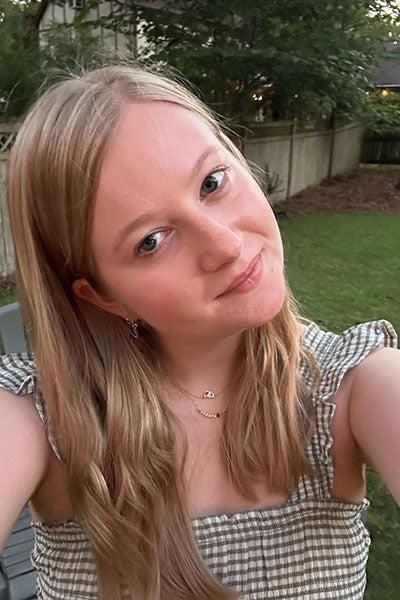
Third-year student majoring in political science working with faculty mentor Kelly McMann, PhD
1. Tell us about the project you’ll be presenting.
My project was a team effort with my mentor, Dr. Kelly McMann, and fellow research assistants including, AJ Curcio and Jared Neely, who are also presenting at Intersections. We looked into if COVID social policies (such as assembly restrictions) were used as a form of opposition control in hybrid regimes.
Social policy is often used as a covert form of control in electoral democracies, which lack repression mechanisms but face some accountability from the public, because it allows them to shore up the regime under the guise of providing a public good. After comparing COVID policies to a country’s level of democracy, we found that electoral democracies were more likely to use strict movement and assembly restrictions than other regime types, even as other policies were used roughly evenly across regime types.
2. What did you enjoy most about working on this project? What kind of work went into it?
One thing that I enjoyed about this project was the opportunity to improve many vital research skills. My academic writing skills have improved a lot and I learned how to use data analysis software like Stata, which we used to find correlations between regime type and policy stringency, both of which have been very useful for other classes. And I’ve learned a lot just working with my professor and the other research assistants.
3. Have you presented before?
This is my first time ever presenting research in college! So I’m both excited and a little nervous.
4. Why do you believe students should get involved with Intersections?
Presenting at Intersections is a great way to develop essential skills for research. It’s also a good opportunity to push yourself outside of your comfort zone (especially if, like me, you are less than enthused about public speaking) while still being supported, by both your mentor and the Undergraduate Research Office.
Gigi Sengupta
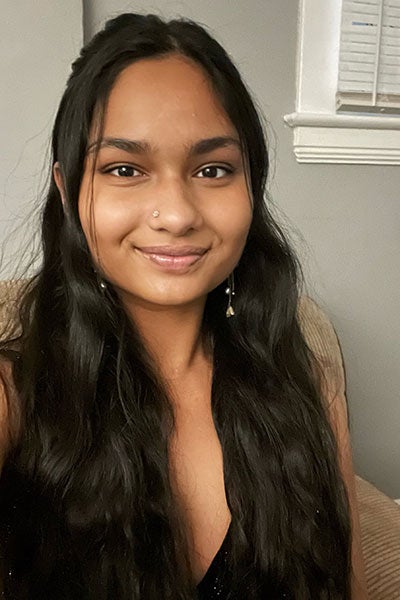
Fourth-year student majoring in the history and philosophy of science, and political science working with faculty mentor Monica L. Gerrek, PhD
1. Tell us about the project you’ll be presenting.
My research, "A Narrative Approach to Establishing Methods of Engaging the Next Generation of Correctional Physicians" uses semi-structured interviews conducted with 15 pre-medical and medical students to disentangle their interests, thoughts, and concerns regarding correctional healthcare. I used a hybrid humanistic and social scientific approach, presenting brief structured data on responses, but focusing my analysis on close reading individual student responses to better understand the roles of rhetoric, morals, values, and language in their narratives. My project aims to understand the perspectives, emotions, and misconceptions of future physicians as they relate to prison medicine, to hopefully inspire more interest in the field through transparent, informative, and narrative-based avenues.
2. What did you enjoy most about working on this project? What kind of work went into it?
My favorite part was working on mixed-methods research that allowed me to engage with people directly and explore my love for correctional healthcare. I'm very passionate about all things prison medicine, as a student member of the American College of Correctional Physicians, and as the co-leader of SoteriCare, a campus student organization that partners with women's prisons in Ohio to provide health and wellness support. But this was my first opportunity to do research on these issues, and my first time working with human subjects. Getting to work with people and understand more about their experiences and views was definitely my favorite part!
3. Have you presented before?
I have not presented at Intersections before, although I have prior conference presentation experience. This is my first time presenting at CWRU, and I'm very excited.
4. Why do you believe students should get involved with Intersections?
I believe students should get involved with Intersections because it is a great opportunity to share research progress, receive meaningful presentation feedback, engage in learning from your peers, and celebrate the diversity of research that occurs at CWRU. Involvement definitely goes beyond just presenting as well; I attended my first Intersections last fall and, although I wasn't a presenter, I loved learning about all the work students are doing around campus.
Emory Trout
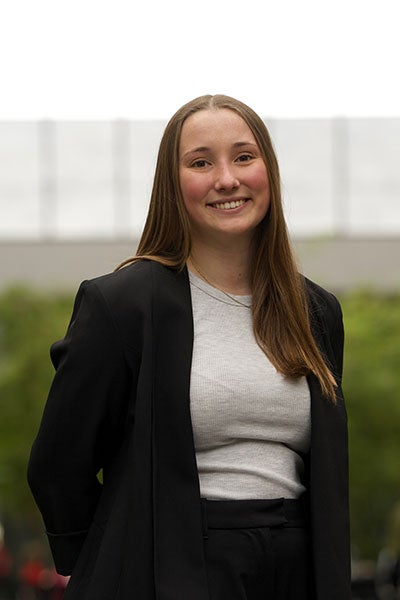
Fourth-year student majoring in neuroscience working with faculty mentor Deirdre Scully, PhD
1. Tell us about the project you’ll be presenting.
My research investigates oxytocin receptor expression in human membranes during labor. Oxytocin is widely accepted as a mechanism to promote labor, and because of this, it is administered for medically induced labor. Despite the widespread use, the interaction between fetal-maternal membranes and oxytocin remains to be fully understood. The project aims at uncovering the dynamics of the oxytocin receptor within the fetal and maternal membranes in order to optimize administration for labor induction.
2. What did you enjoy most about working on this project? What kind of work went into it?
I enjoyed the clinical relevance of this project. Despite its widespread administration, Pitocin demonstrates limited efficacy and often leads to emergency Caesarean sections. This potential impact of our research provides perspective and encourages me to continue to pursue the project. Experiments including immunohistochemistry, immunofluorescence, and RT-qPCR were performed on both human tissues and an immortalized decidual cell line. I also had the opportunity to apply the skills I obtained from BIOL 321 this semester to write a MATLAB program to quantify my results.
3. Have you presented before?
This will be my first time presenting. I have attended Intersections before and am excited to share my work.
4. Why do you believe students should get involved with Intersections?
Intersections provides a great opportunity for students to gain experience presenting their research while learning about their peer’s projects. Intersections allows for students to celebrate the work of others, and it is beneficial to students who are interested in the research opportunities available at CWRU.