New pilot program sends CWRU engineering students to Argonne National Laboratory
A new fellowship places undergraduates alongside leading researchers at one of the nation's premier laboratories.
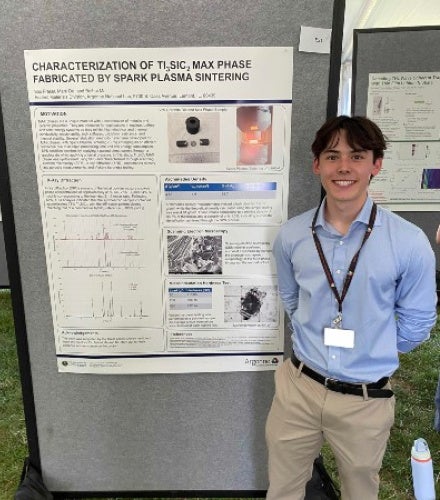
When Sho Fraser, pictured above, arrived at Argonne National Laboratory (ANL) in June, the first assignment wasn’t running an experiment. It was designing one from scratch.
Fraser was one of two Case Western Reserve University Case School of Engineering students selected for a new pilot program that places undergraduates alongside researchers at one of the nation’s premier national laboratories. Created by the Great Lakes Energy Institute (GLEI) and the Case School of Engineering, the initiative works with Argonne’s Institutional Partnerships team to match students with principal investigators.
“For the first two weeks of my internship, I was only at my computer compiling related literature to form a project that I could complete in eight weeks,” Fraser said. “Every three or four days, I would make a presentation with the review that I had done and propose a potential project. I would then get feedback and directions that I should move in to refine my proposal.”
As the Walt and Sylvia Culver Distinguished Fellow in Argonne’s Applied Materials Division, Fraser characterized MAX phase materials—which combine metallic and ceramic properties—fabricated through spark plasma sintering (SPS), an energy-efficient process. The goal was to see whether SPS could match the results of more power-intensive methods like hot pressing.
“They are attractive for applications in nuclear, battery, and solar energy systems as they exhibit high electrical and thermal conductivity, machinability, high stiffness, oxidation resistance, and thermal stability,” Fraser explained.
Fraser also joined a side project with ANL materials engineer Mark Du, PhD, using the same SPS machine to produce tungsten boride (WB) disks and adjusting temperature and pressure to optimize their density.
“One moment where I contributed the most was when I independently characterized the WB samples using X-ray diffraction (XRD),” Fraser explained. “Having previously been trained on XRD, I was able to immediately gather data for Mark.”
The biggest adjustment, Fraser said, was the emphasis on safety and security; it was something unlike any previous lab experience.
“Working in a high-impact research environment, it was extremely important that everything was done in a safe manner
and that all findings were protected for national security reasons,” Fraser said. “I soon grew to appreciate this as it showed me how valued each researcher was at ANL as well as how important the research being conducted was.”
A second fellow, a different challenge
Fellow engineering student Gray Thomas, the Peter Ranney Distinguished Fellow, worked with ANL postdoctoral researcher Reggie Gomes, PhD, on electrochemically generating hydrogen peroxide using potassium carbonate electrolytes. The research aims to standardize how hydrogen peroxide is measured using UV-Vis spectroscopy and hydrodynamic voltammetry.
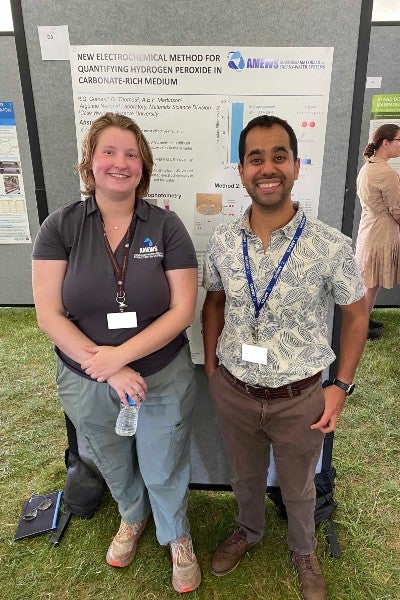
For now, the pilot runs on GLEI discretionary gift accounts. Continuing the program next summer and beyond will depend on finding sustainable funding so more Case School of Engineering students can gain the kind of national lab experience Fraser and Thomas did.
That effort comes as the university deepens its ties with the lab. On Nov. 13, Case Western Reserve and Argonne signed a five-year agreement to expand their collaboration, including through student exchanges, joint faculty appointments and new research programs in eight areas—among them electrochemistry and critical minerals and materials, fields that align closely with the projects Fraser and Thomas tackled this summer.
Back on campus, Fraser is applying characterization techniques such as scanning electron microscopy and XRD to electrochemistry research in the Akolkar EMF Laboratory—and encourages other undergraduates to follow a similar path.
“If you want to be exposed to projects and learn skills that are highly technical and never done before, I recommend this experience,” Fraser said. “I would also tell them to network as much as possible and tour different labs, even in other departments.”