Promotion represents Case Western Reserve’s commitment to further elevate university’s role in driving regional economic development
To further elevate Case Western Reserve University’s role as an engaged and leading driver of regional economic growth and innovation, the university today announced the promotion of Michael Oakes to executive vice president for research and economic development, effective Jan. 1.
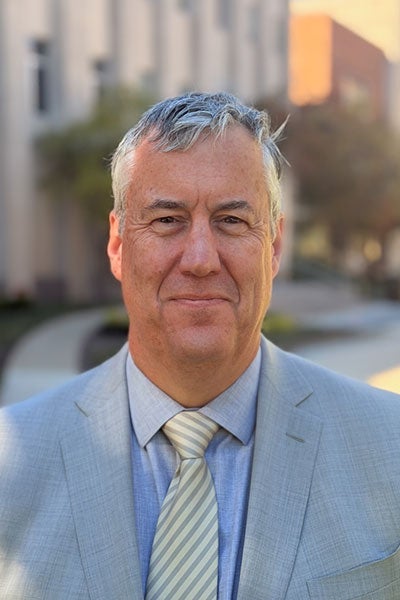
Oakes, who joined Case Western Reserve in July 2022 as the inaugural senior vice president for research and technology, provided insight into what the university envisions for this new, expanded position—including cross-sector partnerships, innovation and impact.
How would you define the university’s role in driving regional economic development?
The role is vital and multifaceted. A university drives regional economic development by developing human capital: attracting, educating and retaining talent. Research in health, technology and the humanities yields patents, startups, clinical trials and productive partnerships. Community engagement elevates openness, culture and learning. These efforts create spillovers as ideas, people and capital move across disciplines and into the broader economy. Startups seed supplier networks and attract follow-on investment. Shared labs and incubators lower costs and speed solutions. Universities convene business, government, nonprofits and communities to identify and solve common problems. As an anchor institution, we hire locally, buy from regional suppliers, invest in neighborhoods and attract federal and philanthropic funding. Together, these roles make a university an innovation engine and a company magnet for regional growth and prosperity. At CWRU, our trustees’ desire for greater research impact and President (Eric W.) Kaler’s creation of the executive vice president for research and economic development role signal our commitment to organize and deliver this work.
How has that changed since you’ve been here?
The mission hasn’t changed; our understanding and execution have. In the past few years, we’ve been able to better appreciate the regional ecosystem—its leaders, assets and opportunities—and have a sharper view of CWRU’s strengths and the people who power them, plus a deeper sense of Northeast Ohio’s history, challenges and potential.
The context has shifted: reputations, inflation, tighter capital, industry realignment, politics and the rise of AI demand faster evolution. Universities must be more agile and demonstrate greater impact—integrating AI across fields and offices, moving from proposal to pilot to scale faster, and aligning with federal priorities to win major mission-driven awards from NSF Engines, ARPA-H, and DARPA. These awards require deep partnerships, strong leadership, workforce outcomes and clear economic or national security benefit. The university relies on productive relationships with elected officials, industry and hospital leaders, higher-ed peers and community partners. Those ties, combined with a more agile stance, enable shared priorities, faster coordination and win-win collaborations. In sum, the vision is steady, but the terrain has changed. So must our playbook.
How is our success toward that goal measured—and how have we done, in your eyes?
The metric is positive impact, but it’s notoriously hard to quantify. We rely on imperfect proxies such as sponsored research dollars, peer-reviewed publications, student success and on-time delivery of major commitments. Just as important, and hardest to track, are the relationships and daily practices that underpin co-creation. How do we measure creative faculty who push for more impact even if it means fewer publications, research administrators who navigate complexity, facilities teams devoted to craftsmanship, or physician-scientists who relentlessly seek elusive cures? CWRU has clearly improved on the proxy measures, and we’re weathering disruptions better than most research universities. Partnerships are stronger, execution is steadier, leaders are emerging and the path from ideas to outcomes is clearer. I think our community has a better grasp of CWRU’s role in society. Our culture is shifting in that direction—more collaborative, outward-facing and accountable, with faster cycles from concept to pilot to impact. Of course, there’s still much to do. In a highly dynamic environment, we can’t be too agile.
When you arrived at CWRU in summer 2022, you saw the position as “an opportunity to do something great. I want to be solving problems and breaking [disciplinary] boundaries.” What are you most proud of having done/are doing to accomplish that?
I’m proudest of the people I work with and the relationships we’ve built. We’re building a culture where data matters, trade-offs are acknowledged and candid disagreements are productive—so we make better decisions and move faster on hard problems. I’m energized by the Interdisciplinary Science and Engineering Building (ISEB): its problem-first, cross-sector model aligns talent and infrastructure with regional needs and accelerates the path from idea to impact. Our new start-up business incubator, across the street from ISEB, offers remarkable support to translate discovery into impact. We’ve also strengthened the Office of Research and Technology Management. We’re better organized, more responsive, more compliant, increasingly automated and service focused. This helps faculty compete and deliver in a tough funding and regulatory environment. We’re learning how to win larger, problem-focused, multisector research awards and to partner more effectively with industry. Our new Corporate Engagement Center is so helpful. There’s much more to do, but I’m proud of the progress we’ve made in just a few years. Change isn’t easy.
What are the biggest opportunities yet to come?
Our best opportunities are deeper, mission‑driven collaboration with hospitals, industry and national labs. We can build consortia that move discovery to deployment and fit evolving federal priorities. It won’t fully change, but research funding is shifting away from hypothesis‑driven, single‑PI grants. It is moving toward use‑inspired programs that value scale, speed and cross‑sector execution. To meet this shift, we need more university‑industry fluidity. That means joint appointments, shared labs and testbeds, faster agreements with clear IP and co‑investment to speed translation. Well over half of STEM PhDs students seek industry jobs, so training should reflect that. If we make these changes, we can win transformational awards, cut time to impact and grow our role as a regional engine of innovation and problem-solving powerhouse.
Biggest challenges to reaching the goals you’ve set for the university’s research enterprise?
The hardest challenge is anticipating what’s next and positioning CWRU today to strengthen our value proposition and sustain a vibrant scholarly community tomorrow. The biggest obstacle is cultural inertia. Universities aren’t built for speed or agility. Silos, risk aversion, distributed governance, contracting and compliance delays, individual-focused incentives and gaps in AI-ready infrastructure all slow innovation and adaptation. Sure, budgets are tight. But it’s near-impossible to sunset less relevant activities. Ironically, internal experiments are rare to non-existent, and risk-takers aren’t lifted up if outcomes fall short. Meanwhile, federal priorities are shifting, talent competition is rising and geopolitics are more complex. I keep CWRU 2050 in view to help President Kaler and Provost (Joy) Ward position our successors for success.
The NSF Engines project is an exciting, potentially unprecedented opportunity—not only for CWRU, Northeast Ohio and statewide, but for the Midwest as a whole. Not to jinx it—because nothing is done until it’s done—but how would you describe what that could mean, both long- and short-term?
CWRU is leading NEO‑SMART, an ambitious consortium of Northeast Ohio industrial, educational, governmental and philanthropic partners. Our goal is to make the region the national leader in advanced materials and manufacturing. We are one of 15 national finalists for the NSF Engines award, which aims to spark cross‑sector partnerships that grow regional prosperity, sustain U.S. tech leadership and support national security. In the short term, a win would bring major resources, speed experiments and pilot scaled manufacturing, expand workforce programs and deepen partnerships across the region, the state and the Midwest. For CWRU, a win would boost engineering and materials science through more industry projects, stronger recruiting and more internships and research placements. It might also accelerate advances in biomedical materials by linking lab advances to clinical validation and device commercialization. In the long term, a win would mean all the benefits of a vibrant innovation cluster. That means more co‑investment, more startups and a self‑sustaining ecosystem that lifts the region and raises CWRU’s leadership in engineering and biomedical materials. Whatever the outcome, the partnerships we have built over three years will keep creating lasting impact. I don’t worry about jinxes. As someone who spent most of his life in hockey country, I am laser focused on supporting the team and putting the puck in the net.
High-profile promotions are personal and public acknowledgements of a job well done. What does this promotion represent to you?
Don’t make me tear up! I’m grateful that our Trustees want more impact, and that President Kaler has a creative vision for this role. The promotion is an honor and a responsibility. It recognizes progress and raises expectations. I don’t take the President’s confidence in me for granted. I work to earn it every day. Importantly, my core leadership values won’t change: mission, integrity, data, partnership and kindness. The title and expanded portfolio equip me to help CWRU thrive today and long into the future. This promotion lets me skate to where the puck will be.