Take a look inside CWRU President Eric W. Kaler’s office
Scenes and stories from the president’s office
At first glance, President Eric W. Kaler’s office, located on the second floor of Adelbert Hall, embodies what one would expect from a university president: framed diplomas, a bevy of crystal awards and a boardroom table.
But a closer look reveals insights into Kaler’s sense of humor, sports fandoms and even his favorite musical artist. Kaler, the Morton L. Mandel Presidential Chair, recently gave CWRU Magazine a tour of his office—from the walls and shelves down to the floor—and shared what he hopes people feel when they leave. “Hope and satisfaction,” he said. “Happiness would be a plus.”

“Probably this chair. This is where I sit when I meet with people, and we problem solve together.”
“They’d see a lot of personal photographs, so they’d learn about my wife [Karen F. Kaler], sons [Charlie and Sam], and grandchildren,” he said. And, of course, his Newfoundland/poodle Lulu, including a photographic progression of her growth measured against the C-W-R-U letters that sit outside his office window. “She’s an adorable, wonderful dog,” he said.

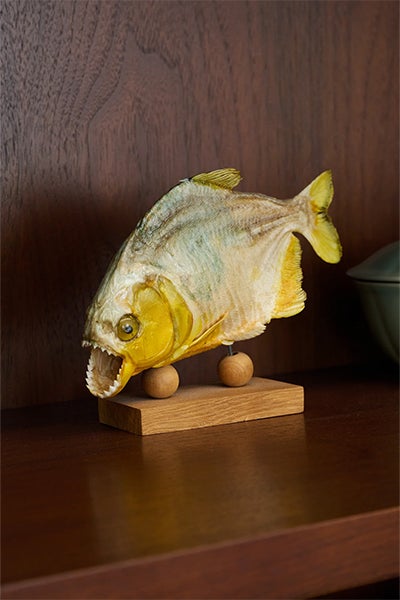
On a trip to Brazil, Kaler bought two piranhas—one painting and one figurine—to remind him of the competitiveness and “sanctity of the peer-review process” in research.
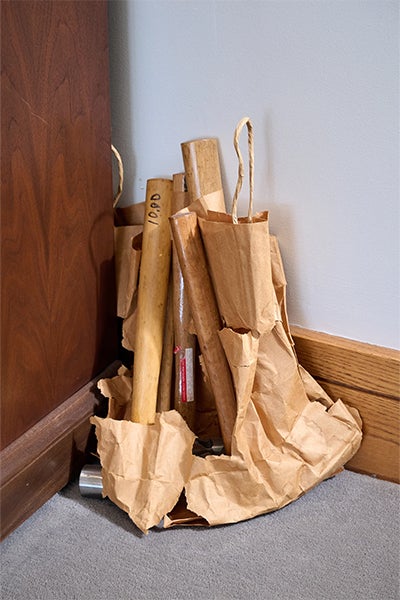
Below the piranha painting sits a deteriorating brown paper bag filled with hammers, a gift from a former colleague at University of Delaware (UD) who had long said anyone who chose to go into administrative jobs in academia was “dumber than a sack of hammers.” When Kaler first became a UD dean in 2000, the colleague hand-delivered him the sack, which Kaler has kept near as his career took him from UD to Stony Brook University to University of Minnesota (UofM) and, now, CWRU.
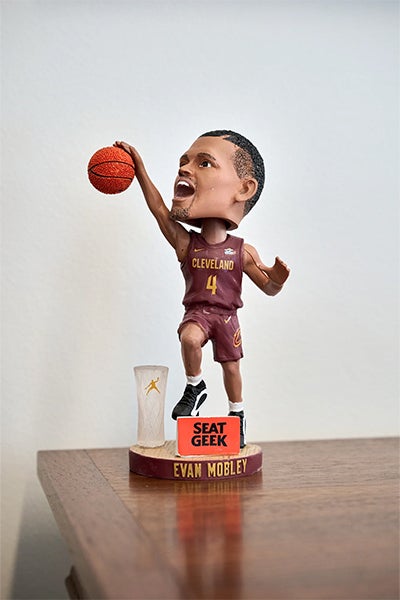
Sports memorabilia can be found in most corners of Kaler’s office, from a bobblehead of Cleveland Cavaliers’ center Evan Mobley to an autographed CWRU Women’s Soccer schedule to an iconic late 1920s photo above his desk of New York Yankees’ center fielder Earle Combs singling in a game against the Philadelphia Athletics. Baseball, Kaler said, is his favorite sport—with the Guardians his (current) favorite team. “I have moved around in my life and career, so it’s kind of like produce: You like the local variety best.”
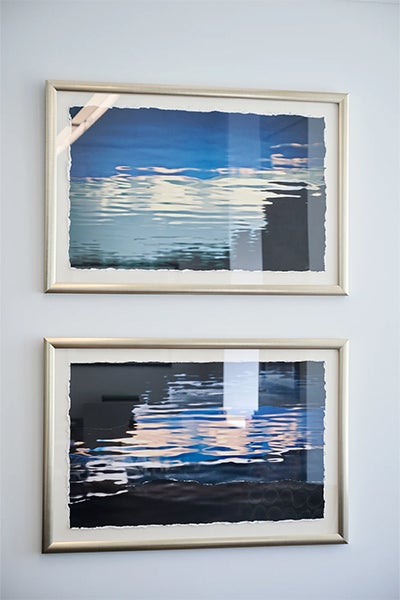
The artwork directly across from his desk was made by artist and close friend Lynn Spinnato. “She took photographs of a variety of bodies of water,” Kaler said. “But then if you look closely they’re torn in bits and reproduced back together to give kind of a kaleidoscope feeling. It brings the memory of a good friend and a little bit of color to the room.”
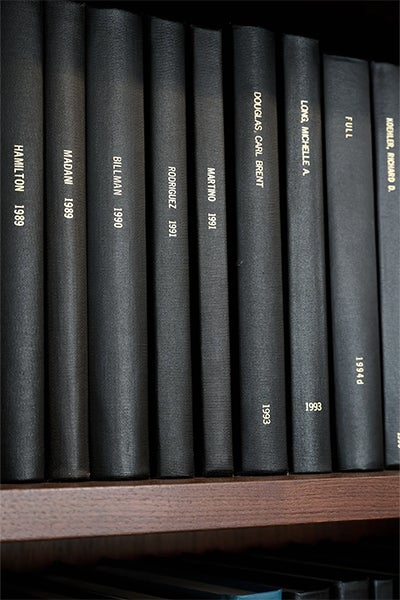
More than 40 dissertations from Kaler’s PhD students line his bookshelf. “The first was Jim Chang in 1986,” he said, “and the last was Matt Helgeson in 2009.”
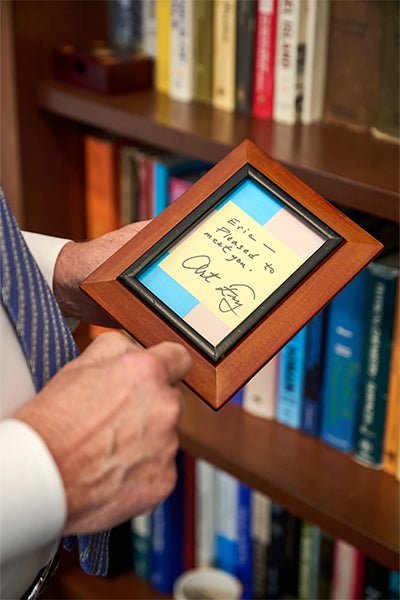
A framed Post-it note, signed by its co-inventor, Art Fry, who worked at 3M. “I went to 3M when I was president of the University of Minnesota. We’re in a conference room, and I said, ‘Wait right here.’ I went out to an assistant and asked for a Post-it note, took it back in, and said, ‘Can you autograph this for me?’”
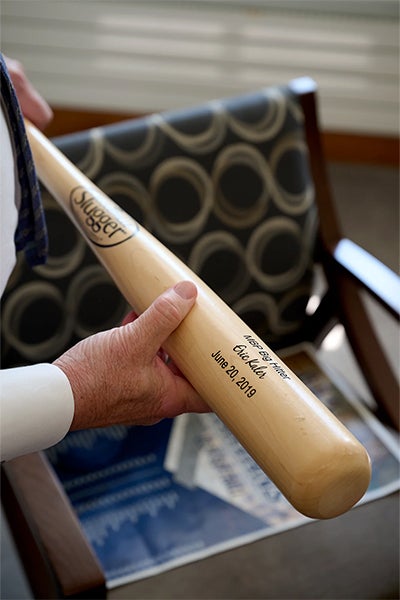
When retiring from UofM, Kaler received a custom Louisville Slugger baseball bat from the Minnesota Business Partnership, a consortium of business leaders. He also had the experience of seeing the Minnesota Marching Band spell “Kaler” on the Golden Gophers’ football field—a framed photograph of which appears on the wall across from his desk.
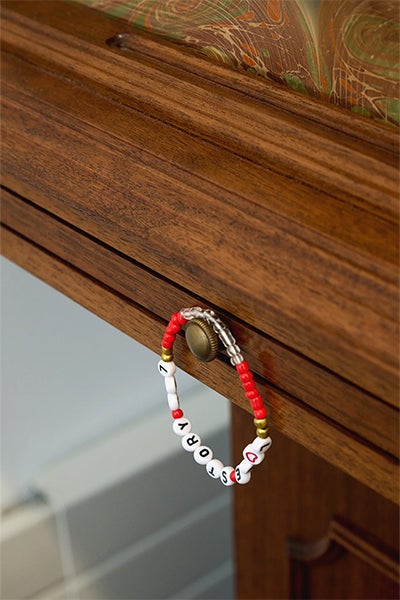
A few Taylor Swift friendship bracelets can be found around the self-proclaimed “Swiftie’s” office. “Her Red album is my workout track.”

A tattered copy of Transport Phenomena sits on his bookshelf. Kaler bought it as an undergrad at Caltech in the late 1970s, kept it for graduate school in chemical engineering and then “taught with it for years and years and years,” Kaler recalled. When one of the textbook’s senior authors, Byron “Bob” Bird, visited UofM, Kaler bought a new copy to get autographed. “I was a little ashamed to have him autograph mine.” Wouldn’t Bird appreciate the wear and tear on the original? “He might have,” Kaler quipped. “But he was brilliant, so he also might have thought I was just too stupid to learn it the first time.”
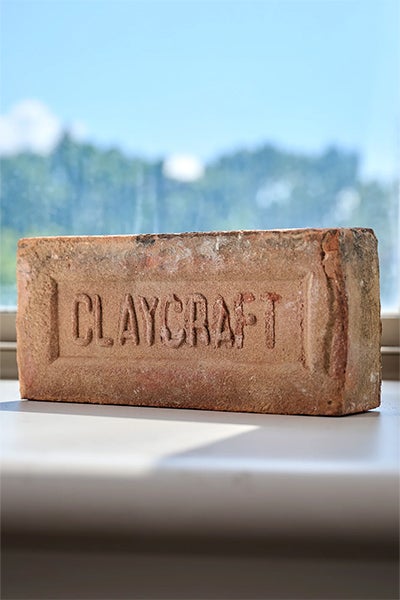
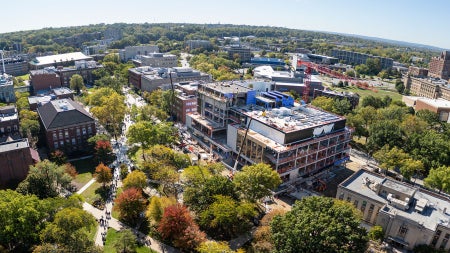
A brick from Yost Hall, which was demolished to make way for the new Roger E. Susi Interdisciplinary Research Building, sits on the west-facing windowsill overlooking the spot that reminds Kaler most of his vision for CWRU: “The Susi Building is an embodiment of the future that I see for interdisciplinary work here. So out that window is a very physical, forward-looking view of where we are and where we are going.”