Case Western Reserve University is home to exceptional faculty scholars across a wide range of fields. They drive innovation, collaboration and creativity, inspiring their students to do the same.
Each year, in recognition of the important role faculty play at our institution, the university selects outstanding faculty members for the title of Distinguished University Professor. This title—the highest honor for faculty members at CWRU—reflects an individual’s career contributions to the university and their respective fields.
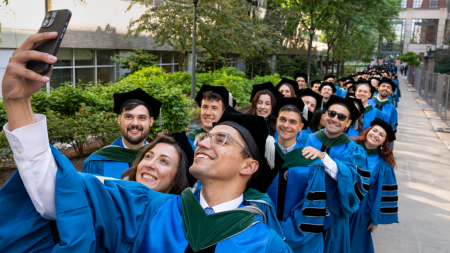
This year, CWRU will recognize three exceptional faculty members with the honor during commencement convocation Wednesday, May 13: Gary Galbraith, Sharona Hoffman, JD, and Anthony Wynshaw-Boris, MD, PhD.
Read more about their distinguished careers.
Gary Galbraith (CIT ’86; GRS ’88, dance)
Professor, Department of Dance
College of Arts and Sciences

Gary Galbraith has built his career at the intersection of art and innovation—reimagining what dance can be and how it can contribute to research, technology and human understanding.
For nearly three decades, his work has pushed the boundaries of choreography through emerging technologies while advancing research in dancer health and redefining how the arts can function within a research university. In recognition of these wide-ranging contributions to dance, scholarship and teaching, Case Western Reserve University has named Galbraith (CIT '86; GRS '88, dance) a Distinguished University Professor—its highest faculty honor.
A faculty member in the Department of Dance since 1999, Galbraith has a national and international reputation for pioneering work in dance and technology. His projects consistently challenge artistic and technical limits, from early experiments with networked performance to more recent explorations using holography and motion-tracking systems.
"Throughout his long career here at CWRU, Professor Galbraith has displayed a strong record of excellence and innovation in teaching," wrote College of Arts and Sciences Dean David Gerdes, PhD, in nomination materials. "His work in this field of dance and technology is one of the areas that helps keep the Department of Dance unique among dance departments in the country."
Among Galbraith’s earliest landmark projects was Kinetic Shadows, a large-scale performance that connected dancers and musicians across more than 2,000 miles using high-speed networking. The work was among the first to leverage Internet2 capabilities in a live artistic setting and helped inform future best practices.
Galbraith has continued to build on that momentum through dances such as Imagined Odyssey and Quest, both of which incorporated Microsoft HoloLens technology to generate live holograms on stage, and In Another Place and Time, which used LiDAR for motion tracking.
This spirit of innovation extends into his teaching. Galbraith has integrated HoloAnatomy software into coursework, allowing students to explore anatomical structures in immersive, three-dimensional ways. His work superimposing HoloAnatomy onto live dancers has also been adopted in medical education at CWRU, demonstrating the broader impact of his research across disciplines.
In addition to his creative and pedagogical contributions, Galbraith has played a pivotal role in advancing research in dancer health. He co-founded the Dance Wellness Program alongside Department of Dance Chair Karen Potter (GRS ’89, dance). He later developed the Dancer Wellness Project, now one of the largest databases of its kind, supporting injury prevention and performance optimization for dancers worldwide. His work in this area has led to international presentations, invited talks, and collaborations with leading dance companies and institutions.
Galbraith’s ability to balance creative and scholarly research has earned significant recognition, including the university’s Faculty Distinguished Research Award in 2019—the first time it was awarded to a faculty member in the arts. He has also received the John S. Diekhoff Award for Excellence in Graduate Teaching in 2005, underscoring his impact in the classroom.
Beyond his individual accomplishments, Galbraith has been instrumental in shaping the Department of Dance. Over the past 27 years, he has helped grow the program, expand its curriculum and establish its reputation as a forward-thinking, interdisciplinary program.
For Galbraith, the Distinguished University Professorship is both a personal milestone and a broader acknowledgment of the arts within a research institution.
“It’s quite humbling,” he said. “When I look at the list of others, I realize I’m something of an outlier—but I’m proud of that. It speaks to the idea that the arts can be an integral part of innovation and the research enterprise.”
Sharona Hoffman, JD
Edgar A. Hahn Professor of Law, Law-Medicine Center
School of Law

When it came to deciding the course of her career, Sharona Hoffman found herself returning to a central focus: health law.
She leaned in, becoming an internationally recognized expert in health information technology and medical privacy law and teaching on the Case Western Reserve University School of Law faculty for what’s approaching three decades. This spring, the university recognized Hoffman’s extraordinary impact in her field by naming her a Distinguished University Professor.
Hoffman’s journey to this honor first took root when, armed with a bachelor’s from Wellesley College and a JD from Harvard Law School, she clerked for a federal judge and then worked for three years at a large Los Angeles law firm on cases including the Exxon Valdez oil spill case.
By this point, it was the early 1990s, and Hoffman knew big-firm work wasn’t for her.
She then began a new path in law at the Equal Employment Opportunity Commission, where she gained experience in employment and disability discrimination.
“It was a very exciting time to do disability law, because the Americans with Disabilities Act went into effect in 1992,” she explained. “So every case was really cutting-edge and precedent-setting.”
While in Houston, Hoffman’s family grappled with several serious health problems, which compelled her to learn how to navigate the American medical and health insurance systems. This personal quest piqued her interest in health law, which led her to earn an LLM at the University of Houston Law Center.
“Everything was leading in the direction of health law,” she said, “and I've never looked back.”
In 1999, Hoffman joined the faculty at Case Western Reserve University School of Law where she is now the Edgar A. Hahn Professor of Jurisprudence and co-director of the Law-Medicine Center. She also has a secondary appointment at the School of Medicine’s Department of Bioethics.
Hoffman is one of the law school’s most prolific writers, having written two books, more than 80 articles and book chapters, and 45 opinion and other short pieces.
“This is remarkable because most law review articles exceed 50 pages,” said law school Dean Paul Rose in his nomination of Hoffman for the honor. “These publications span several areas related to health law, and Dr. Hoffman is recognized for her expertise in each of them.”
Among the subjects about which Hoffman has recently written are law-related aspects of aging, cognitive decline, health care access and artificial intelligence. Her first book, Aging with a Plan: How a Little Thought Today Can Vastly Improve Your Tomorrow, helps readers understand how to build sustainable social, legal, medical and financial support systems for aging and caregiving.
Importantly, Hoffman doesn’t stop at publishing her findings; she takes them on the road, sharing her research with the general public at community venues and events.
“It is a challenge to translate academic work into a popular audience talk,” she said, “but it's important to me that my work have broader impact.”
“It’s been a wonderful 27 years at Case Western Reserve,” Hoffman enthused. “This is a great honor, and I’m humbled to be joining such a distinguished group of scholars.” ”
Anthony Wynshaw-Boris, MD, PhD
James H. Jewell MD ’34 Professor of Genetics
School of Medicine

As a native Clevelander and dual alumnus of Case Western Reserve University who returned to the university in 2013, Anthony “Tony” Wynshaw-Boris, MD, PhD (GRS ’84, biochemistry; MED ’87), has long understood the impact CWRU has as an education and research powerhouse—not only in Northeast Ohio, but around the world.
And through his roles as physician-scientist and educator, he himself has helped make the university the force it has become today. That’s why Wynshaw-Boris is now being honored as a Distinguished University Professor.
Wynshaw-Boris, the James H. Jewell MD ’34 Professor of Genetics, is an elite leader both in the biomedical sciences field and at CWRU School of Medicine. He has served as president of the American Society of Human Genetics, executive editor of Human Molecular Genetics, chair of the American Society of Human Genetics Government and Public Advocacy Committee, and on multiple National Institutes of Health councils and advisory boards.
At the university level, Wynshaw-Boris has served on the Council of Basic Science Chairs, the Committee on Biomedical Research, the Medical Scientist Training Program Advisory Council, the School of Medicine/University Hospitals Cleveland Medical Center Affiliation Advisory Panel and the University Provost Search Committee.
During his decade as chair of the School of Medicine’s Department of Genetics and Genome Sciences, Wynshaw-Boris revitalized the department by growing annual funding, recruiting new faculty members, reviving the Center for Human Genetics and expanding the Genomics Core.
Wynshaw-Boris has mentored countless graduate students, postdoctoral fellows and junior faculty members to help launch their careers. While he’s been a meaningful mentor to many, he also believes that each and every trainee has played an equally vital role in his own career, providing unique strengths and perspectives that have bolstered his work.
“Trainees have been integral to my scientific success,” he said. “I have devoted a substantial effort to optimize the training experiences and career development of my trainees. My approach is to foster their development as independent scientists, physicians or physician-scientists.”
As a researcher, Wynshaw-Boris has been a trailblazer in human genetics for decades. His studies of the pathophysiology of neurogenetic disorders—such as autism, ataxia telangiectasia and lissencephaly—have helped identify novel therapies through the creative use of animal models and inducible pluripotent stem cell models.
“Dr. Wynshaw-Boris is one of the most accomplished physician-scientists of his generation,” wrote School of Medicine Dean Stan Gerson, MD, in nominating Wynshaw-Boris. “[He’s] a visionary leader whose impact on science, medicine, education and our institution has been extraordinary. His achievements exemplify the highest standards of scholarship and service that this honor recognizes.”
His election to the National Academy of Medicine this past fall further cements and recognizes his groundbreaking contributions, which have changed our fundamental understanding of human health and disease.
Through all his successes, Wynshaw-Boris has never forgotten his roots here in Cleveland and at the university.
“Being selected as a Distinguished University Professor is immensely gratifying,” shared Wynshaw-Boris. “Since this has occurred in the bicentennial year of Western Reserve Academy and Case Western Reserve University, two formative institutions of mine, it is especially meaningful.”