What scholarships make possible
With $250 million in new student support, the university is transforming access and opportunity
On a recent Saturday at the Louis Stokes Cleveland VA Medical Center, Alexander Krammer moved from room to room with a deck of cards and a simple question: “How are you doing today?”
Many of the patients he visits have been there for weeks, even months—far removed from the rhythms of everyday life.
“They can lose their sense of agency and independence,” said Krammer, a fourth-year student at Case Western Reserve University. “What we [student volunteers] try to give back is normalcy.”
Sometimes that means a quiet conversation. Other times, it’s a shared laugh or a simple game—small acts to restore connection and dignity. When Krammer saw inefficiencies in the volunteer onboarding process, he helped cut a six-month timeline to just over two weeks, expanding student engagement across the unit.
His commitment is steady and entirely voluntary— spurred by the financial support behind him.
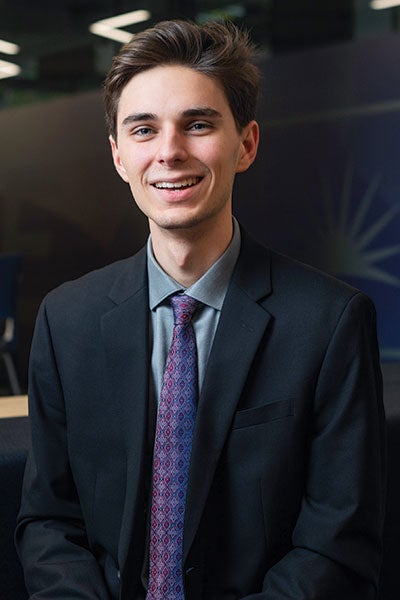
As an Alexander A. Treuhaft Memorial Scholar, Krammer receives a four-year, full-tuition scholarship that has shaped his experience at Case Western Reserve— freeing him to focus on research, service and preparation for medical school. In the biochemistry lab where he studies how dietary nutrients convert into vitamin A— a molecule vital to vision and immune function— he’s there to learn, contribute and grow.
“This scholarship removed a huge burden from me and my family,” said Krammer, who’s from Boulder, Colorado. “And it’s allowed me to do other things that matter to me and my future.”
His path reflects an intentional focus at Case Western Reserve—one that’s helping hundreds of students like him find both access and opportunity at the university.
A single priority
On Jan. 1, 2019, Case Western Reserve began a new chapter.
At the close of its Forward Thinking capital campaign— an effort that raised $254 million for scholarships over 11 years—the university made a decisive pivot to focus primarily on student support. That day, it launched a new initiative with a core fundraising goal and guiding principle: access and affordability.
This focus reshaped the university’s priorities—and sparked a surge of support. What began as an effort to honor President Emerita Barbara R. Snyder’s tenure raised nearly $40 million for scholarships.
That momentum became the foundation for something even bigger: a volunteer-powered, university-wide effort that, earlier this year, surpassed a quarter of a billion dollars in just six years—matching the scale of Forward Thinking in nearly half the time.
“This scholarship removed a huge burden from me and my family.”
—Alexander Krammer
“A volunteer engine powered it,” said Carol Moss, senior vice president of University Relations and Development. She credits the President’s Commission on Student Success— led by then-Board of Trustees Chair Fred DiSanto (WRC ’85, MGT ’86) and his wife, Brittan DiSanto—along with a national corps of alumni volunteers. “At the university, a team woke up every day focused on raising scholarship support.”
Donors who had long supported research, faculty and campus infrastructure shifted their giving to center on students—through endowments, merit- and need-based aid, and partial and full scholarships alike.
“Our university community came to understand just how powerfully their gift could change a life,” said Moss.
That commitment continues with President Eric W. Kaler who has raised the critical importance of scholarship support from day one.
“Case Western Reserve must be a place where access and opportunity are equally available to our talented students,” said President Kaler. “And our donors play a critical role in ensuring that these bright young people not only choose Case Western Reserve but thrive here.”
Building futures
Before they began their careers, started a family or gave back to the university they later supported, Ray (CIT ’71) and Catherine French Garea (FSM ’70) were two students trying to find ways to pay for college.
Both came from families of modest means, where higher education might have remained out of reach. Scholarships opened the door.
“Without that support,” he said, “we never would have gone here—and we never would have met.”
A decade later, the Gareas saw an opportunity to give back and began donating in the 1980s.
“We started small,” said Ray Garea, who built a career in finance and investing, “and as things got better, we gave more.”
When the university invited them to consider expanding their support for scholarships, the Gareas recognized a meaningful way to pay forward the help they once received.
“It shaped how I think about leadership, and about the kind of healthcare provider I want to become.”
—Logan Tsukiyama
“Our gift may not put our name on a building,” said Catherine Garea, a lifelong educator and advocate for adult learning, “but it can help build a future for students who might not otherwise have the chance to be here.”
Structured as both an immediate multiyear pledge and future estate gift, their fund supports undergraduates in the College of Arts and Sciences and graduate students in the Case School of Engineering—reflecting their own respective academic paths at the university.
The true effect of a scholarship, Catherine said, runs far deeper than tuition.
“When you’re 18 years old and someone invests in you, it’s a vote of confidence,” she said. “It builds your sense of responsibility— to do the work, to overcome the obstacles, to make good on that investment.”
That kind of backing has shaped the experience of Makaila Burnham, a third-year civil engineering student from Cincinnati.
Backed by a mix of financial awards— including the James P. Buchwald ’54 Engineering Scholarship—she’s had the freedom to adapt: switching majors without losing momentum, diving into a challenging course on an advisor’s recommendation, and shifting her co-op to summer to stay on track academically.
It also lets her lean into leadership. As a committee chair with the Residence Hall Association, she meets with dining leaders to turn student feedback into fixes. As a university tour guide—and now a training lead—she helps high school students and their families envision life at CWRU.
“They come to hear my genuine student perspective,” said Burnham. “Because of scholarships, I can choose roles that make campus work better for the next student.”
Scholarship as structure
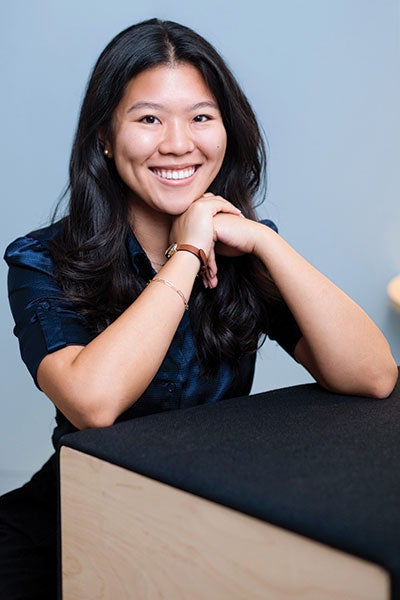
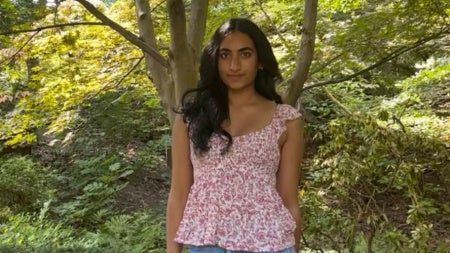
Growing up in Hawaii, Logan Tsukiyama didn’t know much about Case Western Reserve before applying. As a high schooler in Maui, she found the university while researching places where she could pair research opportunities with a future in healthcare.
Still, the distance to Cleveland felt daunting.
But when CWRU offered the strongest scholarship package, including a full-tuition award through the President’s Leadership Development Program, her path became clear. This four-year experience—recently expanded upon with a $25 million gift from the Weatherhead Foundation—was built to develop ethical, human-centered leaders through coursework, mentoring, immersive service and summer opportunities.
“I came in broadly pre-med, but I didn’t know what that meant yet,” said Tsukiyama. “The president’s program gave me the structure to explore different paths—to figure out what makes sense for me, what I care about, where I can have an impact.”
Now a fourth-year student preparing to pursue graduate studies in cardiovascular perfusion, Tsukiyama traces her path through formative experiences: studying global health engineering in Uganda, conducting field research in Costa Rica and deepening her sense of purpose through cross-cultural science. On campus, biweekly cohort sessions with the leadership development program and regular one-on-one advising have helped her reflect, adapt and refine her goals.
“It’s a kind of support that goes beyond money,” she said. “It shaped how I think about leadership, and about the kind of healthcare provider I want to become.”
Legacy by design
Every scholarship starts somewhere. For the Wolf family, it began with a question: What kind of impact do we hope to have— and who do we want to help?
Shortly after the passing of their parents in the early 2000s, the family established a scholarship at Case Western Reserve to honor Milton A. (CIT ’54; GRS ’73, ’93, economics; HON ’80) and Roslyn Z. Wolf (WRC ’77, MGT ’81)—a couple whose belief in education was matched by their commitment to public service.
They’ve since expanded the endowment twice. Today, the Milton A. and Roslyn Z. Wolf Scholarship offers one of the university’s most comprehensive awards: full tuition, housing, fees, books and support for summer experiences that provide life-shaping perspective.
“We wanted something that could tip a student’s decision,” said Caryn Wolf Wechsler, one of the couple’s daughters. “Someone with talent and drive, who might not be able to afford [CWRU] could choose it—and thrive.”
The award’s criteria centers on character, curiosity and capacity for leadership. Starting in 2027, the family’s newest gifts will fund a new Wolf Scholar every other year (increasing frequency from every four years), creating an overlap of recipients and a growing network.
"The scholarship lets students focus on academic and personal growth,” said Wechsler, “without constant trade-offs.”
A belief in the power of learning was one her parents lived out themselves. Roslyn Wolf completed her undergraduate degree at Western Reserve in her 50s “for the joy of learning,” said Wechsler. Milton Wolf earned a PhD in economics at age 70 at the university and taught at Weatherhead School of Management—after serving as U.S. Ambassador to Austria under President Jimmy Carter.
To them, education was both a right and a responsibility.
“We’re guided by the idea of tikkun olam— repairing the world,” said Wechsler. “Our hope is that Wolf Scholars—and all students—use what they gain at Case Western Reserve to lead, to serve and to lift others.”
What endures
Today, around 85% of Case Western Reserve undergraduates receive some form of scholarship or financial aid, making the university more accessible to more students.
But even with that momentum, there’s progress to make. For example, peer institutions fund nearly one-third of student aid through philanthropy—a benchmark CWRU still strives to meet.
“Even though we’ve moved the needle significantly, we’re not done,” said Moss. “Our donor community sees these students as the future—and they’re backing the future those students will create.”
In tune with opportunity
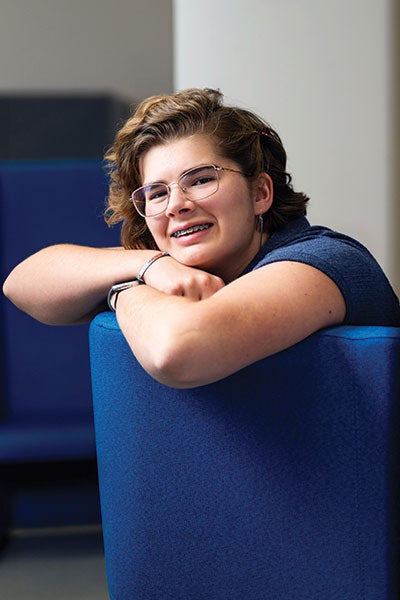
Nearing her high school graduation in the spring of 2024, Lydia O’Dell paid her deposit to another university—convinced the school she’d fallen for on a campus tour, Case Western Reserve, just wasn’t within reach.
Then came the surprise email.
“I was leaving band practice and checked my phone in the parking lot,” she said. “I opened the message and just sat there. It quite literally changed the course of my life.”
O’Dell had been awarded the university’s A.W. Smith Scholarship—a full-tuition, four-year award recognizing achievement in hands-on science and engineering. She was chosen, in part, for the inventiveness of one of her personal projects—3D-printed saxophone mouthpieces—which merged her interests in mechanics and music.
That night, she changed her enrollment. Now a second-year student at CWRU, O’Dell dreams of becoming a design engineer for musical instruments. “It’s the perfect blend,” said O’Dell, a mechanical engineering and music double major. “I can see the line from my classes to my career.”
The scholarship let her fully pursue that goal. She’s spent two summers at a woodwind manufacturer near her hometown of Fort Wayne, Indiana—first on the factory floor, then as an engineering intern improving workflows in bell engraving, finishing and design. On campus, she’s helping launch a make-a-thon club and continues refining her 3D-printed mouthpieces at Larry Sears and Sally Zlotnick Sears think[box].
“I grew up thinking I’d have to choose: engineering or music,” she said. “This scholarship said I didn’t have to— and I’m so grateful.”