

By Pam Turos
At NP3, we often talk about community change as something we practice rather than something we deliver. The Resident Empowerment Fund (REF), grounded in long‑term relationships with Woodhill legacy residents, provides an example of what that practice looks like in real time. The $350,000 Fund was established four years ago with gifts from The Gund Foundation, The Cleveland Foundation, Saint Luke’s Foundation, The Community Builders, and the Annie E. Casey Foundation.
Woodhill legacy residents are former residents of the original Woodhill Homes public housing community who were displaced during a multi‑phase redevelopment of the site through the federally funded Choice Neighborhoods Initiative led by the Cuyahoga Metropolitan Housing Authority (CMHA), the City of Cleveland, and development partners. During the multi-year project, the REF was designed to support resident-led projects that help community members stay supported, connected, and engaged. But the REF doesn’t just fund resident‑led projects; it also helps us explore deeper questions about community governance, decision‑making, and what it means to share power across differences.
Two Groups, One Interwoven Process
One of the defining features of REF is its two‑group structure, each with distinct roles.
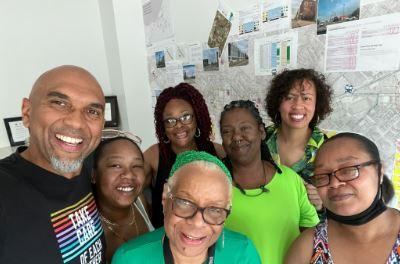
The REF Working Group brings together community leaders who support the Woodhill neighborhood, even if they are not Woodhill residents themselves. This group includes four legacy resident stewards and connectors who live nearby and will continue serving until the final apartment is occupied. The group also includes representatives from The Community Builders (TCB), an affordable housing developer, Saint Luke’s Foundation, and Neighborhood Connections, which stewards the funds.
But the Working Group doesn’t make funding decisions. Instead, they review proposals and provide feedback to help applicants strengthen, clarify, and rethink their ideas. For some Working Group members, this was their first experience participating in a grant review process. Others brought prior experience and grantmaking expertise.
Over the course of eight months, that mix created a learning environment where people could grow individually while also contributing to larger community impact. According to Laylah Allen, NP3’s Senior Community Builder, a partner and convener for the REF process, “Many conversations that begin in REF spaces have turned into one‑on‑one relationships and broader community dialogue,” reinforcing how interwoven this work is. Then, once a resident application has moved through the review process, the REF Grantmakers Task Force, made up solely of Woodhill legacy residents, holds decision‑making authority and votes on which projects receive funding.
While NP3 and partners provide a framework for the process, the structure remains flexible by design, so it can adapt to resident priorities and learning as the process unfolds.
Adjusting in Real Time
One of the most meaningful aspects of the REF funding pilot has been a shared commitment to learning rather than rigid adherence to predetermined structures. Task Force members raised questions about timing, access, and participation. Why did proposals arrive so late for review? Why did some residents feel disconnected from earlier stages of the process? In response, residents who wanted deeper involvement joined the REF Working Group, allowing them to shape proposals earlier and provide direct feedback.
The result is a process that feels increasingly resident‑led, not just in name, but in practice.
What Has Been Funded and What’s Emerging
To date, seven resident projects have been funded with two additional proposals pending review. This includes a wide range of resident priorities, including Healthy Eating and Active Living (HEAL) initiatives, swimming and water safety programming in partnership with Cleveland State University and See You At The Top (SYATT) nonprofit, and IntergenerARTion programming led by residents in collaboration with organizations like MetroHealth.
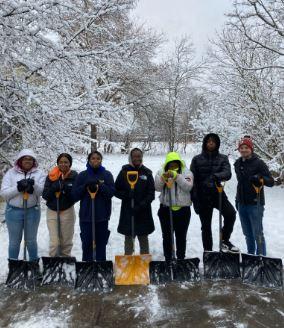
Some efforts focus on practical needs that directly improve daily life, such as snow removal and neighborhood beautification. Others look toward longer‑term connection and healing. Upcoming projects include a proposed Healing Village, envisioned as an outdoor, station‑based gathering addressing grief and loss, hosted in collaboration with the New Image Block Association at a neighborhood pocket park.
Throughout these initiatives, our responsibility is to pay close attention to who is participating, who is benefiting, and how to ensure Woodhill legacy residents are meaningfully included as the neighborhood continues to change.
Stewardship, Connection, and Care
REF does not operate in isolation. It sits within a broader ecosystem of roles and relationships that support legacy resident connections and community building.
In the community there are floor stewards working inside buildings, sharing information and connecting neighbors. And there are connectors, who are also stewards but may not be CMHA residents, working outside buildings to link residents to resources and opportunities. And governing stewards bring these roles together, meeting regularly and serving as a consistent presence for community advocacy. Some residents participate solely through the Task Force, without formally serving as stewards or connectors, others may hold multiple roles.
With the REF implementation in its final phase, Task Force members also have discretion over a portion of the funds to invest in community‑building activities. Recently, funds were set aside for a retreat with the TCB Community Life Team, for the next phase of the Choice Neighborhood Initiative and beyond.
Flexing the Interdependence Muscle
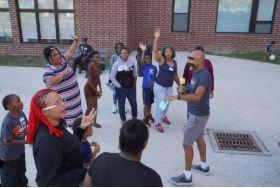
At its heart, the Resident Empowerment Fund is about more than dollars. It is about practicing shared power at a scale and depth that most people rarely experience. “I do think it’s a privilege to just be a part of this. It’s historic. We don’t know when something like this would happen again,” says Laylah, reflecting on her time supporting the REF implementation. “It’s a unique experience, and it’s transformative work. It’s really been an opportunity for everybody to flex their interdependence muscle.”
Laylah reminds us, however, that flexibility has not always been easy. Sharing power requires tradeoffs. For some, it means taking on more responsibility. For others, it means stepping back and making space for new leadership, new ideas, and creative approaches that challenge what feels familiar.
At NP3, we see the REF model as a powerful example of what becomes possible when residents are not just consulted, but centered, and when institutions are willing to learn alongside the communities they serve. The work is ongoing and outcomes are still unfolding, but the relationships built and lessons learned are shaping our path forward.