

Performance measurement can be controversial, evoking disagreement about how to best measure and evaluate performance in such areas as business, healthcare, and education. CHI Center Research Associate Robinson Salazar Rua, PhD, expands the conversation with his new book, “Improving Consistency in Performance Measurement System Design: The Case of the Colombian Public Schools.”
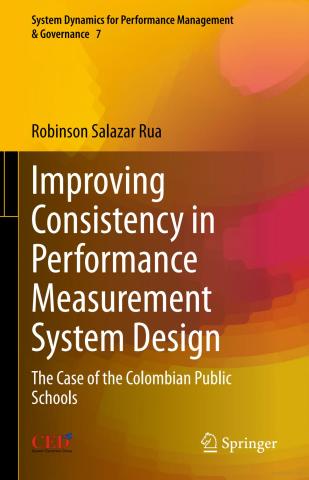
Based on the premise that performance measures are not neutral, the book explores ways in which narrow measures, focused on short-term outputs rather than long-term outcomes, can lead to decontextualized results and dysfunctional behaviors. Dr. Salazar Rua uses system dynamics to explore organizational complexity, sustainability of relevant policies, and the importance of outcome-oriented performance measurement systems.
Although performance measurement systems are widely used in analyzing public sector organizations, such as schools, they have a number of limitations. “Performance management is static in nature. You have inputs, outputs, outcomes, but there is not a feedback mechanism. It’s a linear process,” Salazar Rua explained. “By using system dynamics, you’re able to understand complexity by identifying feedback loops, non-linear relations, time delays, and tradeoffs in time and space. You’re shifting from a static to a dynamic view of the system. These are important benefits.”
System dynamics also brings together multiple perspectives, highlighting the potential for collaborative, boundary-spanning approaches to seemingly intractable problems. “The kinds of issues we’re facing in the public sector are too complex; they cannot be solved by one institution,” said Salazar Rua. “System dynamics helps you integrate multiple stakeholders’ views to support the design of policies aimed at building up common goods.”
While the book addresses performance measurement in public schools, its systems approach is applicable to a wide range of public institutions. Incorporating system dynamics could help create a paradigm shift, writes Salazar Rua, as organizations shift their focus from immediate results to broader, more dynamic contexts.