17 undergraduate students represent CWRU at prestigious National Conference of Undergraduate Research
Strong undergraduate research experiences are a cornerstone of a Case Western Reserve University education. The institution’s recent record-breaking contingent at the National Conference of Undergraduate Research (NCUR) in Richmond, Virginia, demonstrated the power and reach of such opportunities.
Earlier this month, 17 CWRU students from a range of disciplines represented the university at NCUR. Additionally, there was a dedicated showcase of CWRU’s undergraduate research journal, Discussions, and representation from the university’s graduate and professional schools to bolster recruitment efforts to prospective students.
NCUR began at the University of North Carolina at Asheville in 1987, becoming an annual celebration of undergraduates engaged in research, scholarship and creative activities. Each year, the event draws 3,500 to 4,000 students worldwide, offering them the chance to hone their presentation skills and network with others.
"The true power of this year’s NCUR conference was reflected in the incredible number of students who showed up ready to learn, share and grow," said Maya Fenty, PhD, associate dean in the Undergraduate Advising Support Office. "We were so proud and genuinely happy to support them through preparation, encouragement and funding. Investing in their potential is what makes moments like this so meaningful."
We spoke with five of CWRU’s student delegation, who shared their research and experiences from the event.
Answers have been lightly edited for clarity and length.
Paris Martin
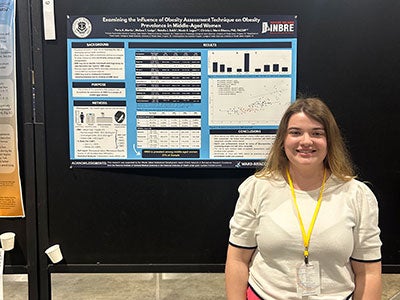
Paris Martin is a third-year student majoring in nursing with a minor in public health. Mentored by Christie Ward-Ritacco, PhD, at the University of Rhode Island, Martin presented her research titled “Examining the Influence of Obesity Assessment Techniques on Obesity Prevalence in Middle-Aged Women.”
1. Can you describe your research?
I am examining how traditional measures like BMI may overlook individuals with normal weight obesity. My work highlights the need for more comprehensive assessment methods to better identify hidden health risks and improve prevention strategies.
2. What interested you in this topic?
I became interested in this topic after being placed in a research lab at the University of Rhode Island as a part of a summer fellowship program and learning more about the limitations of BMI alone.
3. What is the potential application or impact of your work?
This work has the potential to improve clinical screening by encouraging the use of more comprehensive measures beyond BMI, allowing healthcare providers to better identify individuals at risk for obesity-related conditions and intervene earlier.
4. What were your key findings?
The study found that reliance on BMI alone may underestimate the prevalence of obesity, as a subset of individuals classified as normal weight were identified as having elevated body fat levels. This highlights the presence of normal weight obesity and the limitations of BMI as a standalone measure.
5. What was it like to present at NCUR?
Presenting at the National Conference on Undergraduate Research was an unforgettable experience. Sharing my research in a collaborative and supportive environment, while learning from others, made it both motivating and affirming as I continue to grow as a researcher.
Yashwant Pantra
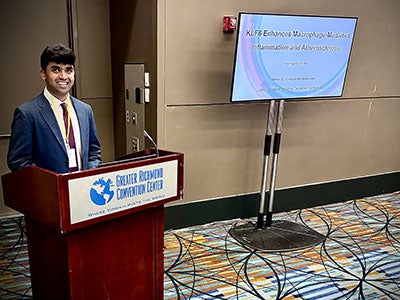
Yashwant Pantra is a second-year student majoring in biochemistry. He was mentored by Ganapati Mahabaleshwar in the Department of Pathology at the School of Medicine, for his research titled “KLF6 Enhances Macrophage-Mediated Inflammation and Atherogenesis.”
1. Can you describe your research?
Our research investigated whether the pro-inflammatory transcription factor KLF6 promotes macrophage-driven atherosclerosis. Atherosclerosis is a chronic inflammatory disease characterized by inflammation of lipid plaques within arterial walls. Macrophages are central to plaque progression because they release pro-inflammatory cytokines that promote foam cell formation, extracellular matrix remodeling, and sustained inflammation within plaques. KLF6 has previously been linked to several inflammatory diseases, but its role in atherosclerosis was unclear. We used both in vivo and in vitro models to study how KLF6 promotes inflammatory gene expression and atherosclerotic plaque development.
2. What interested you in this topic?
I am interested in this topic because I have a strong interest in immunology research, particularly how inflammatory signaling pathways contribute to disease. Atherosclerosis is becoming increasingly understood as an immune-driven condition, making it an exciting area to study the role of macrophage-mediated inflammation in cardiovascular disease
3. What is the potential application or impact of your work?
The potential impact of our work is identifying KLF6 as a novel regulator of atherosclerosis and a potential therapeutic target. Our findings show that KLF6 promotes macrophage-driven inflammation and plaque development, which supports future efforts to target this pathway as a strategy to limit disease progression.
4. What were your key findings?
Our findings showed that KLF6 promotes atherosclerosis in both in vitro and in vivo models. In vitro, KLF6 knockout in macrophages reduced TNF-induced inflammatory gene expression, indicating that KLF6 helps drive pro-inflammatory signaling. In vivo, myeloid-specific KLF6 knockout mice developed significantly less diet-induced atherosclerotic plaque and had reduced macrophage accumulation within lesions. Together, these results show that KLF6 promotes macrophage inflammation and drives atherosclerotic plaque development.
5. What was it like to present at NCUR?
Having the opportunity to give an oral presentation at NCUR was an incredibly valuable educational and professional experience. It strengthened my ability to communicate my research clearly and confidently while presenting on a national stage. One of the most rewarding aspects was being surrounded by students who were passionate about their work, which led to thoughtful discussions and meaningful connections with other researchers. I also appreciated the chance to speak with graduate program representatives and learn more about future opportunities.
Reshma Rajesh
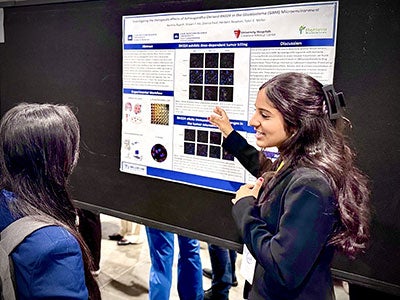
A second-year student majoring in cognitive science, Reshma Rajesh worked with Tyler Miller, MD, PhD, in the Department of Pathology at the School of Medicine on her research titled “Investigating the Immunomodulatory and Tumor-Targeting Effects of Ashwagandha-Derived Therapeutic RH324 in the Glioblastoma (GBM) Microenvironment.”
1. Can you describe your research?
My research focuses on evaluating the anti-tumor and immunomodulatory effects of RH324, a full-spectrum Ashwagandha extract, in glioblastoma (GBM), an aggressive and highly treatment-resistant brain cancer. Using patient-derived GBM organoids that retain the tumor’s native immune cells and intratumoral heterogeneity, I studied how RH324 influences both tumor cell death and the tumor microenvironment immunohistochemistry and spatial analysis.
2. What interested you in this topic?
I was interested in this topic because glioblastoma remains one of the most difficult cancers to treat, with limited effective therapies and poor patient outcomes. This research has been especially meaningful to me as cancer has had an impactful history in my family. Seeing how devastating these diagnoses can be motivated me to contribute to research that could improve future treatment options. I was especially drawn to studying therapies that target not only the tumor itself, but also the immune environment surrounding it. RH324 was particularly interesting to me because it comes from Ashwagandha, a compound many people already take and that is widely accessible. I wanted to explore whether a familiar compound like this could have real anti-tumor or immune-modulating effects in glioblastoma.
3. What is the potential application or impact of your work?
Potential applications of this work is identifying whether RH324 could serve as a novel complementary treatment strategy for glioblastoma. We were interested in understanding how RH324 affects both tumor cell survival and the immune environment within the tumor microenvironment. If RH324 can promote tumor cell death while influencing immune cell behavior in a particular way, it could provide valuable insight into new treatment approaches for GBM patients. Understanding these effects could help guide future therapeutic strategies and improve our understanding of how botanical compounds may interact with brain tumors.
4. What were your key findings?
Our early findings suggest that RH324 may increase tumor cell apoptosis while also affecting immune cell behavior within the tumor microenvironment. Through immunohistochemistry, we observed signs of increased tumor cell death along with changes in the immune environment. However, in the context of glioblastoma, certain immunomodulatory effects can be harmful, particularly when they promote immunosuppressive conditions that support tumor growth, as shown in prior literature. This suggests that while RH324 may have promising anti-tumor effects, its impact on the immune microenvironment warrants greater caution and further optimization when considering its use as a potential therapeutic strategy for GBM.
5. What was it like to present at NCUR?
Attending NCUR exposed me to a wide range of interdisciplinary research across fields from economics to engineering and the humanities, broadening my perspective on research at Case [Western Reserve]. Presenting my work helped me refine how I communicate complex ideas to diverse audiences, strengthening my skills as a student researcher. I also valued learning from my peers’ projects, which offered new perspectives that can inform my own work!
Kanishk Neerumalla
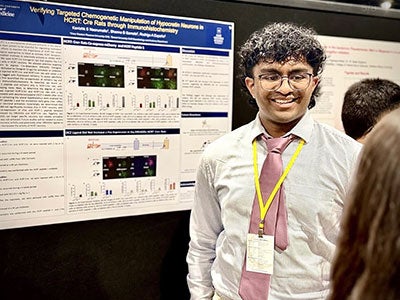
Kanishk Neerumalla is a second-year student majoring in computational biology and business management. He worked with Rodrigo A España, PhD, from the Drexel University College of Medicine on his research titled “Verifying Targeted Chemogenetic Manipulation of Hypocretin Neurons in HCRT: Cre Rats through Immunohistochemistry.”
1. Can you describe your research?
My research focuses on a powerful group of brain cells localized in the lateral hypothalamus that produce a neuropeptide called hypocretin (orexin), which is critical for regulating motivated behaviour, reward-seeking behaviour, and wakefulness. To achieve relative cell-type specificity, we used transgenic rats expressing Cre recombinase in hypocretin neurons and delivered Cre-dependent DREADDS (Designed Receptors Exclusively Activated by Designer Drugs) to selectively modulate neuronal activity when a specific drug is administered. We validated our targeted specificity using immunohistochemistry, confirming selective expression within hypocretin neurons, and attempted to activate these neurons, and assessed neuronal activation via cFos expression (an immediate early gene that marks neuronal activity).
2. What interested you in this topic?
My interest in this research is deeply personal as well as scientifically driven. Broadly, my interest in basic science, neuroscience, and detection-based research stems from my experience as a caregiver for my grandmother, Rani, who suffered a severe stroke at a young age and continues to experience long-term neurological complications (often mood swings and personality shifts), which shaped my desire to understand the impact of specific brain circuits and their implications on recovery, behaviour, and disease detection. Ultimately, this led me to dig deeper, exploring little-known (but incredibly important!) systems like hypocretin, which are crucial in regulating motivation and mood—basic processes disrupted by traumatic brain injuries. I really am interested in how dysfunction in these circuits contributes to mood-related disorders such as depression, anxiety, and apathy. Targeted therapy research is a great way to strike a problem at its root, which is what I am currently doing and plan to do for the future.
3. What is the potential application or impact of your work?
The impact of my work is rooted in improving how scientists manipulate and study specific neural populations involved in motivation and mood regulation. The translational significance of this work lies in improving how preclinical animal models visualize the function of neural circuits so commonly implicated in human disorders. In the past, hypocretin signaling has been deeply linked with incredibly common conditions such as depression, addiction, and post-stroke apathy, which are all disrupted by sleep/wake/arousal systems. By evaluating neuronal control from a chemogenetic standpoint, we are one step closer to assessing how reliably we can manipulate these systems in vivo. Results directly impact the validity of animal models, better position them toward targeted therapy, and will definitely impact human models in the near future.
4. What were your key findings?
Our key findings demonstrate that Cre-dependent DREADDs enable highly specific targeting of hypocretin (HCRT) neurons, as confirmed by robust coexpression of mCherry with HCRT-1 peptide within HCRT: Cre+ rats and absence in controls. However, the functional validation revealed a limitation: administration of a Gq-DREADD ligand drug, deschloroclozapine (DCZ), did not produce a significant increase in cFos expression within HCRT neurons compared to HCRT: Cre- controls. This indicated a successful viral targeting and expression, but not a reliable Gq-mediated chemogenetic activation under these conditions. These results suggested potential ligand efficacy constraints or receptor coupling errors. Ongoing studies are being performed to continually hypothesize, verify and confirm.
5. What was it like to present at NCUR?
NCUR 2026 was an awesome experience and an incredible stepping stone for a professional career. When entering the NCUR conference, you step into a community that sparks your ability to think differently—one that expands your knowledge from pure research into connections, networking and communication capabilities. Additionally, the beauty of NCUR is its ability to create a cohesive research community from a large variety of disciplines, allowing students to share their work while digging deep into whichever category of research they please. Specifically, presenting at NCUR reinforced the importance of experimental design and the value of discussing results, wherever you are within the research process.
Kit Shiells
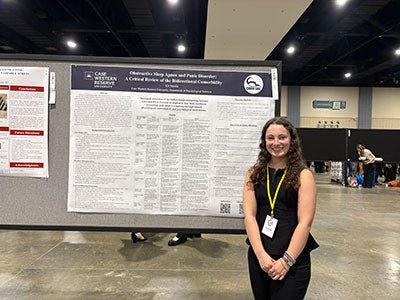
Kit Shiells, who is majoring in cognitive science and psychology, will graduate this spring with an undergraduate degree and a master’s in bioethics and humanities. She worked with Amy Przeworski, PhD, in the Department of Psychological Sciences at the College of Arts and Sciences on research titled “Obstructive Sleep Apnea and Panic Disorder: A Critical Review of the Bidirectional Comorbidity.”
1. Can you describe your research?
My research examines the comorbidity of obstructive sleep apnea and panic disorder (OSA-PD), two conditions that share overlapping symptoms—such as sudden awakenings and respiratory distress—making accurate clinical diagnosis and treatment particularly challenging. By analyzing existing literature, my work explores the bidirectional relationship between these disorders and highlights the need for greater clinical awareness given how each condition can exacerbate the other.
2. What interested you in this topic?
As an aspiring PA interested in sleep medicine and the founder/president of CWRU's Sleep Health Society, sleep disorders have always been a great interest of mine. With my undergrad majors in cognitive science and psychology, this project gave me the opportunity to explore something that I had been curious about for a while.
3. What is the potential application or impact of your work?
With growing wearable technologies in medicine and the impact that sleep disorders and mental health conditions silently have on the overall health of individuals, my work highlights this gap in literature on the relationship between the conditions. As clinicians begin to recognize the bidirectional relationship between the two conditions, they will be better equipped to screen for comorbidity rather than treating each disorder in isolation.
4. What were your key findings?
While there truly was very limited research worldwide on the relationship between these conditions, future studies should aim to increase sample sizes, as diagnostic and treatment technology is now allowing a deeper analysis of the comorbidities that these two conditions are associated with. Increased awareness of OSA-PD comorbidity is essential for timely and accurate diagnosis. Increased awareness in research and clinical practice of the bidirectional relationship between OSA and PD is essential to emphasize how both conditions exacerbate each other’s symptoms through shared physiological, neurological and psychological mechanisms. An integrated clinical approach, such as sleep screeners in primary care pediatrics, that considers both sleep and mental health will offer significant improvements in patient outcomes and quality of life.
5. What was it like to present at NCUR?
Presenting at NCUR alongside so many other dedicated and driven students was truly such a special experience. Having so many familiar CWRU faces with me during this conference reminded me how grateful I am to be a CWRU student and have such a strong support system everywhere I go, even after I graduate.