5 questions with medicine’s Ashleigh Fletcher, Class of 2026
As commencement approaches for Case Western Reserve University School of Medicine students, the excitement of what lies ahead is matched by the gratitude to the people, classes and clinicals that made a difference along the way—because the journey of earning one’s degree is just as important and impactful as the destination of a healthcare career.
To capture that experience, we spoke with several School of Medicine graduates as they prepare to close this chapter and step into the next.
Read on to learn about Ashleigh Fletcher, a Master of Public Health candidate from Cleveland, Ohio.
Answers have been lightly edited.
What initially drew you to CWRU?
I wanted a program that would challenge me and let me shape my own path. CWRU stood out for that. The classes are small, the expectations are high, and you’re surrounded by people who are doing real work across disciplines. Being in Cleveland mattered too. You’re not removed from the issues you’re studying. You see them.
By my first semester, I knew I made the right choice. I wasn’t just completing assignments. I was starting to think differently and take ownership of what I was learning.
What course or campus experience shaped your education most?
It didn’t happen in one moment. It built.
Environmental Health with Maeve Macmurdo changed how I think about health. It shifted my focus toward the environments people live in and how those conditions shape outcomes.
Then I worked with Ashwini Sehgal on a project replacing gas stoves with induction stoves. That experience made everything more concrete. It connected what I was learning to everyday conditions and made it clear how those decisions affect health.
From there, I kept following that line of thinking. My coursework, papers and capstone all started to center on the relationship between health and the built environment. It wasn’t planned, but it became the focus of my time in the program.
My advisor, Andrew Morris, played a key role in that. He was responsive, direct and invested. He helped me think through decisions, make connections, and supported me in shaping my experience around what I wanted to do.
What is your favorite memory as a student at CWRU?
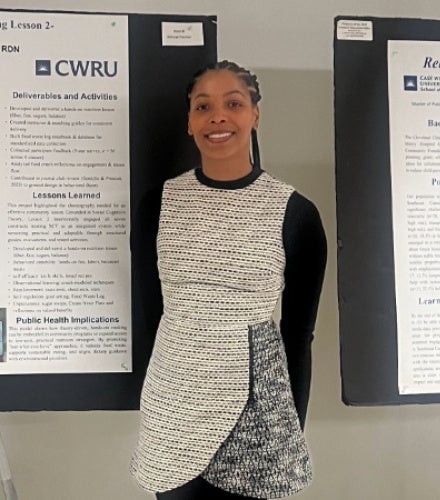
Presenting my capstone: How Effective Are Asthma Interventions? A Meta-Analysis of Changes in Asthma Control Questionnaire (ACQ) Scores in Control and Intervention Groups.
I came into the program without a strong background in statistics. Before CWRU, I was a research coordinator at The Ohio State University and had my first experience co-authoring and presenting an abstract. The capstone pushed that further. I took on a full meta-analysis and worked through the analysis in R.
It was uncomfortable, but I stayed with it. By the time I presented, I could walk through my methods, explain my findings and defend the work. That moment stands out because it marked how much I had grown.
What’s next for you after graduation?
I’ll be pursuing a second master’s in community planning at the University of Cincinnati. I plan to move to Washington, D.C., and focus on public health and the built environment, with the goal of shaping how places are designed and improved.
What advice would you give to new students in your program?
Take advantage of the flexibility. Follow what interests you and let your work build over time. Don’t stay in your comfort zone. The most useful parts of the program come from pushing into areas you don’t fully understand yet. Get to know your professors.