Against the odds: How a dental alumnus defied the prognosis
How unwavering personal grit and a mentor who kept the door open helped John Damiano, DDS (DEN ’89) overcome extraordinary setbacks to earn his dental degree.
Dentistry relies on precision—fine motor control, steady hands and unwavering focus through intricate procedures. For John Damiano, DDS (DEN ’89), those exact physical requirements once made his dream of graduating from Case Western Reserve University School of Dental Medicine feel elusive, improbable and virtually impossible.
Up until June of his senior year of high school, Damiano led a vibrant life in rural LaFayette, NY—ranking in the top five of his graduating class, playing varsity football and the trumpet in the school band, running miles daily and performing magic shows. His mild, undiagnosed temporal lobe episodes had never slowed him down, and his dream of following in his father's footsteps as a dentist was well within reach.
But just before his high school graduation, his life changed.
“A close family friend who was a neurosurgeon misdiagnosed a dormant, harmless lesion on my brain and operated on it with the urgency of a dangerous brain tumor,” said Damiano. “It was poorly executed and arguably unnecessary, which left me with severe motor complications and a limp, unrelated to my lifelong temporal lobe condition.”
Damiano attended his commencement ceremony three weeks after the surgery, bearing visible cranial surgical scars and an uncertain future. It was during the ceremony that the school principal delivered a surprise: reading a letter from CWRU’s admissions director, Phil Aftoora, congratulating Damiano on his acceptance into the university’s highly selective six-year accelerated dental program.
He enrolled at CWRU that fall, but his conditions persisted and worsened. Severe myoclonic spasms spread from his left leg to his left arm, while heavy doses of prophylactic antiseizure medication caused memory loss and speech difficulties.
“It became clear that the direction I was heading in would not lead to a bachelor’s degree, certainly never to a DDS,” said Damiano. “I withdrew after a year and a half and moved home to finish my bachelor’s degree at Syracuse University.”
A second and third brain surgery over the next several years at Montreal Neurological Institute finally cured the seizure disorders, leaving a permanently weak lower limb as the only residual effect.
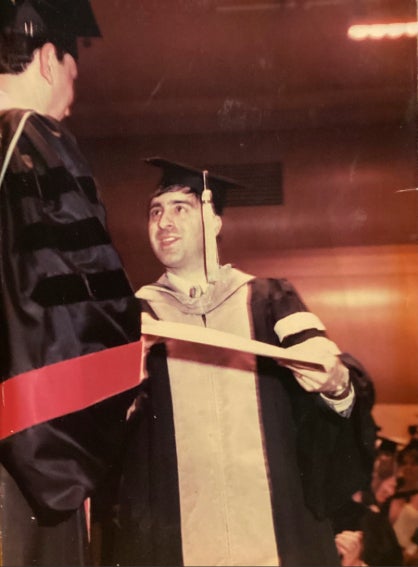
Throughout his medical ordeal spanning four academic years from 1978 to 1982, Aftoora kept his spot at the School of Dental Medicine open. With his health restored, he was ready to reclaim his dream of becoming a dentist and re-enrolled at the School of Dental Medicine.
“The only adaptation that set me apart from my classmates was operating the foot pedal with my right foot versus my left foot, which is standard,” said Damiano. “Otherwise, I performed excellently in all regards.”
After graduating with the Class of 1989, he built a thriving 35-plus-year solo practice in Syracuse, from which he recently retired.
“I promised myself long ago that I would share my story with other struggling, doubtful dental students,” said Damiano. “Serious obstacles are no match for any goal you put your heart and mind into attaining.”
Click here to read Dr. Damiano’s complete first-hand essay detailing his 11-year journey to receiving his dental degree.
We sat down with Dr. Damiano to discuss his extraordinary story of resilience, institutional mentorship and his robust dental career.
Beyond titles and accolades, what does a "meaningful career" look like to you?
By definition, the meaningfulness of your career can only be measured in retrospect when you retire completely from dentistry. Factors that can influence the personal satisfaction flowing from one's vocation, for better or worse, may materialize in a matter of seconds, either at the beginning or the end. The strongest indicator of what made your career meaningful is how you feel you were perceived by your clientele as an empathetic patient advocate. A full waiting room, extravagant lifestyle or a big bottom line are not measures of meaningfulness. In fact, you risk that your patients will conclude that something is wrong. Either you are scheduling poorly and don’t care, or you are very slow, understaffed or overcharging them. The duration and degree of your trustworthiness and empathy that transcended your practice will prevail in your consideration of what gave your career true meaning.
What is a shift in your specialty that excites you most in the next decade?
I don’t specialize per se, but I'm excited to see general dentistry advance by offering treatment options once reserved for specialists. Endodontic apex locators, digital imaging, Invisalign and implementing cone beam for implant placement are examples that come to mind.
What message would you like to share with the next generation of dentists as they begin their careers?
Take heart knowing AI will never replace a dentist. Compassion, empathy and good judgment are wholly human and inseparable from the practice of healthcare. You would be doing dentistry a favor by cultivating those attributes, thus moving what we do further from being taken over by automation in the eyes of our patients. On the other hand, dentists who don’t implement AI in their practice are sure to fall behind their peers who do.
If you could go back to your time at CWRU School of Dental Medicine, what is one piece of advice you would give yourself?
If I had to do it all over again and perhaps do it better, I would take my own advice to find an appointment clerk like Mrs. Carole Zalokar and a study partner as compatible as Dr. Shelly Boss!