

All Stories
August 25, 2016
A risk for sudden death in epilepsy that often goes unmentioned The New York Times: Samden Lhatoo, professor of neurology, talked about increased attention paid to sudden unexpected death in epilepsy.

August 25, 2016
Why do critics still hate Andrew Wyeth? Observer: Henry Adams, the Ruth Coulter Heede Professor of Art History, discussed why more positive attention has been paid to the late artist Andrew Wyeth. “In the 1960s, abstraction was the most dominant form of art,” he said. “Now, the most engaging art…

August 25, 2016
The Sound of Applause ideastream: Jared Bendis, creative new media officer, discussed the latest technology news, including how Pokémon Go has helped Apple and an initiative to help older adults using technology.
August 25, 2016
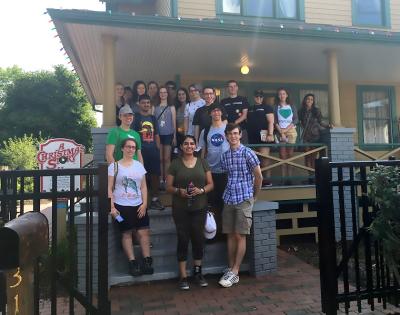
Editor’s Note: To get an up-close perspective of some of the first-year students’ introduction to their new home, the editor of The Daily, Katie Laux, joined students on the Creates Adventure, watching them experience different parts of Cleveland for the first time and witnessing the early start of…
August 25, 2016
In microseconds, every light ray that enters the eye triggers an explosion of coordinated cellular events. Entering light rays focus on a light-sensitive tissue at the back of the eye called the retina while nearby nerve cells convert the rays into cascades of signals that travel through the optic…
August 25, 2016
Despite years of research, cellular mechanisms contributing to cancers like esophageal adenocarcinoma have remained elusive. What has puzzled researchers was how genes in the healthy cells lining the esophagus turned the normal cells into malignant ones. Now, researchers from Case Western Reserve…
August 25, 2016
A new study reveals a counterintuitive cellular strategy that may protect insulin-producing cells from destruction during type 1 diabetes. Type 1 diabetes is an autoimmune disease that accounts for about 5% of the nearly 30 million diagnosed cases of diabetes in the United States, according to the…
August 25, 2016
Fabio Cominelli, MD, PhD, a professor in the departments of Medicine and Pathology at Case Western Reserve University School of Medicine and Director of Case’s Digestive Health Research Institute, has received a five-year renewal program project grant totaling $9.7 million from the National…
August 25, 2016
Brain cells grow faster in children with some forms of autism due to distinct changes in core cell signaling patterns, according to research from the laboratory of Anthony Wynshaw-Boris, MD, PhD, chair of the department of genetics and genome sciences at Case Western Reserve University School of…

August 25, 2016
Case Comprehensive Cancer Center researchers identify several structurally abnormal genes in esophageal adenocarcinoma in first ever genome-wide search Despite years of research, cellular mechanisms contributing to cancers like esophageal adenocarcinoma have remained elusive. What has puzzled…