Arab American Heritage Month: Meet three Arab American members of the CWRU community
In recognition of Arab American Heritage Month, which takes place annually in April, we’re celebrating the accomplishments and experiences of three Arab American members of the CWRU community. Discover more about their experiences at the university—and learn how their heritage has impacted their lives.
Answers have been edited for clarity and length.
Jumaa Baker
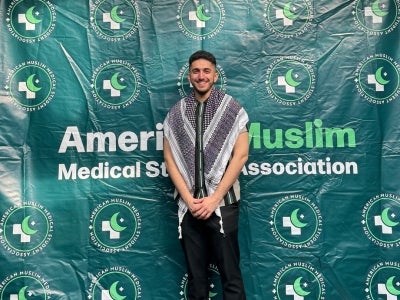
A third-year Doctor of Medicine student, Jumaa Baker serves as chapter president of Case Western Reserve University’s Health, Aid, Education and Leadership (HEAL) Palestine, an organization that provides on the ground services and aid to people in Gaza. As part of HEAL, Baker worked with the Cleveland chapter to help bring three children from Gaza to the Cleveland Clinic to receive needed care. On campus, Baker is also the social chair of the National Arab American Medical Association NextGen and former president of the American Muslim Medical Student Association.
Q. What does your cultural heritage mean to you and how has it influenced your identity and experiences on campus and beyond?
My family is originally from the Palestinian territories—my paternal grandparents were born in Yaffa and my maternal grandparents were born in Jerusalem. My cultural heritage means a lot to me, especially as it has been amplified and scrutinized over the last three years. This gave me the opportunity to share the perspectives and experiences of myself and my family back home with classmates who were unfamiliar with my origin and identity.
Q. In what ways have your cultural experiences shaped who you are today and the impact you hope to make moving forward?
I grew up in a town in Illinois called Bridgeview, which is colloquially known as "Little Palestine" due to its large Palestinian American population. This community has many schools, restaurants and other businesses similar to ones in the Palestinian territories today. Traditions of hospitality, strong family ties and values, and respect for myself and others shaped my upbringing in this community.
Q. Why do you think it’s important for institutions like CWRU to celebrate and recognize various cultural heritages?
I think it is important for institutions to celebrate different heritages, as many graduates from CWRU and other universities enter a society and economy that are deeply globally connected. There is significant diversity among Arab Americans, with many distinct cultures and identities encompassed within what can be defined as Arab, as well as a wide range of religious backgrounds and dialects. It’s important to keep an open mind and avoid assuming that all or most Arabs fit into a pre-set idea.
Catherine Esper
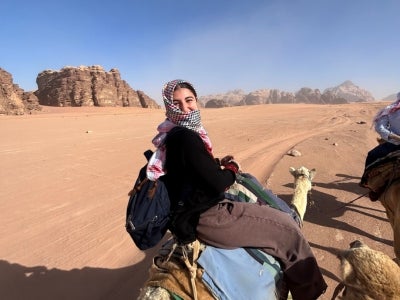
Between 1957 and 1964, Catherine Esper’s grandparents immigrated to the United States from Jordan and Syria. Today, Esper is a second-generation Arab American and a fourth-year political science, psychology and music student at the College of Arts and Sciences. In addition to her studies, Esper serves as president of the Middle Eastern Cultural Association and participates in the campus music scene as a violinist.
Q. Growing up, what traditions, values or experiences most shaped your connection to your heritage?
Growing up, my connection to my heritage was shaped through my family and the traditions that were part of our everyday life. Some of my most meaningful memories come from time spent at my Tata’s house, where she prepared traditional meals and we gathered to share dishes like mansaf and makloubeh—moments that formed my earliest and most cherished ties to my culture. That connection was further strengthened through traditions such as drinking Arabic coffee after meals and having elders read our coffee cups, as well as being surrounded by the Arabic language at home and in conversations with family abroad.
More than anything, it was the time spent with my family—listening to their stories, learning from their experiences, and being immersed in their way of life—that most deeply shaped my connection to and pride in my heritage.
Q. In what ways have your cultural experiences shaped who you are today and the impact you hope to make moving forward?
I come from a family that made many sacrifices to build a life here, which instilled in me a strong sense of responsibility to make the most of my opportunities. Because of this, I sought out ways to connect more deeply with my roots, including a short-term study abroad experience to Jordan in 2024. Visiting my homeland for the first time was incredibly meaningful and inspired me to pursue a minor in Arabic at CWRU.
I also explored these interests academically through my senior capstone project in political science, where I studied orientalism and examined representations of the Middle East in broader political and cultural conversations. At the same time, my culture has shaped how I interact with the world around me. I try to carry the generosity, warmth and strong sense of community that define Middle Eastern culture into my everyday interactions. At CWRU, that has meant being intentional about making others feel welcomed, taking the time to hear people’s stories, and valuing the diversity around me.
Q: What do you think the campus community should know about Arab heritage in general?
I think one of the most important things to understand is that Middle Eastern culture is so beautifully and intricately diverse. It spans many countries, traditions and experiences—each with its own history and identity. There is much richness in Arab culture, from its emphasis on family and community to its many traditions, foods, music and overall hospitality. With this in mind, I would encourage people to approach Arab culture with curiosity and openness, and take time to learn, ask questions and engage with our culture. There is so much to gain from simply being open to understanding one another!
Sarah Shendy
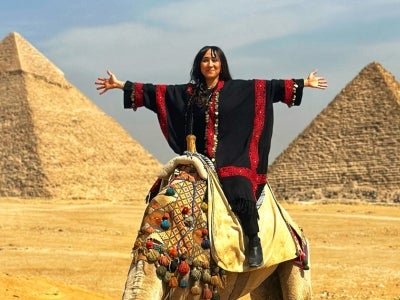
A first-generation Arab-American with roots in Saudi Arabia and Egypt, Sarah Shendy is a lieutenant of training and professional standards at the Division of Public Safety. Born and partially raised in Saudi Arabia, Shendy has used her knowledge of Arab culture to assist in dozens of cases as a victim advocate at CWRU—and beyond. This year, Shendy celebrated her 18-year anniversary in uniform and spoke at the CWRU Unity Banquet, hosted by the Office of Multicultural Affairs.
Q. Growing up, what traditions, values or experiences most shaped your connection to your heritage?
During my childhood, my family lived in Saudi Arabia and Egypt. We immigrated to the United States when I was 6 years old. When asked where I am from, I say Egypt because my family is 100% Egyptian despite growing up in three different countries. Growing up, my parents did a phenomenal job assimilating while helping us maintain our ties and love for our culture, religion and language. We listened to Arabic music, watched Egyptian TV and ate my mom's delicious Egyptian cooking. I am happy that I maintained a comfort level with speaking Arabic. As an officer, it has helped me assist victims of crime across Ohio.
Q. What does your cultural heritage mean to you, and how has it influenced your identity and experiences on campus and beyond?
My cultural heritage means everything to me. When I was younger, I didn't realize what a privilege it is to come from a country that at one point led the world in math, science, medicine, astrology and even makeup. My heritage is my whole identity—I talk about it every chance I get. Being raised in an Arab-American Muslim household absolutely primed me for a career in public safety. The culture and religion embody compassion, empathy, leadership, community and forgiveness, which shapes how I police. At CWRU, I am able to relate to students in the United States for the first time, who are learning to speak English or are unfamiliar with the justice system. I am always happy to help them adjust. I even taught a safety 101 class in Arabic!
Q. What do you think the campus community should understand about Arab American heritage, and why is it important for institutions like CWRU to celebrate and recognize diverse cultural identities?
Everything that we do and believe in is full of love and compassion. Our culture is extremely family driven. We love good food and good music. Our language is beautiful and full of words that are so heartfelt that we cannot translate them into English. We do our best to take care of our families, especially our parents. They sacrificed so much to get us to where we are today.
It is important to celebrate and recognize diverse cultural identities because that is what makes CWRU special. The diverse makeup of our population is what makes our university and community unique and attractive. Every culture matters and everyone is important to make us who we are today.