The body heals itself with collagen. A CWRU lab spins it into surgical thread
A conversation with Ozan Akkus, PhD, engineering professor and entrepreneur, CWRU alum, and co-founder of CollaMedix
Collagen is the most abundant protein in the human body. It builds tendons, ligaments, skin, and bone.
When a surgeon repairs a torn rotator cuff, however, the suture they use is almost always synthetic—polyethylene or polypropylene. Strong and predictable, yet entirely foreign to the body.
A Cleveland-based startup founded out of a Case Western Reserve University lab is trying something different. CollaMedix is blending synthetic sutures with collagen monofilaments to enhance integration between the suture and host tissue.
The technology emerged from the Orthopaedic Bioengineering Laboratory at Case School of Engineering, led by Ozan Akkus, PhD (GRS ’00, mechanical engineering). As the Kent H. Smith Professor, Akkus has spent two decades studying how mechanical forces shape biological tissue.
His lab has developed methods to compact and align collagen fibers into thread strong enough to withstand surgical handling and physiological loading. CollaMedix licenses that process from CWRU and now manufactures it in a facility near campus.
This year, CollaMedix expects to bring its first product—a hybrid collagen suture for rotator cuff and tendon repairs—to market. A second device, a bioregenerative resorbable mesh for treating stress urinary incontinence in women, is also in development. The company will begin its first human trials at Cleveland Clinic, MetroHealth, and Duke this spring.
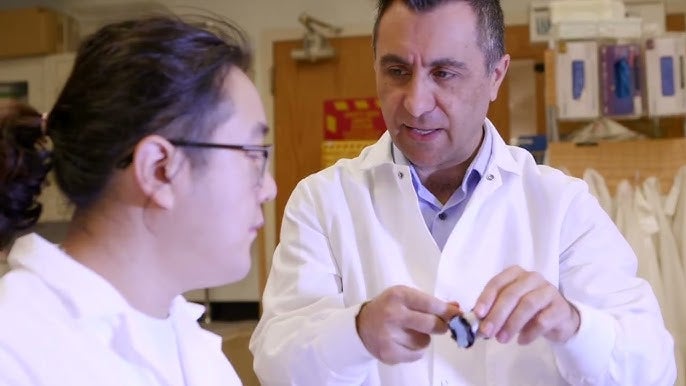
To date, the company has raised more than $11 million—much of it through competitive federal research grants.
Yet, CollaMedix is not his first startup. Earlier attempts to commercialize ideas provided lessons he now credits with shaping the company’s trajectory. He’s also co-founded a second company, ArthroNovus, working on joint repair.
In the conversation below, Akkus speaks about moving a discovery from his lab into a company, his attempts to build ventures, and what he tells engineering students who want to try it themselves.
Can you walk us through the journey that led you to start CollaMedix?
At CWRU, my lab conducts basic science research. In one of our projects, we discovered we can process collagen to compact, condense, and align the fibers better than before. Collagen is the building block of our body; it constitutes load-bearing tissues such as skin, tendons, and bones.
Collagen is the most abundant protein in our body. The ability to condense and reshape collagen has enabled us to create medical devices for functional tissue repair with applications in orthopedic musculoskeletal injuries and urinary incontinence in women.
These medical devices will be safer and promote tissue regrowth and strengthening in ways the current synthetic materials do not.
Our lab was initially focused on biophysics-based research, where we were trying to understand the effects of electrical processes on collagen molecules.
When I realized we could restructure collagen in extremely beneficial ways, I felt my career would be more impactful if this basic science work could be translated and brought to market.
How did the academic and research environment at CWRU shape your venture?
CWRU is very strong in healthcare and engineering, and the university cares about its faculty and students. I felt I was getting good feedback and was in a good environment to collaborate with people from other schools and local hospitals.
The university’s Technology Transfer Office was also a very helpful resource for me, and seed funds were also crucial to test feasibility.
Looking back, what strategic moves would you have done differently at the beginning of CollaMedix?
Before CollaMedix, I tried to bring other ideas to market through my own efforts along with entrepreneurially-inclined trainees. These efforts, where we played the role of entrepreneurs as academics, were unsuccessful. Launching an idea and developing a product is not possible with part-time commitment.

CollaMedix has been successful in part because two experienced entrepreneurs—[CEO] Donna Richardson and [CTO] Subba Shankar—have taken on the commercialization. I provide scientific support and technical input. Meeting the regulations required to bring medical products to market is a decade-long process and is difficult to navigate.
My experiences in earlier ventures shaped how I approached building CollaMedix and looking back there is nothing I would do differently.
I think it is important to realize that entrepreneurs on the team reduce the energy threshold of translation. They are the true catalysts.
What was the most valuable or formative aspect of your time at CWRU, and how has it influenced your career?
The interdisciplinary nature of Case Western Reserve was one of the most notable aspects of CWRU’s influence on my career.
The Weatherhead [School of Management], School of Engineering, and School of Medicine are all very collaborative. Overall, the research community is highly collegial and constructive. Faculty love to work together and address big challenges.
CWRU also has the optimal size; people are not lost in the crowd as they might be at a Big Ten university, but it is also not too small to restrict the number of people you can collaborate with. You run into friends on the [Case] Quad and a brief conversation may generate an interesting idea.
How did others play into your CollaMedix research?
I work closely with other faculty and lab members and frequently participate in joint disclosures. Our collaborations have helped attract major federal funding, such as our ARPA-H-funded team project that included 12 CWRU faculty members working to create the first living knee joint.
These initiatives involve researchers from across all schools—the [College of] Arts and Sciences, [The Jack, Joseph and Morton Mandel] School of Social Sciences, as well as the medical and engineering schools—because large, complex challenges require diverse, interdisciplinary teams. Increasingly, pursuing ambitious projects as a single principal investigator is insufficient; success now depends on having multiple experts contributing their unique skills.
What’s the No. 1 thing you want people to remember about you as a founder?
In all of my ventures and all of my patents, and all of the work I collaborate on, I want to be remembered as someone who extended opportunities to his environment. I want to facilitate others becoming inventors and entrepreneurs.
Trust is also very important to me; I want to be known for being someone who is trusted, keeps his word, and plays his part in endeavors reliably.
What does growth look like for CollaMedix in the next few years?
CollaMedix is looking at some very exciting updates in 2026.
Our journey developing CollaMedix products required developing the product, scaling process, and earning FDA approval.
FDA approval is a time-intensive process, with the product needing a strong folio of test data, as well as toxicology data among many other requirements. We spent the past eight years working hard to develop a seamless process to manufacture collagen threads, from which an array of biological textiles can be fabricated using processes such as braiding, weaving or knitting.
Looking forward, we are going to be submitting the premarket notification to the FDA for our first product this year. Next year, we are gearing up for our collagen sling implants to be applied to the first cohort of women in three clinical trial centers under an investigational device exemption.
Getting our first product approved is super exciting news!
Given that collagen is the basic building block of many tissues, the development of many devices is feasible in the future because the CollaMedix concept is a platform technology with an extensive number of use cases.
What motivates you to be a founder, and would you build a startup again?
I would definitely love to be involved in multiple ventures.
Even now, I am working with ArthroNovus on joint repair products, so I actually already have two startup email [addresses].
What I really like about being a founder is encountering a variety of complex problems and finding creative solutions to them. I love tinkering with processes as a team and taking that teamwork approach to solving problems.
I especially thrive in solving problems with certain constraints, such as scalability, industry regulations and standards, modeling, and marketing. I like the intellectual challenge that comes along with running a venture and would love to continue to build and grow my ideas.
Katie Critchett is a fellow with the CWRU Alumni Venture Fund.