Bringing CWRU's historic banners back into view
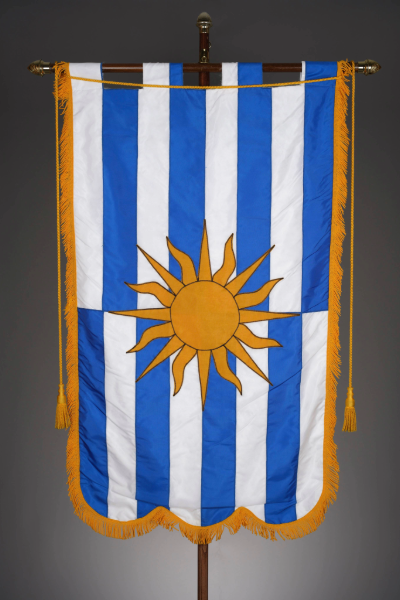
In June of 2025, Kelvin Smith Library (KSL) staff pushed together conference room tables and began to unroll large cloth banners and strings of tassels wrapped around sturdy poles. As each banner stretched across the tables, the staff guessed, based on the symbolism, which banner represented which Case Western Reserve University school. Bright reds, yellows, greens and blues filled the room; colors and symbols traditionally used by heralds at England's College of Arms. They were examining designs by herald Anthony W. C. Phelps, created as part of CWRU’s 150th anniversary in 1976, celebrating the founding of Western Reserve College.
Nearly 50 years later, library staff envisioned recreating these historic banners on a smaller scale and displaying them prominently in the Kelvin Smith Library’s main stairwell. KSL reached out to CWRU University Programs and Events with a bold request: Could we borrow the original heraldic banners to capture high-quality photos for display and then further share them online? To our delight, the answer was yes! Because these banners are traditionally used in university ceremonies, we had a small window of time to take this on, after commencement in May and wrap up our work with them before convocation in August.
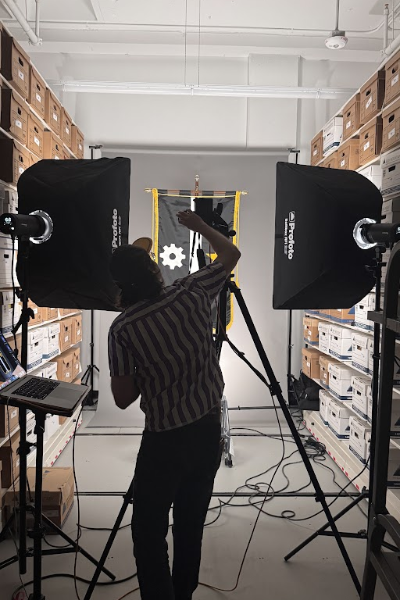
Which brings us back to June, marking the beginning of an ambitious project. Before Digitization Specialist Zach Fox could begin capturing these historic objects, the Kelvin Smith Library invested in specialized lighting equipment designed for projects of this scale. The upgrade not only made this project possible but also expanded our capacity to capture any three-dimensional object. Consideration also needed to be given to where these items would be photographed. They were simply too large to photograph in KSL’s own digitization lab or anywhere else in the library. The solution was to photograph them at the KSL Collections Annex, located in the basement of the building known as the 11000 Cedar Incubator.
“From setup to teardown, it took me about four days,” Fox shared, “with half of those days dedicated to adjusting and troubleshooting to get the lights and positioning of the banners just right.” Each banner, when standing upright on its pole, is just under seven feet. Which meant that the backdrop alone needed to be twice the height of the banners, and almost every adjustment, including the camera, lighting and objects themselves, required climbing a ladder. It was meticulous work, but essential to meeting the goal of preserving and making these banners accessible for generations to come.
Fox adds, “Most students only see the banners on their graduation day, and even fewer are familiar with what the colors and symbols on each represent. By making them accessible online through platforms like Digital Case, we can connect current and former students as well as faculty and staff to these objects that stand as symbols of the university's rich past.”
Now, anyone can view, download, and share images of these historic banners here.
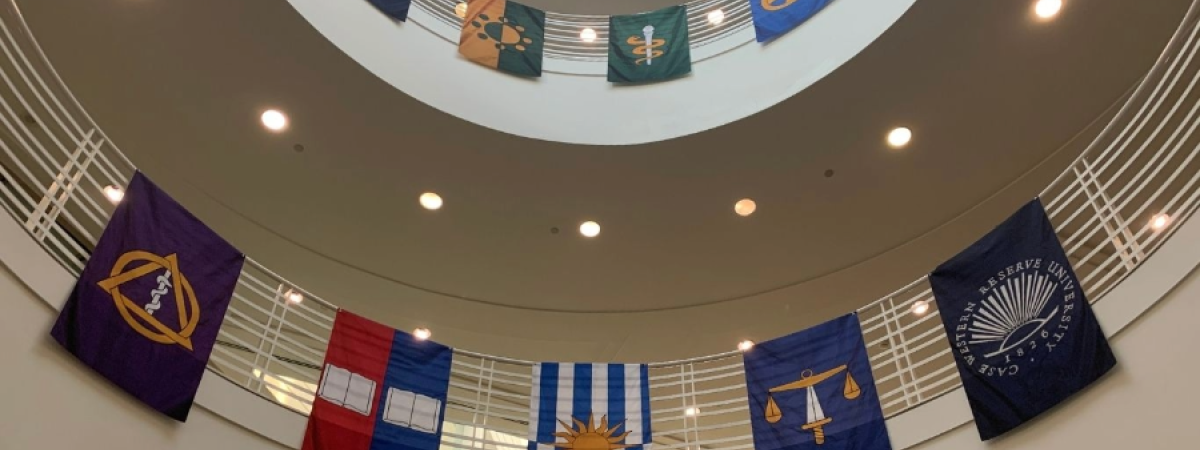
Nine of these banners have been replicated and are on display in the central staircase of Kelvin Smith Library. KSL’s exhibits librarian faced a challenge in finding a specialty product compatible with our large-format printer. They searched through our purveyors and requested material samples to match a fabric-like look. The new high-resolution images were printed in-house on a cotton and polyester fabric blend, fitted with metal fasteners and displayed prominently so that all library visitors can view part of this historic collection. The banners are supplemented by signage that provides context and brief facts about them, all of which create a tangible connection to the past for visitors. Representing both closed and continuing schools across the university, the banners honor both legacy and present.
Additional library activities will continue to celebrate our university’s history, including a Special Collections exhibit in Spring 2026 exploring the History of Schools of the University, both those that remain and those that have closed, such as the School of Library Science.