Building bridges to better health: How two CWRU students are advancing health literacy
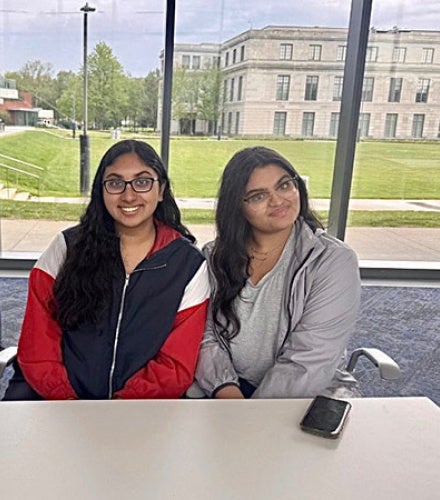
When Case Western Reserve University juniors Aditi Bohre and Mahek Goel began gaining healthcare experience through various volunteer opportunities and jobs, they came to the same realization: Many people struggle not only to understand their health but also the systems they must navigate to receive care.
“Cleveland has some of the best healthcare institutions in the country, but proximity to world-class care doesn’t necessarily mean everyone can easily access or navigate it,” said Bohre. “Through my job as a patient care nursing assistant at Cleveland Clinic, I’ve seen how barriers such as transportation, language, health literacy and unfamiliarity with the healthcare system can still make those resources hard to use.”
With that in mind, Bohre and Goel—both pre-med students studying neuroscience, CWRU’s fastest-growing major—started Bridges Beyond Barriers, a nonprofit that works to reduce healthcare barriers and inequities by promoting health literacy. Their goal is to help people feel more confident taking charge of their health, making informed decisions and navigating the healthcare system.
Bridges Beyond Barriers does this by working directly with local organizations, including the Cuyahoga County Juvenile Detention Center and Cleveland Hope Lodge, to offer health education workshops. Each workshop is designed to be interactive, combining discussions, case scenarios and hands-on activities to cover topics such as healthy lifestyle habits, preventive care and digital medical tools like MyChart.
Beyond workshops, Goel and Bohre have also created online resources hosted on the Bridges Beyond Barriers website, including multilingual medical terminology guides and activity books for children. They’re even developing a board game to teach health concepts to kids in a more engaging way—an idea inspired by CWRU Associate Professor Ashley Nemes-Baran, PhD, who used a board game to teach the properties of neurons in one of their classes.
“CWRU has played a huge role in shaping both my perspective and our nonprofit,” shared Goel. “As a pre-med student, my coursework in neuroscience and sociology has taught me not only about the methods and value of education but also to understand the biological and social factors that influence health.”
Goel’s experiences outside the classroom reinforced those lessons in real time. Through her involvement in organizations like PERIOD and Universal Health Aid, Goel worked directly with communities on health education initiatives. One especially formative experience was giving a reproductive health education presentation at the Cuyahoga County Juvenile Detention Center.
“I learned a lot about how differently you have to approach health education depending on who is in the room,” she said. “The activities, language and way of starting conversation all have to make sense for that particular audience.”
That philosophy continues to shape how Bridges Beyond Barriers develops its programming. The organization works with the community to understand which health issues matter most to the people they serve, then tailors each workshop to those needs as well as the audience. A session for children might focus on emotional well-being through games and activities, while workshops for adults may address health insurance.
As Bridges Beyond Barriers continues to grow, Bohre and Goel hope to expand both its reach and its impact across Cleveland by building more long-term partnerships with schools, community centers and other nonprofits, as well as by distributing health literacy materials through libraries and other public spaces.
By centering community voices and making health education accessible and approachable, Bridges Beyond Barriers is helping people feel empowered in their healthcare journeys because, as Bohre put it, “Health literacy should be part of treatment itself, not an afterthought.”