A dual perspective: a 3L’s path through health law and social work
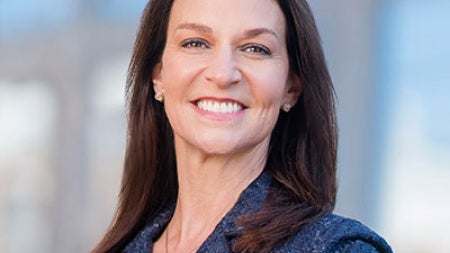
By pairing a JD with a MSW, Noah Perrin blends hands-on social work, health law scholarship and state agency experience to advocate for underserved populations.
Noah Perrin’s academic journey consists of two intertwining paths: law and mental healthcare. Since the day he graduated from Eastern Michigan University in 2022 with a Bachelor of Arts in political science and Bachelor of Science in Psychology, he has carefully explored each path—spending time working in both spaces.
“There's just something about mental health and law that's really interesting,” said Perrin, now a third-year student at Case Western Reserve University School of Law. “[People with serious mental illness] sometimes go unnoticed. You don't hear a lot of people interested in that area of law, but there are so many ways this group is regulated on a day-to-day basis—hurdles they have to go through, things they have to do to get basic services. There’s a lot of work that can be done.”
Perrin’s dual interests are what led him to take a year off after undergraduate school to work as a mental health case manager at a community behavioral health center. He worked with patients with severe and persistent mental illness, helping coordinate their care, housing, and Social Security, Medicaid and Medicare benefits.
He was eventually drawn to CWRU in 2023 because of the dual Master of Social Work (MSW) and JD degree, which allows him to combine his seemingly divergent passions. During his first year, Perrin received the Wurzburger Health Law Scholarship—one of the many opportunities for financial support at CWRU School of Law—which supports aspiring health law professionals who show exceptional promise in advancing health policy and legal frameworks and protecting the rights of patients and communities.
Perrin threw himself into his legal education, taking courses and working at the law school’s Health Law Clinic. He spent his second year at the social work school and completed a placement at The Centers for Families and Children—one of the oldest and largest health and human service agencies in Northeast Ohio—where he supported the harm reduction team, screened patients, researched regulations, and assisted the agency in compliance work.
Summer learning
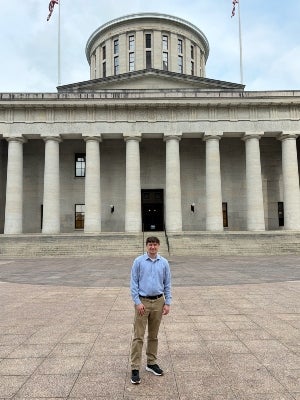
By 2025, Perrin was back in law school, finishing up his second year of coursework and lining up his latest experiential experience that brought together his two interests: a summer externship in the procurement department with the Ohio Office for Medicaid in Columbus.
From May to August, Perrin worked on agency contracts, making amendments, drafting language and procuring products and services. But it’s the research he liked most.
“That's really my favorite thing to do,” he said. “Say there's a service that we need to contract out that is in the law. So what does this mean? What do we need to have the agency do? What do we need in the contract? I’m spotting issues and helping make the agreements make more sense for people.”
His two years of coursework gave him a solid foundation as he navigated the landscape of Ohio’s healthcare system.
“When you go into a government agency, people just keep throwing around acronyms. It’s like a different language,” Perrin explained. “But the class I took—”Healthcare Finance and Regulation”—it was almost like I had some fluency in that language.”
As he finished up his externship in August, Perrin reflected on what it was like living in Columbus.
“I think it's been a good change of scenery,” he said. “It's been cool to be in the capital as a legal intern because you have the Supreme Court and the Statehouse right there. We went to a controlling board hearing on my first day. I've never experienced that, so it was interesting to see how that worked.”
Now back at CWRU, Perrin will finish up his dual degree and get closer to his ultimate career goal: mental disability law. His final year will include taking courses in mental health and constitutional law. He’ll also be working in the law school’s Human Trafficking Clinic all year, which simultaneously satisfies his MSW placement and JD capstone requirements.
It’s admittedly a lot to juggle, but Perrin insists it’s all been worth the effort.
“In law, I think you can sometimes lose sight of other fields,” he said. “But when you mix it with something like social work, you get a different perspective. You can think: ‘How is my client? What are other things in their life that will help them?’ It’s helpful to have these perspectives, so you can be a bit more creative and stand out from other attorneys.”