Emeritus engineering professor Eli Reshotko passes away
For nearly four decades, Eli Reshotko, PhD, helped guide the evolution of engineering research and education—thoughtfully and with a deep commitment to both students and faculty. A respected scholar and leader, he played a central role in building internationally recognized research programs while mentoring those who would carry the work forward.
The Case Western Reserve community and the broader engineering field are now remembering Reshotko, who died on Dec. 6 at age 95.
Reshotko pursued a lifelong passion for engineering, earning his undergraduate degree from Cooper Union, a master’s degree in mechanical engineering from Cornell University, and later a doctorate in aeronautics and physics from California Institute of Technology.
Reshotko joined the Case Institute of Technology in 1964, bringing with him a growing national reputation for foundational research in aerodynamics and fluid mechanics developed during his time working at what is now known as the NASA’s Glenn Research Center. He went on to chair the Department of Fluid, Thermal and Aerospace Sciences, which became the Department of Mechanical and Aerospace Engineering, and later served as dean and interim dean of the Case Institute of Technology from 1986 to 1987. He was elected to the National Academy of Engineering in 1984 and received numerous awards for his work, in addition to serving on and leading a wide range of committees and boards.
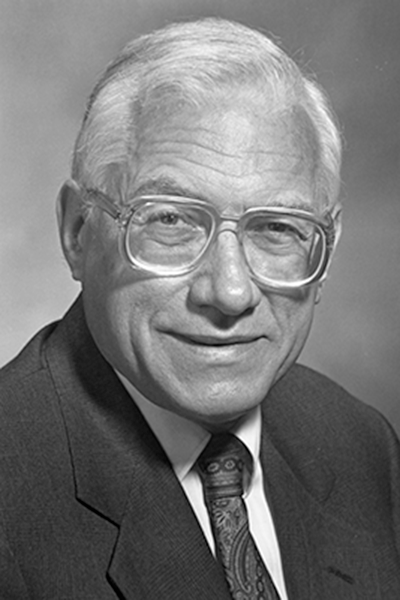
"Eli Reshotko was a man of remarkable scholarly achievement combined with an incomparable quality of character," said Chris Zorman, PhD (GRS ’91, ’94, physics), interim dean for the Case School of Engineering. "Stories abound of Dr. Reshotko's mentorship, wisdom, steady leadership, kindness and a great sense of humor. We at the Case School of Engineering are honored to have had such a titan among our faculty ranks. He will be sorely missed."
Reshotko was internationally known for his pioneering work on compressible boundary layers, their stability and transition. While at CWRU, he continued to collaborate closely with NASA, leading and contributing to research on topics ranging from fluid transfer in propellant tanks to icing and hypersonic flight—much of it supported by NASA-sponsored grants.
Within the university, Reshotko’s influence extended well beyond his research. As a department chair in the 1970s, he helped guide CWRU’s aerospace and mechanical engineering programs to international prominence, attracting students and faculty from across the country and around the world.
“Professor Reshotko laid the foundation of modern fluid mechanics and related research fields, and significantly improved the understanding and design of high-speed aerospace systems,” said Robert Gao, PhD, chair of the Department of Mechanical and Aerospace Engineering. “The department is fortunate to have been associated with such a world-class scholar as Eli Reshotko.”
Reshotko was equally admired for his teaching and mentorship. Known for his clarity in explaining complex physical concepts, he emphasized a deep understanding of fundamentals and their application to real-world challenges. Former students and colleagues recall his welcoming demeanor and reassuring presence, and many credited him as a mentor whose guidance shaped both their careers and the culture of the department.
“It is heartwarming to read the many reflections shared by colleagues,” Gao added. “Whether from a former graduate student more than 40 years ago, a newly-hired faculty member at that time or colleagues who worked alongside him for many years, they all share one thing in common: He was an exceptional individual, a true leader, both scholarly in achievement and humane in character.”
At Case Western Reserve University, Eli Reshotko is remembered not only for the scientific trail he blazed, but also for the community he helped build—one grounded in intellectual rigor, thoughtful leadership and a lasting commitment to educating the next generation of engineers.
Read Reshotko’s formal obituary.
Students who would like support during this time are encouraged to contact University Health and Counseling Services at 216.368.5872. This line is staffed by a counselor 24 hours a day, seven days a week. Faculty and staff can access counseling at any time by calling AllOne Health (formerly IMPACT Solutions) at 1.800.227.6007.