An enduring legacy: CWRU students share how their mentor-mentee relationships have shaped their experiences
A mentor can make a lasting impression a pupil carries through life—transcending career stages. Hiba Obeid, a PhD student in genetics at Case Western Reserve University, is an example of just that, often reflecting on the lessons she learned from Elias Rahal, her master’s program faculty mentor in Lebanon.
“He didn’t just teach me the technical skills of being a scientist; he truly believed in my capabilities,” said Obeid. “His mentorship was the foundation that gave me the confidence to pursue my PhD and be where I am today.”
Thousands of miles and years removed from those impactful lessons, the insights Rahal imparted on Obeid reverberate at Case Western Reserve University. Now, Obeid shares what she’s learned with Karisa Liaw, a fourth-year undergraduate student she mentors in the Chopra Lab at CWRU.
Mentorship relationships are like a family tree, with lessons passed down from generation to generation. At Case Western Reserve University, women in science are carrying those lessons forward—supporting one another in fields where mentorship can be the difference between staying or stepping away. In recognition of Women's History Month, celebrated annually in March, we spoke with three women who share a common mentorship lineage.
“Mentorship is the backbone of the scientific community; it is the primary way knowledge and experience are passed down,” Obeid said.
Teaching practical skills
In science, discoveries are rarely linear and often come after a series of frustrating setbacks. As a new researcher, Obeid quickly learned from her mentors that persistence and patience are necessary qualities in science, and she credits these lessons with her ability to succeed through graduate school.
“My mentors taught me to approach these challenges with curiosity rather than frustration, viewing every unexpected result as a critical opportunity to learn something new,” said Obeid. “The most critical advice for Karisa and other mentees is to remain unintimidated by the unknown.”
In Atul Chopra’s lab at the Harrington Discovery Institute at University Hospitals, Obeid and Liaw’s mentor-mentee relationship developed organically as they experienced the letdowns of failed first experiments and joys of breakthroughs side-by-side in their quest to understand rare genetic disorders. Obeid encourages Liaw to continuously ask questions to drive the research process.
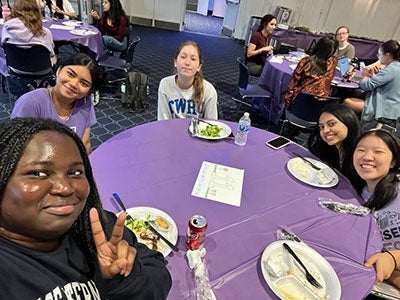
Keenly observing how Obeid carries herself in the lab, Liaw also has taken away the importance of collaboration in science.
“From Hiba, I have learned that science flourishes best in community,” Liaw said. “Hiba has shown me that meaningful scientific work is not done in isolation, but through collaboration, support, and shared curiosity. This perspective has inspired my personal motivations to not only contribute to research, but also to help others feel welcomed and thrive in every scientific space I join.”
Liaw is intent to convey the importance of curiosity-driven collaboration to Meara Evans, whom she connected with through the Women in Science and Engineering Roundtable.
“Mentorship is not only about sharing knowledge or advice, but it is fostering curiosity and creating an environment of mutual growth and collaboration,” Liaw said.
Sharing guidance
Beyond technical skills, Obeid, Liaw and Evans have found mentorship to be a critical component of their career development.
Liaw and Evans both are pursuing double majors in neuroscience and physics, a combination Evans considers to be somewhat unique. Drawing from her own experiences, Liaw shared suggestions of opportunities and connections Evans should make to propel her studies forward. Evans also has taken interest in medical physics after learning about it through Liaw.
“Comparing oneself to peers or feeling pressured to have everything figured out can be overwhelming; instead, it is valuable to learn from those around them, engage with different perspectives, and explore different interests and passions,” said Liaw. “Each experience contributes to growth and everyone is on their own unique path, often leading to unexpected opportunities.”
Taking that guidance to heart, Evans has embraced active involvement on campus, stretching herself to gain new experiences.
“My mentor has taught me that I should prioritize getting involved, putting myself out there and being open to learning about and pursuing new opportunities and paths,” Evans said. “Balancing social and academic commitments is important to getting the most out of your college experience, and what you learn is ultimately more important than the scores you receive.”
Now, as Liaw eyes graduation and graduate school, Obeid is impressed by the student and scientist her mentee has become.
“It has also been a privilege to witness Karisa’s journey through the graduate school application and interview process. Seeing her navigate those milestones with such maturity brings a sense of immense pride in the person and scientist she is becoming,” said Obeid. “These experiences serve as a constant reminder of how impactful the mentor-mentee relationship is for both participants.”