Four questions for the University Archivist
As Case Western Reserve University marks its bicentennial, we celebrate the vital role the University Archives plays in preserving and sharing the stories of the people, programs and places that brought us to this milestone. Every day, archivists make it possible to explore images, records, yearbooks, newspapers and more. Their guidance to students, researchers, and the community serves the entire university ecosystem.
The University Archives has been planning for the bicentennial for nearly a decade, strategically building a foundation of information. We spoke with Helen Conger, archivist at Case Western Reserve University, to learn more about the excitement surrounding the bicentennial and the preparations and projects that help bring 200 years of history to life.
Long before the celebrations began, staff began prioritizing the digitization of records that would resonate most broadly with the community, such as yearbooks and student newspapers. They also invested time in creating and publishing the Archives' finding aids, making it easier for staff and users to search for the information they needed once the bicentennial arrived. The Archives’ early planning has paved the way for publications, exhibits and digital resources that connect the past to the present.
What are some of the most significant contributions the University Archives has made to the bicentennial celebrations, and how is your team working with campus partners to help tell the university’s story?
Planning work for Case Western Reserve University's bicentennial began years ago, and the work continues! Early efforts included working closely with the bicentennial coordinator to research past anniversaries and milestone dates, as well as collaborating with consultants to provide historical context for symbols, colors, and graphics that inspired the bicentennial logo and visual style.
The Archives also made significant contributions to major publications. For the CWRU Bicentennial Book, the team hosted the author for week-long research visits, facilitating access to collections, providing research assistance and digitized images and conducting fact-checking for the book manuscript. Similarly, for a book highlighting Western Reserve Academy (WRA), the Archives partnered with WRA’s librarian to share resources and information that highlight the institutions’ shared history.
In addition, the Archives worked closely with CWRU’s University Marketing and Communications to supply images and historical context for the official bicentennial website, which launched on February 7, and continues to be updated with stories. On a smaller scale, the archives staff also work with individual offices to provide information and images for departmental activities.
How is the University Archives marking the bicentennial, and what special projects or initiatives are you excited about?
The University Archives is marking the bicentennial with a series of its own projects designed to celebrate and share a variety of stories. Visitors can explore four unique exhibits displayed along the hallway walls of the University Archives at 11000 Cedar Avenue, each offering a glimpse into different chapters of CWRU’s 200-year journey.
Online, the University Archives launched Celebrating 200 Years of CWRU, a dynamic site featuring curated stories such as Western Reserve College and the Civil War, the Establishment of the Medical School and CWRU's Monuments Men.
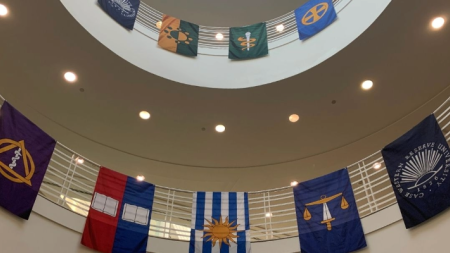
Beyond its own space, the Archives is deeply involved in activities across the library, contributing to projects like the digitization and reproduction of CWRU’s Heraldic Banners, a 2026 History of CWRU Libraries Calendar and special exhibits that highlight the university’s legacy.
What is your favorite CWRU story to tell?
When asked about her favorite story to tell, university archivist Helen Conger admits it’s impossible to choose just one. “There are many interesting stories to tell– happy, sad, inspiring, humorous. It's too hard to pick one,” she says. “But the Archives tries its best to preserve the stories of people associated with the university. We continuously collect information in which memory is embedded and put it to use when needed.”
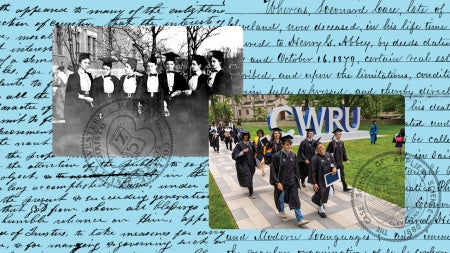
While there are countless stories in the Archives, Conger shares that one of her favorite traditions is commencement. “It’s a celebration of why we’re here, our students, and the joy and pride on graduation day never gets old.”
To share in that joy, visit the Commencement Collection on Digital Case, which features audio recordings, images, invitations, programs, speeches, and more celebrating the accomplishments of graduating students past and present.
Why does preserving and sharing the university’s history matter, and how does it shape the campus community today?
Preserving and sharing the university’s history isn’t always about looking back. It’s often about making sure CWRU can honor its commitments and protect its legacy for generations to come. Conger explains, “For long-lived institutions like CWRU, the consequences of decisions and actions are felt long after they’re made. Some of those actions incur long-term obligations; others confer long-term rights. One of the jobs of the Archives is to ensure the university has a reliable long-term institutional memory so we can meet our obligations and protect our rights.”
That responsibility is at the heart of the mission: to collect, preserve and make available for use the permanently valuable records of the university. One striking example of these long-term obligations is the perpetual scholarships sold in the 19th century to raise funds. Some of these scholarships allowed lineal descendants of the donor to receive four years of free tuition. While many of these were eventually turned in over time and are no longer extant, there are still some that are valid. Accurate records allow the university to meet its obligation.
As we celebrate 200 years of CWRU, these efforts remind us that every story becomes part of a legacy that endures. Digitizing collections, curating exhibits, and creating resources that connect generations allow students, alumni, faculty, and friends to explore the challenges and successes that have shaped CWRU.
Find the pages referenced in this article and other pages of interest in the quick links below.
CWRU’s official bicentennial site
Celebrating 200 Years of CWRU, University Archives blog site
About the University, highlighting quick facts about the history of Case Western Reserve University and its predecessor institutions, including athletics, buildings, symbols, and university life
Student Yearbooks, representing all of CWRU's 19 current and historic schools and colleges
Student Newspapers, representing nine titles held in the University Archives
Images of events, activities, people, places, and things. The digital collection, while growing, represents a tiny fraction of the overall collection.