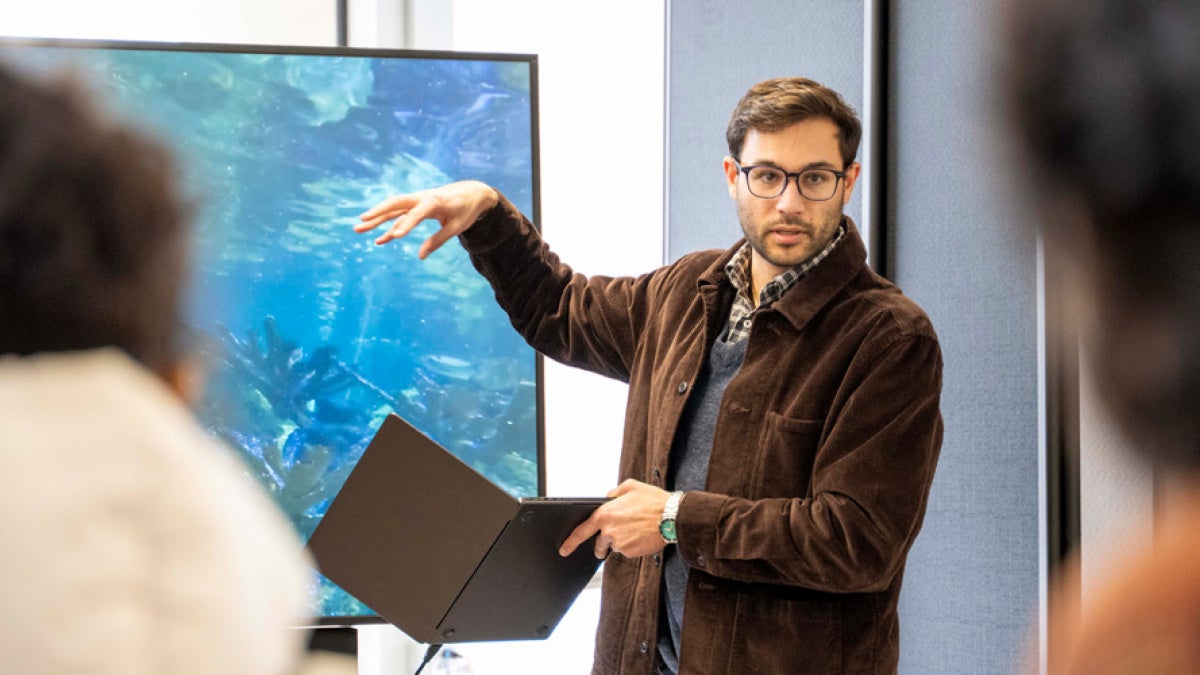
How Case Western Reserve University researcher Zach Patterson uses bioinspired robots to build safer, smarter machines
assistant professor of mechanical and aerospace at Case School of Engineering
Area of Focus: bioinspired robots and control algorithms
Case Western Reserve University researcher Zach Patterson constructs robots taking cues from biology—exploring how they function, move and are constructed—in an effort to build safer, smarter, more efficient robots.

He's interested in near-term research that, in the next five to 10 years, could expand the envelope of what a robot can do in a warehouse, factory, kitchen or beyond.
"What can we make work right now?" said Patterson, assistant professor of mechanical and aerospace at Case School of Engineering.
Part of that includes integrating a wider range of materials and functional systems into robots. The other piece of the puzzle, he explained, is figuring out how to use those new physical capabilities in the robots' control algorithms.
"How can the body make the brain's job easier?" Patterson said.
Animals have found relatively energy efficient ways to move through the world, Patterson explained. Take sea turtles, who are among the most efficient swimmers on the planet thanks to their high endurance and the passive mechanics of their flippers.
Patterson's Lab, Cybernetics and Physical Intelligence Laboratory (CyPhiLab), is working to develop a turtle robot and other bioinspired robots.
"If we can deploy energy-efficient devices that can be as thrifty about using energy to traverse the world's waters, we increase our capability to deploy human accessible machines into remote environments, into the depths, and into our waters in general," he said.
Patterson’s lab is part of the Human Fusions Institute (HFI), a Case Western Reserve University institute pioneering research in neural engineering and human-technology integration. He joined CWRU last year, bringing experience in corporate research and development. Patterson said he was thrilled to join CWRU for its deep legacy in robotics and its research history, as well as the to join HFI, where he collaborates with biomedical engineers and neuro-engineering experts.
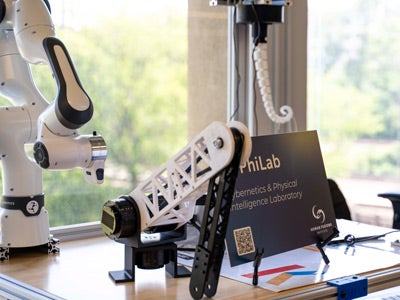
“We're taking this new venture to join robotics with the BME people and with the humanities, to really see how far we can push interdisciplinary research in that context,” he said.
Once he's built robots that rely on nature-inspired mechanics and structure for efficiency, that opens up his next set of questions: How can those unique physical attributes enable safer, smarter robots? What changes in the control algorithms are needed to use the newly unlocked functionality in the body? And how does that expand what the robot can achieve?
For a turtle robot, that's teaching it how to swim, or Patterson said, "best of all, how can we get our robots to figure out how to swim on their own? So that's the intelligent aspect of it."
To support this physical intelligence, Patterson is working on robots constructed of a wider variety of materials, specifically materials integrated with functionality.
He's interested in putting low resolution, soft, tactile-sensing skins on robots that can cover a whole body.
Patterson notes this is work that people have been doing for decades, but the research has often focused on high-density sensing in a precise area. Instead, he's exploring scalable skin architectures for robots.
Currently most robots that bump into something unexpected have an emergency stop function. His goal is to cover a human-sized robot with a skin that would enable it to respond to unexpected bumps without hurting humans, itself or the environment.
"As I think about that, I think about how the skin enables the body to move in new ways and more confidently, knowing that it's okay if I bump into something,” Patterson said. “And if I do bump into something, here's how I should respond.”
This is a critical enabling technology for deploying robots into spaces where every inch isn't perfectly mapped out—anywhere a robot might bump into things, such as a factory or a warehouse floor.
His class and lab provide students hands-on experience with robotics research. Patterson enjoys helping students of all levels find their passion in engineering and robotics, whether that's guiding PhD students as they get started on their own research; or helping undergraduate students as they find their path.
"Students here, when they find what they want to do, they do it," Patterson said. "They're motivated, invested, and when they're stuck on something, they want to hear my thoughts and opinions on it, but they've also worked hard to try to get themselves unstuck. These types of student interactions are what are all big parts of what keeps me invested."