Keeping the signal strong for generations of Spartans
David Caban recognized with Newton D. Baker Distinguished Service award for decades of service to WRUW and student broadcasting
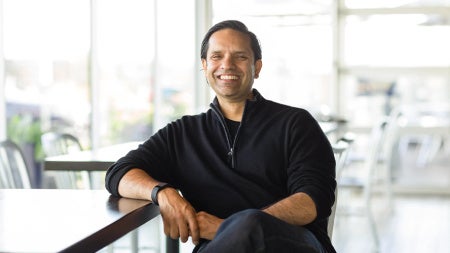
For over four decades, David Caban (CIT ‘89) has remained a steady presence at Case Western Reserve University’s radio station—first as a student discovering a passion, and later as an alumnus helping generations of DJs and student leaders keep that tradition alive.
That commitment earned Caban the 2026 Newton D. Baker Distinguished Service Award from the Alumni Association of Case Western Reserve University. Named for former Cleveland mayor and U.S. Secretary of War Newton D. Baker—a champion of public service, supporter of Cleveland College and co-founder of BakerHostetler—the award recognizes an alumnus, faculty or staff member, or friend of the university whose significant service has helped ensure the institution’s long-term success.
Caban arrived at CWRU in 1984 to study engineering, but quickly found a second home at WRUW-FM 91.1. He got his first radio show in 1985, later served as technical director and student general manager, and never fully stepped away after graduating. In 2003, when WRUW’s technical director role unexpectedly became vacant, he agreed to fill in “temporarily”—a role he still holds more than two decades later as a volunteer.
A longtime host of Sunday Matinee—which has been on the air since September 1985—Caban has also used the station to combine his love of radio and theater. Along the way, WRUW became part of his life beyond campus: It’s where he met his wife, Sue (then Jaconetta) (CWR ‘90)—also a one-time WRUW student DJ—with whom he is celebrating 30 years of marriage this year.
Over the years, Caban has become a source of continuity, technical expertise and institutional memory at the student-run station. He is especially proud of leading the redesign and construction of WRUW’s two primary broadcast studios, modernizing the station’s audio infrastructure while making the spaces more comfortable, reliable and flexible for student and community DJs.
“A DJ shouldn’t have to think very much about the technical infrastructure behind a broadcast,” he said. “They should be able to walk into the studio, sit down and concentrate on doing their show.”
Caban said he hopes his work has helped students focus on making radio rather than struggling with equipment—and that the station remains firmly theirs to shape.
“I want WRUW to be one of the best uses of both a student’s time and the money students invest in activities at CWRU,” he said.