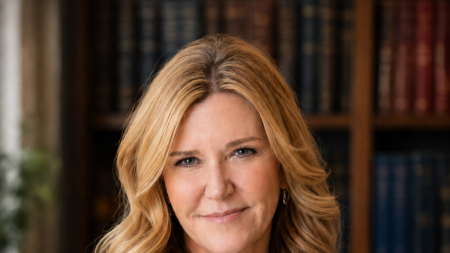
Leading with Curiosity: A Conversation with Alumni Board President Luis Tollinche, MD
From medical school to executive leadership, he reflects on why medicine is a team sport and how alumni involvement creates lasting impact.
For Case Western Reserve University School of Medicine Alumni Board President Luis Tollinche, MD (MED '00), CWRU shaped far more than his medical knowledge—it shaped his approach to leadership, collaboration and life. Recently named Chair of Anesthesiology at City of Hope National Medical Center, Tollinche credits CWRU with instilling a mindset of curiosity and service that continues to guide how he leads, teaches and cares for his patients.
"CWRU shaped me in ways that go well beyond the medical knowledge I gained in medical school," Tollinche said. "It taught me to be curious, to question assumptions and to think about medicine not just as a science, but as a profession with a responsibility to society."
Tollinche was deeply influenced by faculty, mentors, classmates and patients who challenged him to think differently. That foundation gave him the confidence to pursue non-traditional paths across clinical practice, medical education, scholarship and executive leadership.
"Looking back, I appreciate how much CWRU taught me about the importance of relationships," he said. "Medicine is ultimately a team sport, and some of the most important lessons I learned were about listening, collaborating, and understanding perspectives different from my own. Those lessons have stayed with me throughout my career and are particularly important to me now as I lead a large academic anesthesiology department."
Read more about Tollinche’s work with the alumni association, his definition of a meaningful career and his advice for the next generation of medical professionals.
How did you become involved with the School of Medicine alumni association and what would you say to your fellow alumni to encourage them to get involved?
My involvement with the CWRU School of Medicine alumni community grew out of a desire to stay connected to an institution that had such a profound influence on my life. Over time, I became increasingly interested in giving back—not simply financially, but by contributing my time, experience, and perspective.
I currently have the privilege of serving as president of the CWRU School of Medicine Alumni Board. What I've come to appreciate is that an alumni association is really about relationships. It creates an opportunity to reconnect with classmates, build relationships with physicians and scientists across generations, and help shape the future of the institution that helped shape us.
To my fellow alumni, I would say: get involved in whatever way feels meaningful to you. You don't have to serve on a board or make a major commitment. Mentor a student. Attend an alumni event. Reach out to a former classmate. Share your experience with someone just starting their career.
We all benefited from the people who came before us. Staying connected and giving back is one way we can make sure the next generation benefits from the same kind of community and support.
Beyond titles and accolades, what does a "meaningful career" look like to you?
For me, a meaningful career is one in which you can look back and say that you made a difference—not only through the patients you cared for, but through the people you helped develop and the systems you helped improve.
It means being useful. It means making the people around you better, creating opportunities for others, and leaving an institution stronger than you found it.
I also think a meaningful career requires staying intellectually curious. I still enjoy learning, writing, teaching, and having conversations with people who see things differently than I do. Some of the most rewarding moments in my career have come from unexpected places—a patient interaction, a conversation with a trainee, a research project, or an idea that ultimately led to a change in practice.
Ultimately, I don't measure success simply by what position I hold. I measure it by the people I've helped, the relationships I've built, and whether the work I've done continues to have an impact after I'm no longer in the room.
What message would you like to share with the next generation of physicians and scientists?
Don't be afraid to let your career evolve.
When you're in medical school or residency, it is easy to believe that you have to figure out exactly what you want to do and then follow a straight line to get there. In reality, careers are rarely linear. Opportunities arise that you couldn't have anticipated, and sometimes the things you initially thought were distractions turn out to become some of the most meaningful parts of your career.
I would also encourage young physicians and scientists to develop a broad definition of success. Clinical excellence matters enormously, but so do teaching, mentorship, scholarship, leadership, advocacy, and service. You don't have to choose just one.
Most importantly, find work that gives you a sense of purpose and surround yourself with people who challenge you, support you, and make you better. Your career is long. Think about the kind of physician, scientist, colleague, and person you want to become—not just the next position you want to obtain.
If you could go back to your time in medical school, what is one piece of advice you would give yourself?
I would tell myself to slow down and enjoy the journey a little more.
Medical school can feel like a race—you are always thinking about the next exam, the next rotation, the next application, the next milestone. At the time, it is easy to believe that you have to optimize every decision because it will determine the rest of your life.
It doesn't.
Work hard and take your responsibilities seriously, but don't be afraid to explore, to change your mind, or to spend time with people and pursue things that have nothing to do with medicine. Those experiences become part of who you are as a physician.
And I would remind myself that there is no single definition of a successful career. There are many different ways to build a meaningful life in medicine.
What is something about your life outside of medicine that might surprise your former classmates?
I think my former classmates might be surprised by how much I enjoy the parts of life that have nothing to do with medicine.
Medicine can be all-consuming, particularly when you move into leadership, so I've learned to deliberately protect time outside of work. I enjoy traveling, scuba diving, wine, cheese, exploring different cultures and cuisines, reading, and spending time with family and friends.
I also have a strong interest in communication and storytelling. I enjoy writing and thinking about how we communicate—between physicians and patients, between colleagues, and within organizations. That interest has increasingly become part of my academic work and leadership philosophy.
I think one of the most important things I've learned is that being a good physician doesn't mean making medicine your entire identity. The experiences and relationships you have outside of medicine ultimately make you a better physician, leader, and human being.