Meet an aspiring physician-scientist who is turning curiosity into impact
Kate Letai never wanted to choose between helping patients and asking scientific questions. Growing up around medicine and research, she saw firsthand how discoveries in the lab could change lives in hospital rooms—and she knew she wanted to be part of both worlds.
Originally from the Boston area, Letai studied neuroscience at Princeton University before returning to her hometown to work in research at Harvard Medical School. That experience solidified her desire to pursue both medicine and science—a path that ultimately led her to Case Western Reserve University.
Today, Letai is an MD/PhD student in the School of Medicine’s Medical Scientist Training Program. Having just begun her clinical rotations after completing her PhD at the Institute for Glial Sciences in the labs of Paul Tesar, PhD, and Marissa Scavuzzo, PhD, Letai’s focus has been on the gut’s nervous system and how glial cells can be targeted to improve disease outcomes.
Beyond the lab and clinic, Letai is deeply committed to mentorship and community engagement—working to make careers in science feel possible for students across Greater Cleveland by volunteering for Rise Up: Northeast Ohio, a nonprofit that provides immersive scientific experiences to students—while still finding the time to nurture her passions for hiking and baking.
Read on to learn more about Letai’s research, motivations and vision for the future.
Answers have been edited for length and clarity.
Why did you decide to pursue a dual MD/PhD degree, and what made CWRU the best fit for that?
I was always interested in math and science growing up. I also knew that I wanted to pursue a career where I could really help people and make an impact on their lives.
My dad [National Cancer Institute Director Anthony Letai, MD, PhD] is a physician-scientist, so I grew up with that around the house, and definitely benefited from some early exposure to the career. I saw him talking on the phone with people from our neighborhood who had issues, but then also doing really cool research in the lab that was advancing care. And I thought, “Wow, I want to do something like that.”
I was tempted to just do one or the other, but the entire time I was doing basic science research, I always found myself coming back to how this is going to actually affect people. It almost felt unsatisfying not to be able to see that side of it. But when I thought about just being a doctor, I found myself constantly thinking about science and what experiments I would do to help determine whether a new treatment would work for a patient population.
So I ended up deciding I had to do both together.
When I interviewed at CWRU, I was struck that I really liked all the people I met, both the professors and also, most impactful, the current students. I was looking around and realized that the students in this rigorous training program seemed really happy and balanced.
What is your research focus?
The nervous system in your gut consists of two main cell types: neurons and glial cells, which are often overlooked but are just as important, if not more important, than neurons.
Glial cells are involved in basically every function of your gut. That includes immunity, replenishing the gut lining, interacting with your microbiome and moving contents through the gut. But a major roadblock to understanding this is that they're really difficult to study. The technologies are just not there to easily grow them in a dish. So I spent a lot of time during my PhD developing a new cell culture system so that we could actually culture these cells and study them in the dish.
We also sequenced the gene expression of these cells in different disease states—acute inflammation, chronic inflammation, colon cancer, Parkinson's disease—to see what changes occur in disease states.
By combining new sequencing and culture technologies, we've been able to characterize previously unknown ways that these cells are reacting to disease states, and hopefully, we'll be able to take advantage of those in the long term to target glial changes to help advance disease treatment and care.
Why is volunteering with organizations like Rise Up: Northeast Ohio important to you?
I am very aware that having a scientific medical mentor in my household growing up made a huge impact on my vision for my own career. I want to be able to pay that forward to other people who don't happen to live with a doctor or a scientist.
When you see that spark brighten up students' faces, and they start asking questions, it's really exciting to see that you're allowing someone to think about a path that maybe they wouldn't have considered before. Even giving one student the idea of “Maybe I should try to go to college to do this thing” is so valuable.
How do you balance everything, and what do you enjoy doing outside of school?
Balancing is definitely a challenge of this path, but I think it's somewhat in my nature to be involved in a lot of things all the time. I like having variety in my life.
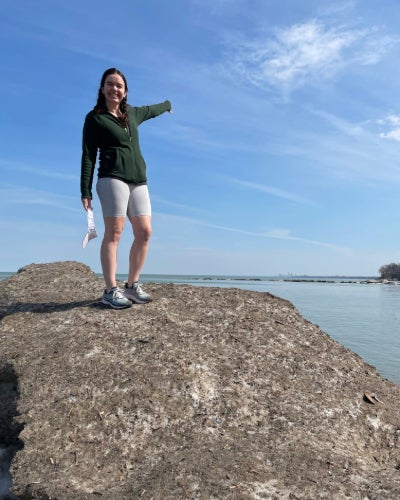
I really like hiking around the Cleveland Metroparks. I often cook and bake with friends. I've become somewhat of a Cleveland sports fan—though I’ll never give up my New England roots. I'm a big foodie, so I love exploring Cleveland restaurants.
Having all sorts of things outside of school that I'm interested in enables me to stay focused when I'm thinking about school. That balance is necessary for me.
Where do you see yourself after CWRU?
I definitely want to maintain both clinical and scientific research components to my career. I have always said that I intend on being a traditional physician-scientist, where I run a lab and see patients, but I've become more open-minded because there are a million different ways that you can combine the two careers. I could see myself working for a biotech company while also maintaining a clinic. How I actually break that down is to be decided. I think that's one really powerful thing about this degree—you have so much flexibility.