Meet a postdoc investigating how chemical reactions begin, spread and power devices
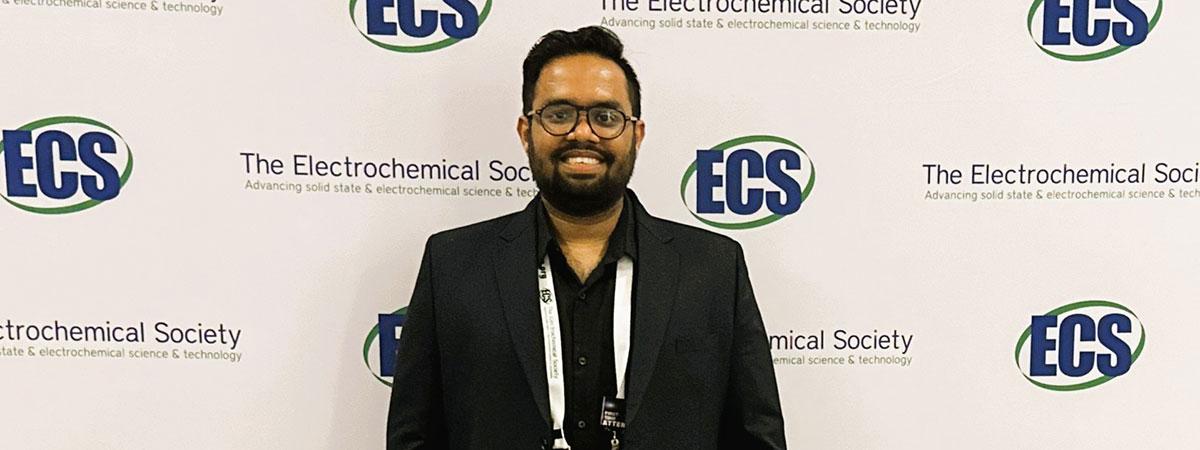
As a researcher, Arvind Singh Heer is committed to understanding the theoretical principles underlying his technical work. After completing a master’s degree, he went on to become an assistant professor in India. He was compelled to understand electrochemistry on a deeper level. That is what initially drew him to Case Western Reserve University, from which he earned his PhD in chemistry in 2025.
It’s also what kept him on campus as a postdoc, where he continues to conduct research with Daniel A. Scherson in the Department of Chemistry at the College of Arts and Sciences.
“Academia provides a unique environment where curiosity-driven research can truly thrive,” said Heer. “I value the freedom to ask fundamental questions, design careful and rigorous experiments, and explore ideas in depth without being limited to immediate short-term outcomes. For me, research is not just about solving a problem, but about understanding it at its roots.”
As a result, Heer’s work is situated at the intersection of the fundamentals and applications of chemical reaction dynamics. In Scherson’s lab, Heer aims to better understand how chemical reactions occur on metal surfaces via electrochemical techniques and real time imaging techniques that he developed in the group, applying his research to batteries, fuel cells and catalytic systems. His PhD studies also involved developing methods to observe and control the reactions. During his time as the PhD and Postdoc he has collaborated with multiple industries on projects such as sensor and batteries development.
In collaboration with colleagues, he has contributed to developing the fundamental science behind a small, low-cost modular device to convert air into pure oxygen in real time, leaning on his deep understanding of electrochemical gas separation and catalytic conversion processes at metal interfaces. Understanding the principles of kinetics, surfaces and transport gives researchers like Heer the opportunity to make technologies such as energy storage systems or gas-conversion devices more efficient, selective, and scalable.
His PhD and postdoc research has been published in high-impact journals, including the Journal of the American Chemical Society.
Building on his experience as an instructor in India, Heer is committed to mentoring younger scientists and taking on leadership roles. While earning his PhD, he served as vice president and treasurer of the Chemistry Graduate Student Association and as vice president of the Graduate Council of Arts and Sciences. In these roles, he worked with university administration on stipend advocacy and resource allocation. He also helped organize professional development activities and mentorship initiatives.
“Moving from India to the U.S. for graduate school was both challenging and transformative,” Heer said. “It pushed me to adapt, grow, and expand my perspective as a scientist. I’m grateful for the mentors and colleagues who have supported me along the way, and I’m proud to be part of the CWRU community.