Meet the scientist helping uncover the hidden structures of a common food additive
Michael J. A. Hore, PhD
Associate professor in the Department of Macromolecular Science and Engineering, Case School of Engineering
Area of Focus: Polymer physics
From ice cream and plant-based meats to shampoo and toothpaste, methylcellulose is widely used as a thickener in food, cosmetics, and pharmaceutical products, thanks to its unique properties, which enable it to form stable, water-holding networks (hydrogels).
However, the microscopic organization behind these properties was not fully understood—until recently.

Working with collaborators from Northwestern University, who led the project, Michael J. A. Hore, PhD, associate professor in the Department of Macromolecular Science and Engineering at Case School of Engineering, helped uncover a previously unseen structural organization in cellulose hydrogels, a finding that may open up more applications.
“Since we use methylcellulose as gels, we may want to understand its mechanical strength,” Hore said. “This understanding comes from the knowledge of its structure.”
Studying the material’s structure across multiple length scales requires large, sophisticated instruments—tools that Hore has extensive experience using. The team at Northwestern University called upon Hore’s team at CWRU to help visualize and analyze methylcellulose using techniques that were complementary to theirs.
A puzzling compound
The compound methylcellulose is synthetically derived from cellulose, a type of dietary fiber found in fruits, vegetables, and grains.
Methylcellulose is a long chain of smaller units that can be further assembled into multi-chain “fibrils,” which are extremely fine, thread-like structural components. What makes methylcellulose an effective thickening agent is its ability to form three-dimensional networks, called hydrogels, that can hold and stabilize a large amount of water.
Interested in the unusual structural behavior of methylcellulose hydrogels, researchers wanted to better understand how they were able to form these three-dimensional networks. The mechanical properties of methylcellulose hydrogels differed from predictions based on the behavior of other hydrogels.
When the project first started at Northwestern University, the team used a microscopic technique with electron beams, which produces magnified images up to one million times the size of an object. This magnification power is needed to view nanostructures like methylcellulose hydrogel networks. Yet, this technique would require completely removing water from the structures or exposing them to strong ionizing radiation, which may disrupt the very networks they wanted to study.
Troubleshooters join forces
The team then reached out to Hore, who has expertise in neutron and photon scattering (X-ray) measurements, techniques that can reveal how molecules organize over nanometer-to-micrometer length scales. He and his PhD student, Nehal Nupnar, used these techniques—ones that have long been used to determine structures of DNA, proteins, and other biological materials—to analyze the methylcellulose hydrogels.
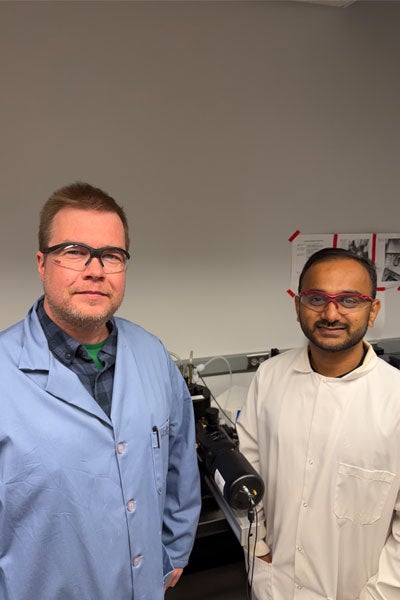
The results revealed something unexpected. Their measurements confirmed the observations at Northwestern University that methylcellulose assembles fibrils into large bundles that are upwards of 100 to 1000 times stiffer than individual fibrils.
As an additional line of evidence, the researchers also utilized a small-angle light scattering (SALS) instrument built by students at Morozova Lab, led by Svetlana Morozova, associate professor in the Department of Macromolecular Science and Engineering.
This finding helps explain why methylcellulose gels can act as effective thickeners in solution and why their behavior differed from previous theoretical predictions. From the team’s findings, scientists and engineers can now better predict the rheological properties of cellulose gels and tune aspects such as how the material flows and how much it resists deformation. These insights can inform the selection of hydrogels as additives and optimize their performance across a variety of products and applications.
“I was especially happy to see that laser light scattering—done on an instrument built by a CWRU undergraduate student and taught in my undergraduate courses—could also provide essential information regarding the methylcellulose structure that could fill in gaps in our understanding,” Hore said.
The team’s findings were published in Nature Materials.
A scientist behind curiosity-driven research
Often energized by curiosity, Hore has engaged in various projects that further the understanding of macromolecules and polymers.
During the pandemic, limited access to laboratory facilities led Hore to focus on computer simulations. After months of working to develop new computational approaches, those ideas evolved into a major research direction in his laboratory. Hore became interested in developing new techniques to study how different classes of polymers “wiggled” in his simulations.
The approaches were first applied to bottlebrush polymers – molecules resembling a bottle-cleaning brush, with side chains attached along a dense backbone.
Hore’s ideas during the pandemic eventually translated into three publications that studied the motions of different classes of polymers, two of which are in collaboration with his undergraduate students.
“Solving scientific problems takes a lot of patience sometimes. At times, I may want to set the problems aside and work on them later,” Hore said. “Yet, I do not usually give up.”