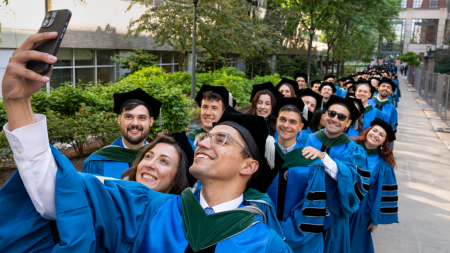
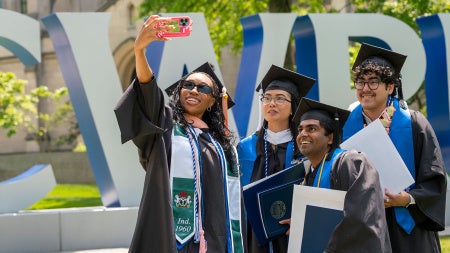
Every late night, every game-winning play, every hour of service—it all leads to this moment. Next week, Case Western Reserve University will celebrate the graduating Class of 2026 at commencement ceremonies May 15-17.
We could never tell every story. But ahead of commencement, we sat down with four undergraduates to hear about the experiences that defined them, the challenges that shaped them, and the ambitions they're carrying into what comes next.
Learn more about our commencement ceremonies and join the university in celebrating students during the clap out on Case Quad on May 13 as graduates proceed to convocation.
Quinn Watercutter
College of Arts and Sciences
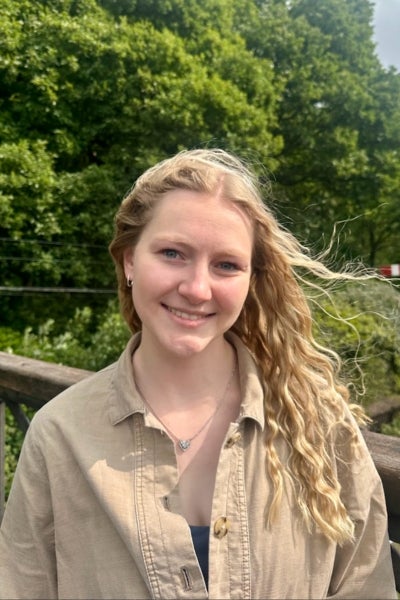
Quinn Watercutter came to Case Western Reserve knowing she wanted to pursue medicine. What she didn't know was that it would take losing something she loved to figure out what that really meant.
Following her freshman year, Watercutter was diagnosed with hip dysplasia—a congenital condition that required a full reconstruction of her hip and forced her to relearn how to walk. The sport she'd played for years, basketball, was gone. The college experience she'd imagined looked different now.
"Instead of feeling defeated, this moment allowed me a chance to rethink what I wanted to do during college, meet new people, and develop a resiliency that I will take with me throughout the rest of my life," she said.
The Dayton, Ohio, native started volunteering with Special Olympics basketball and began research at the Davalos Lab, where she trained in image analysis and wet lab protocols and contributed to projects spanning multiple sclerosis to alcohol abuse. She learned quickly that curiosity without communication goes nowhere.
"If you can't explain the work, its impact will be limited," she said.
Then, in the winter of her sophomore year, she joined the university's rowing team—a sport she had never competed in before. Through this, she found camaraderie, gained determination and endurance, and established a confidence in herself that she’ll take with her into her career.
“I put myself in challenging settings, rowed through blistered hands, cracked and bleeding, and pushed through freezing temperatures and pouring rain during early mornings,” she said. “I persevered through pain—but I did it all with my teammates.”
Through research, service and sport, she developed a deep interest in pain management, orthopedics and rehabilitation—drawn, in part, by what she'd lived through herself.
After graduation, Watercutter will work as a pediatric orthopedic surgery clinical researcher at University Hospitals Rainbow Babies before applying to medical school. She arrived at Case Western Reserve with a plan and left with a direction—shaped, above all, by her willingness to stay curious when life didn't go as planned.
Filip Goshevski
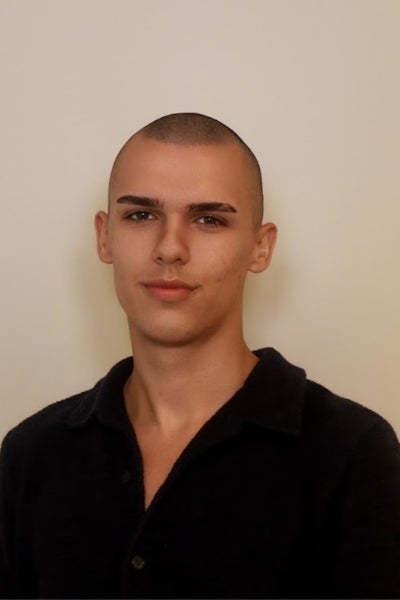
Case School of Engineering
Filip Goshevski is no stranger to being far from home. Originally from Smojmirovo in North Macedonia, Goshevski attended United World College Maastricht in the Netherlands for his postsecondary studies, approximately 2,000 kilometers (or 1,242 miles) away. But crossing the Atlantic Ocean to attend Case Western Reserve University felt like a huge leap—one Goshevski is glad to have made.
As an undergraduate student majoring in biomedical engineering on a pre-med path, Goshevski took advantage of a wide range of opportunities, including conducting direct patient care as a nursing assistant.
While volunteering on the telemetry floor at University Hospitals, he carefully noted the technologies monitoring patients’ heart rhythms, oxygen saturations and blood pressures, seeing just how valuable these tools are in the real-time decisions a care team makes.
“What excites me most about biomedical engineering is the ability to actively modify and enhance biological and clinical systems, whether through developing new biomaterials, improving medical devices or designing technologies that address unmet clinical needs,” said Goshevski. “The field challenges me to think both creatively and analytically, transforming innovative ideas into tangible solutions.”
He’s done that in the lab of Amar Desai, PhD, at the Case Comprehensive Cancer Center, where he’s contributed to projects that characterize therapies for a range of hematopoietic malignancies and other conditions.
During his second year, Goshevski also completed a part-time co-op in the lab of Vijay Krishna at Cleveland Clinic, where he characterized novel metal nanoparticle formulations for targeted photothermal breast cancer therapy.
On campus, Goshevski also has made significant contributions to the engineering community. He’s served on the Biomedical Engineering Society leadership team, including a stint as president the past year, and team lead for VoxAid, a project within HyperCase that aims to assist patients with bilateral vocal cord paralysis.
And, Goshevski has been an active member of two fraternities: Tau Beta Pi, the engineering honor society, and Delta Tau Delta.
Now, looking to graduation, he plans to fully immerse himself in research at Case Comprehensive Cancer Center as he prepares medical school applications and weighs the options of an MD or MD/PhD program. Ultimately, he aims to combine all of his skills as a physician incorporating what he’s learned about biomedical engineering into clinical decision making.
Nora Collins
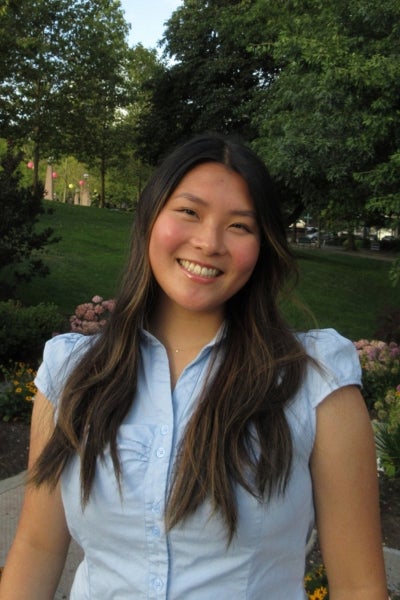
Frances Payne Bolton School of Nursing
Aside from the day she was born, Nora Collins had never set foot in a hospital before college. She had no doctors or nurses in her family—and no roadmap for what a healthcare career actually looked like up close.
What she had was a feeling. Case Western Reserve gave her the chance to find out if it was real.
Nursing clinicals in her very first semester put her at the bedside of real patients, and the question of whether she'd chosen the right path answered itself. A critical care course with Janna Kinney, DNP, pushed her further, opening her eyes to the high-stakes world of ICU nursing.
"Her ability to teach complex subjects in a simplified way made me confident that ICU nursing was something that I would be able to accomplish and thrive in," Collins said.
She spent the next four years proving it. At Louis Stokes VA Cleveland Medical Center, she completed more than 400 hands-on clinical hours alongside a preceptor, shadowed in the ICU, and finished an evidence-based practice project on preventing moisture-associated skin damage in patients.
Her senior practicum at Cleveland Clinic's Cardiovascular Intensive Care Unit—one of the most demanding clinical environments a nursing student can enter—became the experience that defined her. Caring for freshly post-op cardiac patients, and learning the devices and interventions that keep people alive, she found her calling in cardiology.
In her time at the university, Collins accumulated more than 1,300 clinical hours. She also studied abroad twice—shadowing in Chilean hospitals and building Spanish fluency in Spain, which helped her earn a secondary major in Spanish alongside her Bachelor of Science in Nursing.
After graduation, Collins will return to her hometown of Seattle to start her nursing career—not just ready, but certain that the feeling she arrived with four years ago was worth following.
“The most important thing that I learned outside of the classroom is that passion will drive your success in your career,” Collins explained. “Being diligent and working hard comes naturally when you love what you do, and you remind yourself of your 'why.'"
Theo Borchert-Isaacs
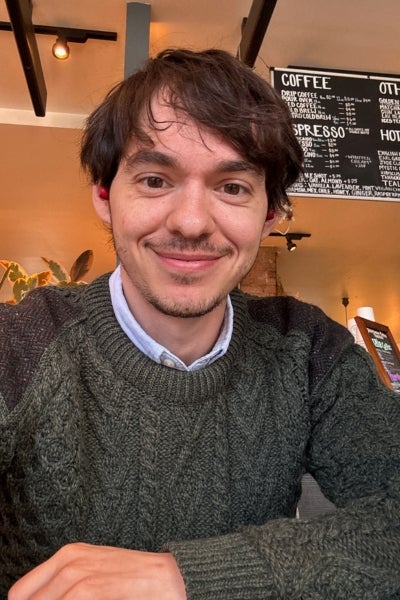
Weatherhead School of Management
Theo Borchert-Isaacs is no stranger to Case Western Reserve University. His great grandfather T. Keith Glennan was the fourth president of Case Institution of Technology and was a major figure in the institution’s federation with Western Reserve University. The connection doesn’t end there, either, as his mother, Anne Borchert, and grandfather also have ties to CWRU.
But, when it was time to enroll in an undergraduate program, Borchert-Isaacs did not choose CWRU—at least not at first. Instead, he attended Dickinson College in Pennsylvania for more than two years, at which point, he took a step back to reevaluate the role higher education could have in his life.
During that time, he nurtured his love of rock climbing.
“Climbing gyms have been a safe space for me whenever I was unsure about my path forward,” said Borchert-Isaacs.
And climbing eventually pushed him toward the direction he was seeking. He realized he wanted to open his own rock climbing gym, and a degree in business management would best position him to achieve that goal. This time, he opted to come to CWRU.
Now, he will carry on his family legacy as he receives his bachelor’s degree from CWRU next week.
Balancing a full-time job at Shaker Rocks Climbing Gym, Borchert-Isaacs took his time as he completed his degree. He also was intentional about his courseload to ensure he would retain what he’d learned.
One class in particular sticks with him: an entrepreneurial strategy course taught by Megan Buchter.
“The most impactful thing to me from this class is the idea of a business as a social enterprise,” Borchert-Isaacs said. “I would like to open a climbing gym that not only makes money but also builds and enhances the surrounding community. Professor Buchter brought many entrepreneurs to the class who have built such companies, and it was very eye-opening and inspiring.”
After commencement, Borchert-Isaacs will move to Germany to live with his fiancée Reed O’Mara, who is a PhD student in art history at CWRU. O’Mara is completing her dissertation through a Kress Fellowship, and Borchert-Isaacs intends to use this time to support her as she did helping him keep focused.
Then, the next step is clear: Borchert-Isaacs will begin laying the groundwork for his dream of opening his own gym.