Meet a student who landed his dream internship at Rolls-Royce—and has already been asked back next summer
A gap year offers students time to reflect and gain clarity about their interests and ideal future career direction. David Kaplan experienced that firsthand before he began his undergraduate education at Case Western Reserve University.
After his high school graduation, he took a year off, during which time he obtained his pilot’s license. Though he’d been determined to study computer science—even teaching himself how to code—he realized he had new ambitions.
“The minute I got behind the yoke and heard the sound of the plane’s engine as it rolled down the runway, I knew that I wanted to build these things,” he said.
Now a third-year student double-majoring in aerospace and mechanical engineering, Kaplan is already contributing to such projects. This past summer, he earned his ideal internship at Rolls-Royce, where he worked alongside the development assembly team. There, he had the opportunity to see every jet engine the company sells in the U.S.—and some they don’t—up close.
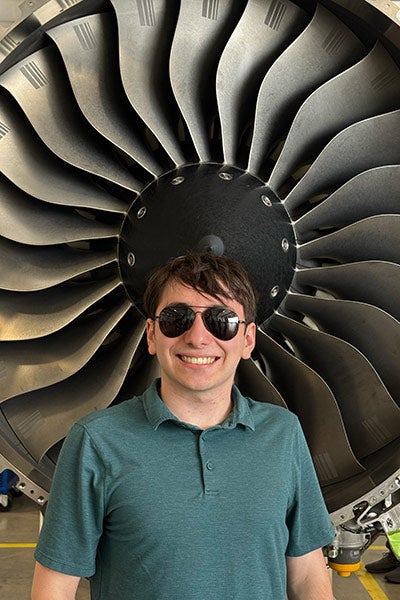
Kaplan’s work involved writing assembly instructions for jet engines, creating operational planning dashboards for other Rolls-Royce facilities, designing and 3D printing assembly fixtures and writing scripts to automate data processing.
His internship also gave Kaplan a look at the operations side of manufacturing, where he observed how leaders tackled large assembly tasks to ensure they are scheduled efficiently and reach demand.
Kaplan will have more opportunities to learn firsthand from employees at Rolls-Royce, where he will intern again next summer, this time with LibertyWorks, the company’s advanced and emerging technology department.
“I am incredibly excited to get the opportunity to work on cutting-edge technology and do some design work in service of real-world applications, even if they may not see the light of day for years to come,” he said. “I enjoy working on new technologies, and I am looking forward to seeing what impact I can make during my time there next summer.”
In the meantime, he will be busy with several projects on campus.
Kaplan is highly involved with CWRU Motorsports (also known as CWRU Baja), an organization that captured his interest before he even completed his application to the university. His many roles within the organization have included design engineer and documentation lead. This year, he aims to improve the organization’s documentation to ensure future members will have records to inform their design and analysis process.
Kaplan said his work with CWRU Motorsports helped prepare him for his internships, including another with Lincoln Electric.
“The team has taught me how to work with a team of engineers, how to collaborate with others on a design, how to design parts according to requirements, how to conduct engineering analysis, how to take feedback professionally, how to give feedback professionally, and much more,” he said.
In addition to CWRU Motorsports, Kaplan is a member of the CWRU Film Society, where he’s become a projectionist and the organization’s business manager, and The Athenian, for which he serves as the webmaster and archivist, as well as a copy editor.
He’s also a member of Tau Beta Pi, the engineering honor society, a peer tutor and recently joined the Neural Dynamics and Modulation Laboratory with Dr. Escobar at the Cleveland Clinic.
Learn more about Kaplan.
Answers have been lightly edited for clarity and length.
1. What initially drew you to CWRU?
What drew me to CWRU was the easy access to research, Sears think[box], and the culture on campus. I am a firm believer that the best way to learn something is by doing, and a college should facilitate that form of learning. Sitting in the classroom only gets you so far, so having the chance to actually go out and apply the knowledge you are learning right here on campus was very attractive when I was touring. From my personal experience, I have found it incredibly valuable to be able to jump right into student groups engaging in advanced engineering challenges (like the motorsports team, which I joined day one). I also liked how easy it was to get involved around campus in other student organizations as well.
2. What about your minors in electrical engineering and computer engineering?
I came in with a fair amount of AP credit, so I had some open space in my schedule. I figured that since I already knew how to code, I should add a minor that would be relevant for me as an engineer. I chose electrical engineering since everything that I intend to design in my career has electronics in it, so I thought it would be a good idea to learn more about that aspect of engineering. I also really wanted to take these specific classes about computer hardware design since it just personally fascinates me, which essentially gave me the computer engineering minor already.
3. What have been the most memorable experiences during your time at CWRU?
I think the most memorable moment during my time here at CWRU was the first science fiction marathon I attended at the Film Society. I didn’t realize quite how large that event was, and it was great to interact with so many different Film alumni and hear their stories.
4. Can you talk about your experience with Lincoln Electric?
I was actually never intending to co-op with Lincoln Electric at all. In my freshman year, I participated in a wire-arc additive manufacturing lab, which is essentially a big welder attached to a 3D printer so it can 3D-print metal. At the career fair, a Lincoln Electric recruiter saw that I had experience in that lab and offered me an interview for their fall co-op position. I debated taking the position for a while, but in the end, I decided to put classes on hold and work at Lincoln Electric for a semester, and I am very glad I did.
At Lincoln Electric, I worked in their machine research and development division, specifically in the guns and torches division. While there, there weren’t a ton of active development projects, so I found my own project to work on. The group was in the process of validating some electric vehicle charging cables that they were working on, and one of the things they needed to do was a flex test, where they repeatedly bend the cables back and forth to see how many times they can be bent before they stop working. Doing this manually for hundreds of thousands of cycles is incredibly tedious, so I designed and built a custom test stand that would take the cables and bend them back and forth automatically. It was a very good opportunity to engage in a project that made a difference to the team.
5. What are your future career goals?
After college, I’d like to earn a graduate degree in aerospace, and after that, enter the aerospace industry as a design engineer, though I don’t intend to remain one forever. Eventually, I hope to move up and lead larger projects, and I would really love to someday head up the management of a significant aerospace project, like the development of a new rocket or aircraft, or potentially start my own business somewhere in the field of aerospace.