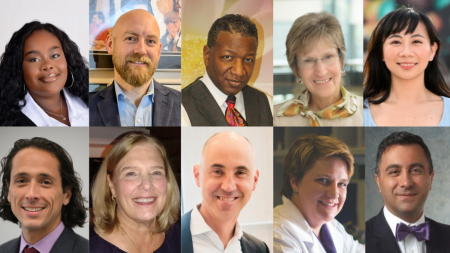
Meet three APIDAA members of the CWRU community
From future physicians hoping to help people regain their vision to students volunteering at food banks and local pantries, those of Asian, Pacific Islander, Desi and Asian American heritage are engaged with countless facets of Case Western Reserve University—and beyond.
In recognition of Asian, Pacific Islander, Desi and Asian American (APIDAA) Heritage Month, which takes place annually in May, we spoke with three APIDAA members of the CWRU community, who shared insight on their experiences and how their heritage has impacted their lives.
Read on to learn more.
Answers have been edited for clarity and length.
Krish Shah
Rising second-year medical student, School of Medicine
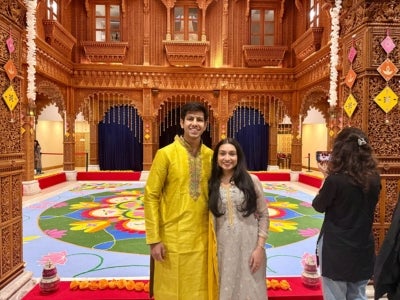
Growing up in an area with few Indian families, Krish Shah (CWR ’24; chemical biology and economics) sometimes felt disconnected from that part of his identity. But family traditions like celebrating Diwali—the Hindu festival of lights—visiting temples, sharing meals, wearing traditional clothing and gathering with loved ones helped strengthen that connection. A visit to his father’s village in India also left a lasting impression, giving him a deeper appreciation for his family’s sacrifices and the close-knit sense of community he witnessed there.
At CWRU, Shah found a similar sense of community through his involvement with the Undergraduate Diversity Collaborative and other student organizations which made him feel at home.
“I always admired how passionate students across different organizations were about supporting their communities and creating inclusive spaces on campus,” he said. “Being surrounded by people who cared so deeply about culture, representation and connection made a big impact on me.”
Now a rising second-year medical student, Shah aspires to help people preserve or regain their vision as an ophthalmologist. He also hopes to give back through outreach and service, particularly in underserved communities where access to eye care can be limited.
“In places like India, many people do not have easy access to procedures such as cataract surgery, even though those treatments can completely change someone’s quality of life,” Shah said. “I would love to continue participating in service initiatives that help bring care to those communities.”
Q. In what ways do you share your APIDAA identity at CWRU?
I have shared my APIDAA identity through several organizations and experiences throughout my time at CWRU. As an undergrad, I was a member of Case Kismat, the university’s Bollywood fusion dance team, which became one of the most meaningful ways I connected with my culture. I was also involved with Naach Di Cleveland, eventually serving as director my senior year, where I helped organize a national intercollegiate dance competition that brought together hundreds of performers from across the country. In medical school, I continue this involvement through the South Asian Medical Students Association, helping organize social and community initiatives for students and Indian patients. I also regularly participate in cultural events on campus and enjoy being part of spaces that celebrate and share APIDAA cultures with the broader CWRU community.
Q. What does your cultural heritage mean to you and how has it influenced your identity and experiences at CWRU and beyond?
My cultural heritage means understanding the traditions, values and perspectives that shaped my family long before me. It has helped me become more open-minded and appreciative of differences between people and cultures. I try to see those differences not as barriers, but as opportunities to learn from others and better understand the world around me.
At Case Western Reserve University, being able to reconnect with and express my culture through different organizations and communities played a huge role in my personal growth. Coming to CWRU helped me embrace a part of my identity that I did not always feel fully connected to growing up. Through dance teams, cultural organizations and events, I found spaces where I could celebrate my background while also building friendships and community with people from many different experiences.
Q. If someone wanted to understand your culture through one meal, song, film or holiday, what would you choose?
I would probably choose Diwali because it encompasses so many different aspects of Indian culture. It includes religion, food, music, dance, fireworks, family gatherings and traditional clothing all in one celebration. What is especially interesting is that different regions of India celebrate it differently and even call it by different names, which reflects how diverse Indian culture really is. I think Diwali captures both the strong traditions and the incredible variety that exist within Indian culture.
Q. Why do you think it’s important for institutions like CWRU to celebrate and recognize various cultural heritages?
Students come to universities like CWRU from all over the world, and many leave behind family, traditions, language and familiarity in order to pursue opportunities here. Celebrating different cultural heritages helps students feel welcomed, valued and more at home, especially during stressful times in school or training. It also creates opportunities for the broader campus community to learn from one another and build a more connected and inclusive environment. It is important not to let differences feel like barriers, but instead to see them as opportunities to learn from one another and appreciate perspectives outside of our own.
Samyuktha Jaikrishnan
Staff auditor, Audit Services and Enterprise Risk Management Program
Born in Chennai and raised in Mumbai, India, Samyuktha Jaikrishnan (MGT ’24) grew up immersed in one of the world’s most fast-paced cities and the home of Bollywood. Living in Mumbai exposed Jaikrishnan to a blend of cultures from across India, helping shape her multilingual identity. Fluent in Hindi, Tamil and Telugu and conversational in Marathi, she credits South and West Indian traditions with deepening her connection to her heritage.
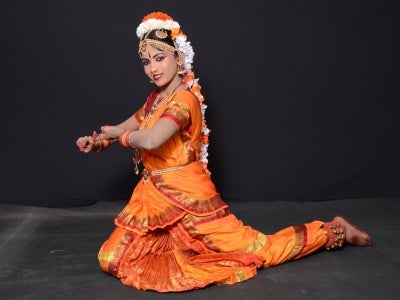
While Jaikrishnan’s family celebrated South Indian traditions such as Pongal, a multi-day Hindu harvest festival, the cultural experience closest to her heart is Mumbai’s Ganesh Festival, a 10-day Hindu celebration honoring Lord Ganesha, who is considered the elephant-headed god of wisdom and new beginnings.
“The energy of the Tasha drums and the community spirit always makes me feel deeply connected to my roots,” Jaikrishnan said. “Additionally, my years of training in Bharatanatyam, a classical Indian dance, played a massive role in keeping me grounded in my cultural heritage.”
A graduate of the Master of Accountancy program, Jaikrishnan was drawn to Case Western Reserve University for its academic reputation and innovative curriculum.
“I wanted a strong foundation in accounting, but what truly set [CWRU] apart for me was the data analytics track integrated into the program,” she shared. “I loved the idea of blending specialized accounting and financial knowledge with a data science edge to future-proof my career.”
Beyond academics, Jaikrishnan was also drawn to the university's vibrant global community.
“Knowing that students from all corners of the world come here to study made it clear that CWRU is an open, globally minded institution where everyone is truly welcome,” she said.
Today, Jaikrishnan works in CWRU’s Audit Services and Enterprise Risk Management Program as a staff auditor, where she hopes to bring a dynamic, global perspective to her profession by combining analytical thinking with cultural understanding.
Q. What does your cultural heritage mean to you, and how has it influenced your identity and experiences at CWRU and beyond?
Coming from such a diverse, multilingual background is something I am incredibly proud of, and it has shaped me into someone who loves connecting with people from all walks of life. At CWRU, my upbringing makes navigating a global campus feel natural and exciting. Because of the languages I know, I love dynamically switching between them when I meet different people. Being in the U.S. now, I deeply appreciate having a diverse community around me, and my roots have given me the confidence to share my story while learning from others.
Q. In what ways do you share your APIDAA identity at CWRU?
I love sharing my heritage at CWRU through food, Bollywood movies and dance! During my time as a student here, I eagerly brought my traditional dance skills to the stage, performing at the campus Diwali party and the welcome party for graduate students to represent South Asian culture. Now, working on campus with the Audit Services Department, I continue to share my identity every day simply by connecting with colleagues, talking about my favorite foods and movies, and proudly bringing my full cultural background to my professional life here.
Q. What do you think the campus community should know about APIDAA heritage in general?
I want the campus community to understand just how incredibly vast and diverse the APIDAA community truly is. Even looking at a single country like India, we are not just one culture—we are a beautiful mosaic of dozens of languages, unique states, distinct foods and completely different ways of doing certain things. There is so much nuance and richness within our heritage, and it brings me immense pride to represent that multifaceted identity here on campus.
Q. Why do you think it’s important for institutions like CWRU to celebrate and recognize various cultural heritages?
I have always believed that a richly diverse community brings invaluable perspectives to the table. For someone like me who moved halfway around the globe, seeing CWRU celebrate different cultural heritages instantly makes this campus feel like a home away from home. It allows the broader campus community to gain a deeper understanding of people from all over the world, fostering a truly inclusive international environment. I still vividly remember when I first arrived for my graduate studies and saw a CWRU t-shirt that read, "Everyone is welcome here." By actively recognizing and celebrating our unique backgrounds, the university completely lives up to that message, ensuring students from every corner of the world feel valued, seen, and at home.
Srila Munukutla
Rising fourth-year medical anthropology student, College of Arts and Sciences
A rising fourth-year medical anthropology student, Srila Munukutla traces her roots to Andhra Pradesh in South India. While her grandparents immigrated to the U.S., her parents were raised in the Midwest during a time when they often faced racism and discrimination—experiences that shaped the way they raised their children.
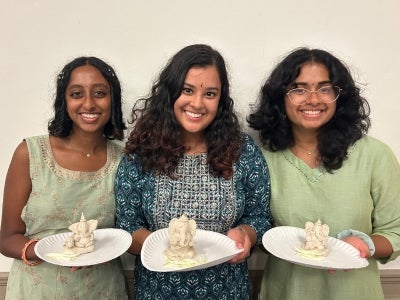
“Because of that, they were intentional about raising my brother and me in a more diverse environment so we would feel a stronger sense of belonging,” Munukutla noted. “We speak Telugu and I’m even named after the Goddess Lakshmi, which has also been a meaningful connection to my cultural and spiritual roots.”
Another major influence on Munukutla’s cultural identity has been Hindu Swayamsevak Sangh (HSS), a Hindu education and service organization she has participated in since first grade. Through HSS, she volunteered at soup kitchens, organized donation drives and helped lead cultural programming, experiences that taught her to view Hinduism not simply as a religion, but as a way of life grounded in service and community.
At CWRU, Munukutla found opportunities to combine her academic interests with leadership and service as a research assistant in the Department of Orthodontics. She also served as a two-time campus orientation leader and president of Feminine Empowerment in Media, Arts and Literature (FEMAL). Off campus, she volunteers regularly throughout the Cleveland community at food banks, hospitals and local pantries.
After graduation, Munukutla plans to attend dental school and hopes to combine dentistry with community-centered care, particularly for underserved populations navigating unfamiliar healthcare systems. Inspired by her own family’s experiences, she is especially interested in making oral healthcare more approachable through storytelling, including a long-term goal of creating a children’s book series that helps reduce fear surrounding visits to the dentist.
Q. What does your cultural heritage mean to you and how has it influenced your identity and experiences at CWRU and beyond?
My cultural heritage has deeply influenced my creative work. I minor in creative writing and have had multiple poems published in undergraduate, independent and national literary journals, almost all of which relate to my culture. One of the most meaningful moments was performing a spoken word poem about my name and how it is constantly mispronounced in front of over 5,000 students and faculty. Afterwards, students approached me and shared their own name struggles, and one of my teachers even apologized for repeatedly mispronouncing my name and later practiced saying it correctly.
Some of the hardest and most meaningful pieces I’ve written have also centered around my family and culture, including a documentary-style poem exploring the arranged marriages of my parents, maternal grandparents, and paternal grandparents. Writing these pieces has made me more confident in sharing personal aspects of my identity, and I hope to continue writing with honesty and specificity, sharing stories rooted in my life and culture.
Q. If someone wanted to understand your culture through one meal, song, film or holiday, what would you choose?
I would invite them to celebrate Ganesh Chaturthi with my family. This 10-day festival, usually in August, celebrates the birth of Lord Ganesha, the remover of obstacles. We dress in traditional Indian attire, make clay idols of Ganesha and decorate them with flowers. We then perform a puja (or prayer) before immersing the idol in water. The festival reflects the Hindu belief in the cosmic cycle of birth, life, death and rebirth since the idol is ultimately returned to nature. To me, it serves as a reminder that everything is temporary, to not take things too seriously and to stay grounded.
Q. In what ways do you share your APIDAA identity at CWRU?
The biggest way I share my APIDAA identity at CWRU is through dance. I’ve been learning the Indian classical dance form Kuchipudi for 15 years and have performed at theaters, festivals and temples, and have been featured in newspapers. On campus, I established the Kuchipudi lead on Case Western Nritya and continue to choreograph and teach pieces that blend contemporary music with traditional dance, making it more accessible to broader audiences. I’ve also taught Kuchipudi at a Department of Dance class and have collaborated with other organizations to host large performances. One of my first poems that was published in an independent literary journal was about the statue of Nataraja, Shiva as the lord of dance, and reflected on my dance journey and connection with Mother Earth.
Q. What do you think the campus community should know about APIDAA heritage in general?
APIDAA heritage is incredibly diverse, even within individual subgroups like the Desi community. There is often a tendency to generalize Indian identities into one singular experience, but in reality, there are hundreds of languages spoken across India, along with major regional, cultural and religious differences. For example, traditions, food and even daily customs can vary significantly between different regions. There is no single way to represent what it means to be Indian. Recognizing that diversity is important because it allows people to move beyond broad generalizations and appreciate the individuality within these communities.