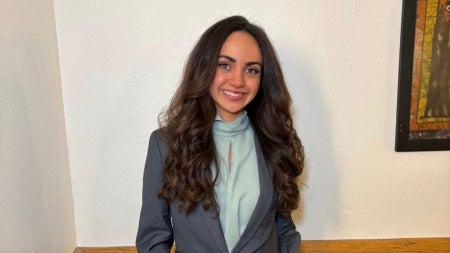
Meet an undergraduate providing free English tutoring to those affected by conflict and displacement
As a second-generation Syrian-American, undergraduate Zaina Albirini felt a personal connection to those in Syria who were affected by war, conflict, and displacement—many of whom were not given the opportunity to learn English, limiting their opportunities to study or work abroad.
Motivated by these personal connections, a passion for cross-cultural communication, and a desire to make the medical field a more welcoming and inclusive space, Albirini introduced the Case Western Reserve University community to Paper Airplanes, an organization that provides free English language tutoring to those affected by conflict and displacement. Albirini saw the organization’s impact firsthand through family friends and wanted to support English learning for others by removing the financial barrier.
Albirini, a second-year student on the pre-med track majoring in chemical biology, launched a chapter of the organization at CWRU. She was inspired by the organization’s mission to help people gain the skills needed to pursue higher education, secure scholarships, and advance their careers abroad. Albirini hopes it will give Case Western Reserve students a more global perspective. Those who would like to participate can join Paper Airplanes on CampusGroups or visit the national Paper Airplanes website and sign up to tutor.
Alongside Paper Airplanes, Albirini also supports those affected by conflict through PCRF, Palestine Children's Relief Fund, which raises money for children in the Middle East, focusing on humanitarian aid and medical care. Albirini, who has minors in Arabic and Bioethics and Medical Humanities, is also involved with Global Medical Brigades and Case Reserve Review, a student-published literary art magazine.
As an aspiring physician, Albirini was drawn to Case Western Reserve for its proximity to local healthcare institutions Cleveland Clinic and UH, which offer medical opportunities for volunteering and research, and the vibrant, welcoming campus community.
Learn more about Albirini’s experiences and Paper Airplanes.
Answers have been edited for clarity and length.
1. How did you choose your areas of study?
I chose ChemBio because I was really interested in the classes and core sequence. I really enjoy chemistry, and learning about chemistry and bio together sounded super exciting.
As for my minor, I speak Arabic at home, but it’s not as good as I want it to be. I can speak it, but my writing and reading could be a lot better. I wanted to learn more about [Arabic] and advance in the language. Languages in general have always been a passion of mine. From a young age, I studied Spanish, and I find it fascinating to notice connections across languages—especially similarities in vocabulary and expressions between Spanish and Arabic. Being able to recognize these cross-cultural language similarities is super cool.
2. What motivated you to start Paper Airplanes at CWRU?
I was motivated to start a Paper Airplanes chapter at Case [Western Reserve] because I felt both the students here and learners abroad could truly benefit from it. A lot of the students here are looking for volunteering hours, and this is a great way to do that. I just felt like more people should know about the organization and what they do. I wanted to create an opportunity that was meaningful and sustained rather than one-time volunteering.
A lot of us take for granted that we know English, that we're able to speak and write, and that we're at this school. We're very privileged to be here, and it would be really impactful if we helped those who didn’t get that same opportunity. By starting a chapter here, I hoped to both raise awareness about the organization’s mission and give Case students a way to use their knowledge to support others’ educational opportunities.
3. What's been your most rewarding experience working with Paper Airplanes?
It would have to be my student last semester; she did really well on her English exam. That was really rewarding because I know the majority of the hard work was hers, putting in the effort and studying and doing the reading, but it was just nice to know that I helped her with that, and she benefited from me being there and helping her.
4. How have your studies and academics at CWRU helped you in working with Paper Airplanes?
I've definitely grown a lot since I came to Case [Western Reserve].
Not just as a student, but also socially and mentally—and just as a human being. I've learned a lot of new skills, such as interacting with new people that I otherwise wouldn't have, and I've been more brave to do things that I wouldn't have done in the past and put myself out of my comfort zone.
My studies here at Case [Western Reserve] have helped me significantly in my work with Paper Airplanes by developing both my communication and teaching skills. Through my coursework, I have learned how to explain complex ideas in clear ways, which is essential when tutoring English learners with different educational backgrounds.
Part of the reason why I was able to become a tutor and do Paper Airplanes was because I really grew from my first year. The wonderful friends, faculty and peers that I have—and interacting with them daily—have really brightened my life, and they definitely gave me the confidence to do the things that I'm able to do today.
5. What have you learned from Paper Airplanes?
I've learned how to interact with people whose backgrounds, ages, and levels of English differ from my own. Tutoring requires me to be patient, flexible, and intentional in the way I explain concepts, since I have to adapt my teaching style to meet my students’ needs. I've realized how much I love being a teacher or an advisor, someone who can help somebody else. I realized the relationship was mutual—I was teaching her, but she was also helping me by allowing me to learn about her experiences and perspectives. It's really nice to know that I'm always there for my student if she ever has any questions, and I'm always there for her if she needs anything.
6. What are your career goals? How has Paper Airplanes influenced/helped your career goals?
My career goal [is to] become a physician. [Paper Airplanes] has helped influence my career goals because I've learned that being a doctor and wanting to pursue medicine come with a lot of difficulties and challenges. For example, there might be people you can't communicate with because of a language barrier. For this reason, I want to broaden my perspective and learn how people from different backgrounds experience the world. I try my best to learn something new about my peers’ culture and traditions every day, and I hope that by the time I’m in my career, this will pay off as I will have the background and skills I need to make my patients feel as comfortable as possible.
That goes along with why I want to study bioethics. It's all about understanding the ethical side of medicine. Patients bring their beliefs, values, and experiences into the room with them, and I want to recognize that. Even small efforts to understand someone’s culture or communicate in a way that makes them feel comfortable can make a big difference. By doing this now, I know that it will be beneficial to future patients. I know that it will help make them feel more comfortable in a healthcare setting, more relaxed and supported.
7. What do you hope your club members gain from working with Paper Airplanes?
I hope that my club members gain the same experiences and the same insight that I got from this organization—speaking skills, communication skills, and organization skills—and I hope that they benefit in the sense that they know that they're helping somebody else, increasing somebody else’s chances of having a better career and having a better future by helping them learn English. For the students here at Case [Western Reserve], I hope it helps them see perspectives beyond their own and understand the challenges of learning English in a different environment. More than anything, I hope they develop a sense of happiness and joy when they know that they're helping somebody else level up in their English language abilities.