Meet an undergraduate student being honored nationally as a promising student in aerospace engineering
Throughout the four years of her undergraduate career, Andrea Silva has balanced double majors in mechanical and aerospace engineering, dedicated involvement on the Case Rocket Team, and the challenging schedule of a student-athlete on the Spartan women’s soccer team.
Though it can get hectic, Silva remains grateful, reminding herself she’s doing everything she ever wanted.
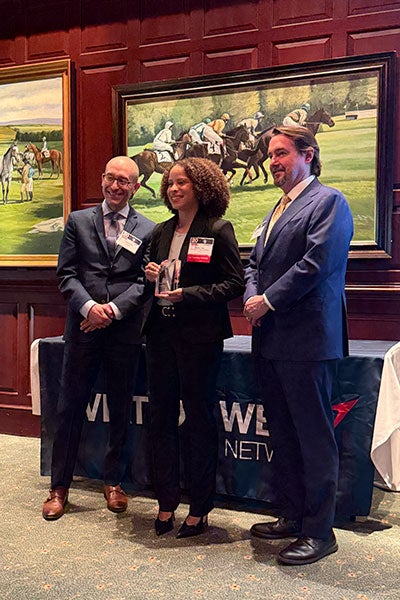
And the future is bright: Silva was recently named to the 2026 20 Twenties class by Aviation Week. She accepted the honor last week at a banquet in Washington, D.C. The honor recognizes the “brightest, most driven aerospace-bound STEM students.”
Though her interest in aerospace engineering developed as a young child with a fascination for the planets, stars and space phenomena, what captivated her most was how the industry could drive advances in everyday life.
“I still believe that aerospace engineering is the industry that pushes humanity to achieve its greatest potential,” said Silva, who is originally from Virginia.
On the Case Rocket Team, Silva has helped build rockets for the International Rocket Engineering Competition, serving as an aerostructures technical lead (composites), public relations manager, and president during her time on the team.
Silva has further contributed to the Case School of Engineering community as a member of the school’s professional engineering fraternity, Theta Tau, and an inductee of the engineering honor society, Tau Beta Pi. She is a teaching assistant in the mechanical and aerospace engineering department and a student employee with the Case Alumni Association.
She also serves as a systems engineer team lead for the aerospace design senior capstone, which tasks students to design and analyze a commercial passenger/cargo jet.
Next month, she will present her senior project, which explores bipropellant rocket engine injectors through computational fluid dynamics and digital modeling, at a NASA Glenn Research Center.
Silva will graduate in May and plans to work in industry on in-space chemical propulsion and pursue a master’s degree in space systems engineering. She also hopes to take flight herself by pursuing a pilot’s license in the future.
Learn more about Silva.
Answers have been lightly edited for clarity and length.
1. What initially drew you to CWRU?
Initially, it was the (at the time) top 25-ranked women's soccer team that attracted me to CWRU, as I wanted to pursue collegiate soccer at a school that prioritized high-level academics. After that initial impression, I looked into CWRU's aerospace program and potential opportunities.
2. What is your vision for the future of aviation?
Accessibility to space, its spinoff technologies and aerospace education are my largest priorities for the future of aviation. Making space travel beyond low-earth orbit a tangible reality in a way that can be affordable is my greatest dream for the industry. Doing this in a way that reaps technology that can readily be used on Earth and advances educational programs to inspire the next generation of engineers would be my ideal vision for the future of this industry.
3. What did it mean to you to earn the 20 Twenties recognition for Aviation Week?
Earning 20 Twenties awardee recognition from Aviation Week Network has been an absolute honor. After a decade's worth of education, rocketry and leadership positions, receiving this award has been a culmination of years of fostering a career in aerospace.
I am looking forward to being a part of an incredible network of awardees and alumni from across the globe and the world's most prestigious universities that have made incredible strides in this industry.