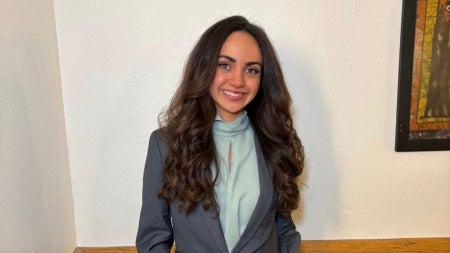
Meet an undergraduate student who is already making her mark in research
When second-year Case Western Reserve University student Alicia Mathew was growing up, her mother—a physical therapist specializing in dementia care—would share textbooks from her college days. Fascinated by the brain and the science behind it, Mathew spent hours reading about neuroanatomy and biology, discovering a passion that would eventually shape her future.
That passion has already taken her far. Last fall, as a first-year student, the neuroscience major presented research at the American Physical Society Division of Fluid Dynamics (APS DFD) conference, considered the premier international conference for fluid dynamics and one of the field's largest annual gatherings. First-year undergraduates rarely present at APS DFD, making the opportunity an early milestone in Mathew's research career.

The research she presented at APS DFD grew out of a fully funded summer research experience at Texas A&M University–Corpus Christi through the Army Educational Outreach Program. There, Mathew investigated how biofilms—communities of bacteria—form around microscopic oil droplets in seawater using “ecology-on-a-chip” microfluidic technology. By recreating environmental conditions on a tiny laboratory chip, researchers can better understand how bacteria behave during oil spills, with implications for environmental cleanup as well as biomedical research.
Although her long-term goal is neuroscience, Mathew already sees connections between engineering and biology.
“There are applications for the materials and the methods that we've used in that engineering lab to biology,” said Mathew. “Mainly to model tissues, organs and fluid interactions that are difficult to observe in living organisms.”
She hopes to apply the microfluidic techniques she learned during the project to emerging technologies such as "brain-on-a-chip" systems that model brain tissue for research.
Since arriving at CWRU, Mathew has continued to build on that momentum. During her first semester, she began shadowing in the lab of Associate Professor Grant O'Connell, PhD, at the Frances Payne Bolton School of Nursing after reaching out to faculty whose research aligned with her interests. She went on to officially join the lab the following semester to do undergraduate research and plans to return this fall.
This summer, she was accepted into a competitive National Science Foundation Research Experiences for Undergraduates (NSF REU) program, which supports undergraduate students conducting intensive research across NSF-funded disciplines.
Read on to learn more about Mathew and her experience with undergraduate research.
What sparked your interest in neuroscience?
My mom really introduced me to it, and over time I realized I was especially interested in molecular biology and neurobiology. I love being in a lab, and neuroscience combines that with the science I've always enjoyed. That's what made it the right major for me. My ultimate goal is to pursue a PhD and become a research scientist!
You presented research at the American Physical Society Division of Fluid Dynamics conference as a first-year student. What was that experience like?
It was honestly a little surreal. During the summer I was living on my own, working in the lab every day and preparing my research. Then I was nominated by my principal investigator to present at the conference, where I was talking with PhD students, researchers and faculty from around the world.
I definitely felt like one of the youngest people there, but I also had a great support network from my lab. Even though my own interests are in neuroscience rather than engineering, it gave me a unique perspective. I could explain the research from more of a biological standpoint, which was different from what many people at the conference were used to hearing.
How has Case Western Reserve supported your research interests so early in your college career?
One of the biggest reasons I chose CWRU was because students can get involved in research right away. I also felt incredibly supported when I traveled to present my research. My professors understood how important those opportunities were and were very encouraging. It really showed me that research is valued here from your first year onward.
What advice would you give to other first-year students who want to get involved in research?
Be proactive. Cold email professors, introduce yourself and don't be afraid to follow up. That's how I found my lab with Dr. O’Connell. I'd also encourage students to apply for undergraduate research programs, even as first-years. Many of them accept students with different experience levels, provide housing and a stipend, and give you the chance to spend a summer doing research while meeting people from across the country. First-year students shouldn't count themselves out.
Outside of research, what are you hoping to accomplish during your time at CWRU?
I really want to keep investing in interests outside of STEM. This fall I'm taking “Community-Based Research on the Ethics of AI” because I'm really interested in that topic, and I'm active in several music ensembles, including Early Music Singers and Klezmer Music Ensemble. Even though rehearsals take a lot of time, it's something I genuinely enjoy. As I continue at Case, I hope to become even more involved on campus and find something that feels uniquely my own—a community where I really feel a sense of belonging.