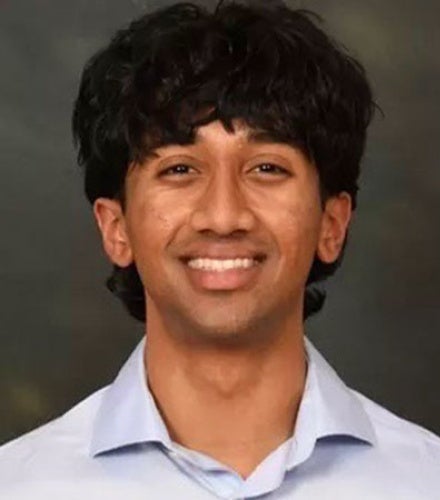
Meet an undergraduate student who discovered his path at CWRU
As a high school student in Virginia, Tanush Anand knew he was interested in pursuing a career in engineering, but his exact direction was unclear. What he was certain about: Case Western Reserve University’s academic flexibility would allow him to find clarity. It also would provide him the opportunity to continue competing in track and field while developing professionally.
Now a rising fourth-year student, Anand discovered an interest in manufacturing and related topics.
In his first year at CWRU, Anand took EMAE 160: “Mechanical Manufacturing” with Jason Bradshaw, unlocking an interest in fabrication and deciding to major in mechanical engineering.
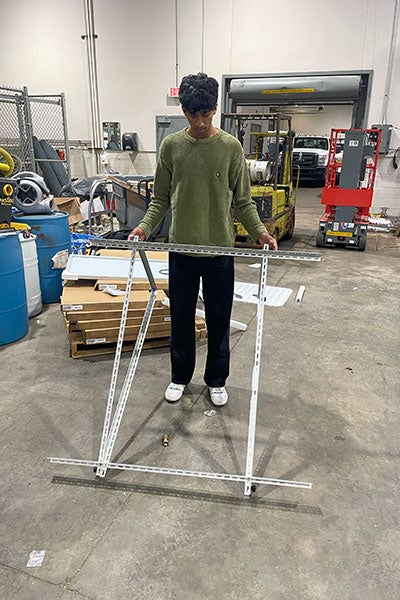
Under the direction of John Lewandowski, PhD, Anand has conducted research at the Advanced Manufacturing and Mechanical Reliability Center. His research entails working toward a longer lifespan for tooling used in open-die forging before they need to be replaced or reworked.
“Metallurgy felt like the perfect mix of mechanical and material science engineering, and it was rewarding to apply both areas of study to one problem,” Anand said.
He’s also contributed to the U.S. National Science Foundation HAMMER (Hybrid Autonomous Manufacturing, Moving from Evolution to Revolution) Engineering Research Center, a partnership between the National Science Foundation and an alliance of organizations, including Case Western Reserve University.
Furthering his interest in mechanical engineering, Anand joined CWRU Humanitarian Design Corps during his first year, becoming part of the Solar Team, which focuses on bringing solar charging stations to campus. He’s gone on to serve as the engineering team lead, collaborating across disciplines to design and build a solar charging station in the Leutner Pavillion.
As a ThinkEnergy Fellow at CWRU, Anand also founded startup Solmate to develop a non-invasive roof mounting adapter.
In recognition of his work and promise in manufacturing, Anand was selected earlier this year for an Ellwood Metallurgy Scholarship, which included an internship opportunity. This summer, he’s working at Ellwood as a metallurgy intern. In this role, he’s been responsible for creating a process for simulating fatigue analysis on crankshafts and verifying quench hold times on the shop floor.
As he enters his final year at CWRU, Anand knows he has found the direction for which he was looking.
“I came into this school still unsure of what I wanted to do, and I feel certain now that I've found my path,” Anand said.
Learn more about his engineering experiences.
Answers have been lightly edited for clarity and length.
1. What are the potential implications of your metallurgy work at the Advanced Manufacturing and Mechanical Reliability Center?
Improving the customer's die life is one benefit, but the study also provides comparisons across multiple alloys used in high-strength, high-temperature applications. This provides the industry with more informed data for alloy selection in demanding forging environments.
2. What interested you in applying for the Ellwood Metallurgy Scholarship?
Working on the research [at the Advanced Manufacturing and Mechanical Reliability Center] got me really curious about heavy manufacturing. I got lucky that a few months into the research, this scholarship came up within my department, so I applied for the chance to work on more industry-related projects.
3. What drew you to work with the Humanitarian Design Corps and solar work in general?
I've always wanted to apply my knowledge to projects that utilize environmentally friendly tech, so I was drawn to the Solar Team's charging station project.
4. Can you describe some of your most meaningful moments throughout your education and research so far?
Everything I've done has been meaningful, but working on NSF-ERC-HAMMER's Wire Arc Additive Manufacturing printer has to stand out most. Getting to design fixtures and redesign components for the machine gave me some of the first projects I got to fully own at CWRU.
5. What are your career goals?
I really want to go into some form of manufacturing. I'm especially interested in metal 3D printing, heavy manufacturing, and other industries where I can really utilize everything I've learned throughout my time at CWRU.
6. Is there anything else you’d like to share?
I'm very grateful for all the help I've had from Professor John Lewandowski, as well as PhD students such as Vishnu Ramaswamy and Mick Bastuga, who supported me throughout the years.