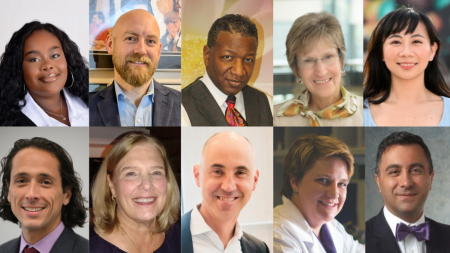
A new stage for social science: Students organize campus-wide research showcase
It started with a casual conversation over lunch—a group of Case Western Reserve anthropology PhD students reflecting on the work happening around them and a shared realization that much of it went unseen.
“We were just chatting about how there aren’t that many opportunities for us to showcase our research unless we go to an external conference,” said Jenna Hays, a third-year PhD student in medical anthropology. “So we decided to make our own opportunity.”
Thanks to the efforts of Hays and fellow organizers Anuoluwapo Ajibade, Sarah Namirembe and Aria Wanek—and with support from professor and anthropology department chair Janet McGrath, PhD—that idea has since grown into Social Science Research Day: a new student-run event that will bring together undergraduate and graduate researchers from the social sciences on April 10.
“It’s been a super collaborative effort,” said Wanek, a second-year PhD student in medical anthropology. “We started with a general outline and then just kept building—getting buy-in from other departments, figuring out logistics and shaping what we wanted the day to look like.”
The result is a dynamic program featuring both undergraduate poster presentations and graduate student oral presentations, representing disciplines of anthropology, psychology, sociology and more. In total, nearly 20 presentations will be showcased, reflecting a wide range of topics and methodologies.
For the organizers, the event is about more than just sharing research—it’s about elevating the role of the social sciences within a research-intensive university.
“I think typically when people think of research, they think medical and quantitative,” Hays said. “But qualitative and mixed-methods research is research, too. Having this platform shows that the social sciences are here and that they’re supported.”
That sentiment was echoed by Ajibade, who noted both the quality and real-world relevance of the work being done. “The social science community at CWRU produces a wide range of thoughtful and impactful research,” he said. “We thought it would be nice to have a space where students can present their work and also build skills that help them share that research beyond the university.”
Second-year medical anthropology PhD student Sarah Namirembe said the event also serves as a reminder of the broader potential of the field. “It’s about reminding social scientists that we can do more,” she said. “We’re not just studying and writing about people’s lives—we can create change and make a real impact.”
With strong participation and support in its inaugural year, the organizers hope Social Science Research Day will become an annual tradition—one that continues to grow and highlight the value of social science research at Case Western Reserve University.
The entire campus community is invited to attend Social Science Research Day on Friday, April 10, from 12:45 to 5:30 p.m. in the Biomedical Research Building, room 105.
We spoke with three of Friday’s presenters to give you a preview of the event. Learn more about the day in CampusGroups.
Zachary Slade Milko
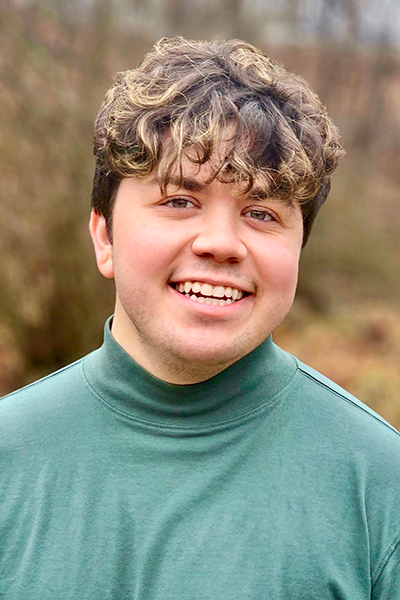
Fourth-year PhD student, Department of Sociology
Can you briefly describe your research and what inspired you to explore this topic?
My research examines how artificial intelligence (AI) and algorithmic governance systems on TikTok produce stratified economic outcomes for content creators, with a particular focus on LGBTQ+ and racial minority creators. I am developing two original theoretical concepts, algorithmic and tactical legibility labor, to explain how platform classification systems encode culturally dominant assumptions about whose expressive labor is valuable and whose is risky or ungovernable. What inspired this work is both personal and intellectual. As someone who thinks seriously about race, gender and sexuality from a critical and intersectional perspective, I kept noticing that the existing literature could document that algorithmic systems disadvantage marginalized creators, but lacked a precise sociological mechanism explaining why and how. I wanted to build that theoretical infrastructure.
What do you hope others take away from your research or presentation?
I hope attendees leave with a clearer sense of how algorithmic systems are not neutral technical tools, but culturally and historically loaded infrastructures that reproduce existing inequalities in new forms. I also want people to walk away thinking about platform governance as a labor issue and a social justice issue, not just a technology issue. For scholars specifically, I hope the concepts of algorithmic and tactical legibility labor feel useful and generative beyond the TikTok context. Ultimately I hope this work contributes to broader conversations about what more just and equitable algorithmic systems could look like, and that people leave feeling not just critical of the status quo, but motivated to imagine and push for something better.
Why did you decide to present at Social Science Research Day?
This is early stage dissertation work and I am actively developing the conceptual framework, so presenting at the inaugural Social Science Research Day felt like a valuable opportunity to get feedback from scholars across disciplines before the project moves into full data collection. I also think the questions my research raises about AI, inequality and digital labor are ones that resonate well beyond sociology, and a cross-disciplinary social science audience is exactly the kind of intellectual comm
unity I want to be in conversation with at this stage.

Eleanor Gillerlane Hinkes
Sixth-year PhD student, Department of Anthropology
Can you briefly describe your research and what inspired you to explore this topic?
My research is focused on disaster response, specifically examining the roles and operations of organizations. I was inspired by my volunteer work with a local organization working in disaster response, where I have seen firsthand how people are impacted by disasters and have been part of the response process.
What do you hope others take away from your research or presentation?
I hope people learn more about anthropology and qualitative research from my presentation, specifically how valuable anthropological methods can be applied across research settings. I hope people also learn more about the local disaster response process and organizational landscape in Ohio.
Why did you decide to present at Social Science Research Day?
I wanted to present at the symposium to support my peers who have created and organized the event, as well as share my work with the broader social science community at CWRU to help foster interdisciplinary learning and collaboration.
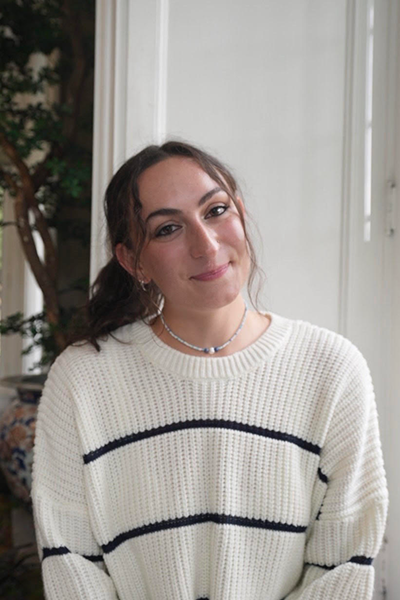
Cristiana Miele
Fourth-year undergraduate psychology and Spanish student
Can you briefly describe your research and what inspired you to explore this topic?
I am a research assistant for Kate Freeman who is a sociology PhD student. Her dissertation examines differences in societal reactions to men having chronic conditions versus women. I'm interested in studying gender and sexuality, so I was really drawn to her project and am very excited to see her conclusions. I've helped her with data collection, and also authored a paper arguing that TikTok should be considered a valid tool for gathering sociological data which I will be presenting at Social Science Research Day.
What do you hope others take away from your research or presentation?
This was a really valuable experience for me because I'd like to get a graduate degree in psychology and become a therapist. It gave me research, writing and presenting experience, and it's a topic that could really improve my study of psychology. Sociological study can definitely offer me explanations and background on human experience that will help me understand my future clients more thoroughly. I really believe sociology and psychology are two sides of the same coin, so I'm thrilled to understand the field better, even though I'm not studying it in classes.
Why did you decide to present at Social Science Research Day?
I originally decided to participate to gain experience with presenting research, especially before I present my capstone at Intersections research symposium, but as the day approaches, I've become more excited to show off work that I'm proud to have accomplished. This paper on TikTok as a methodological research tool is the first article that I authored, and I think it's helped me grow as both a student and a researcher.